





Hotel AI Chatbots: A Complete Guide for Hotel Guest Communication
Updated at Oct 14, 2026
10 min to read
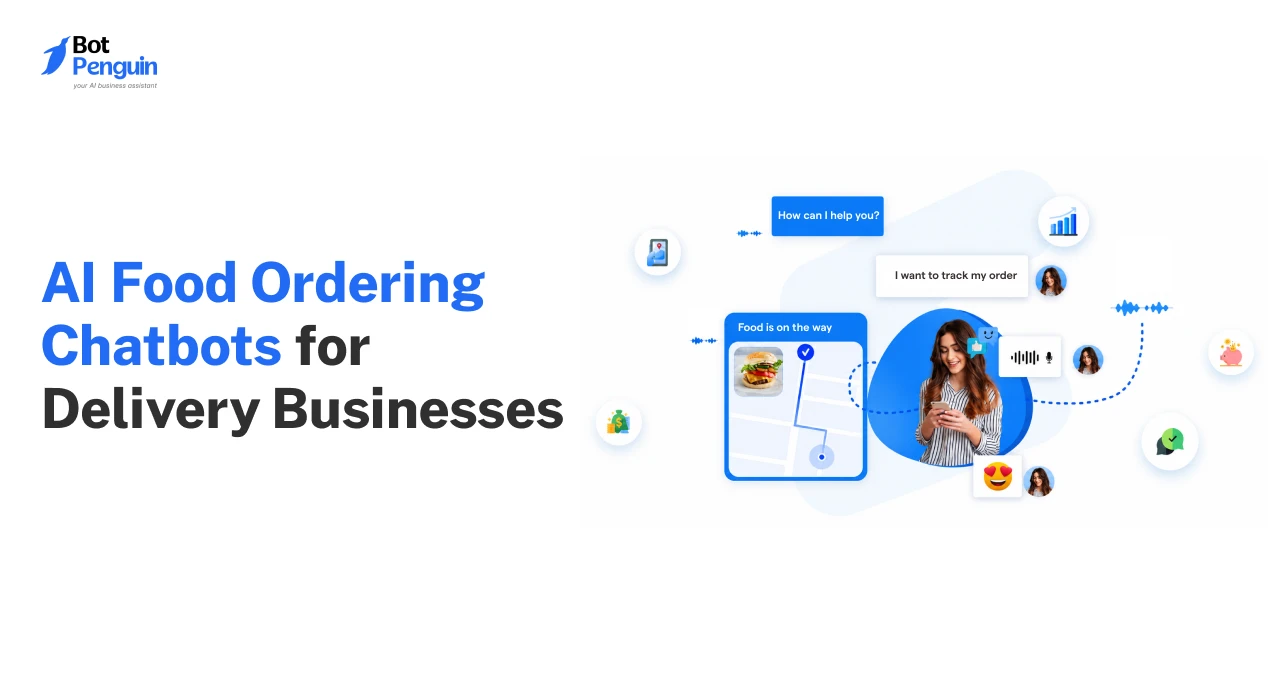
A food ordering chatbot is a conversational tool that lets customers browse menus, customize meals, place orders, pay, and track delivery through chat. Restaurants, cloud kitchens, cafes, and delivery businesses can use it on WhatsApp, websites, and messaging apps to automate ordering while reducing repetitive work for staff.
The greatest utility of food ordering apps is the quick ordering experience. But if that doesn't happen, customers don't mind abandoning their orders.
Many food businesses still depend on manual order handling, delayed replies, and overloaded support teams.
However, the 21st-century eater is not willing to wait.
This is where a food ordering chatbot changes the experience. It automates ordering, answers questions instantly, tracks deliveries, and helps businesses handle more orders without slowing down service.
A food delivery chatbot extends that automation beyond checkout by helping customers with delivery options, order status, estimated arrival times, complaints, and repeat orders.
In this guide, you’ll learn how food ordering and delivery chatbots work, where WhatsApp food ordering fits, their key use cases, benefits, features, and how delivery businesses can use them effectively.
A food ordering chatbot is a digital assistant that helps customers browse menus, place orders, make payments, and track deliveries through chat.
It works on websites, apps, WhatsApp, Instagram, and other messaging channels.
For instance, Domino's “Dom” chatbot can handle orders, reorders, and live delivery tracking on WhatsApp and Messenger. Today, over 75% of Domino's sales come from digital channels.
While both sound similar and are often used interchangeably, they are built for different jobs and serve different purposes.
Here’s how to see that distinction in practice:
Think of it this way: A food ordering chatbot is the one taking your order, while a restaurant chatbot is the one answering your questions at the front desk.
Want to go deeper on restaurant chatbots? Check out our comprehensive Restaurant Chatbot Guide for Reservations, Orders & FAQs.
An AI-based food ordering chatbot goes beyond fixed button-based replies. It can:
At this stage, it's worth understanding the workings of a food ordering chatbot that does far more than just take orders.
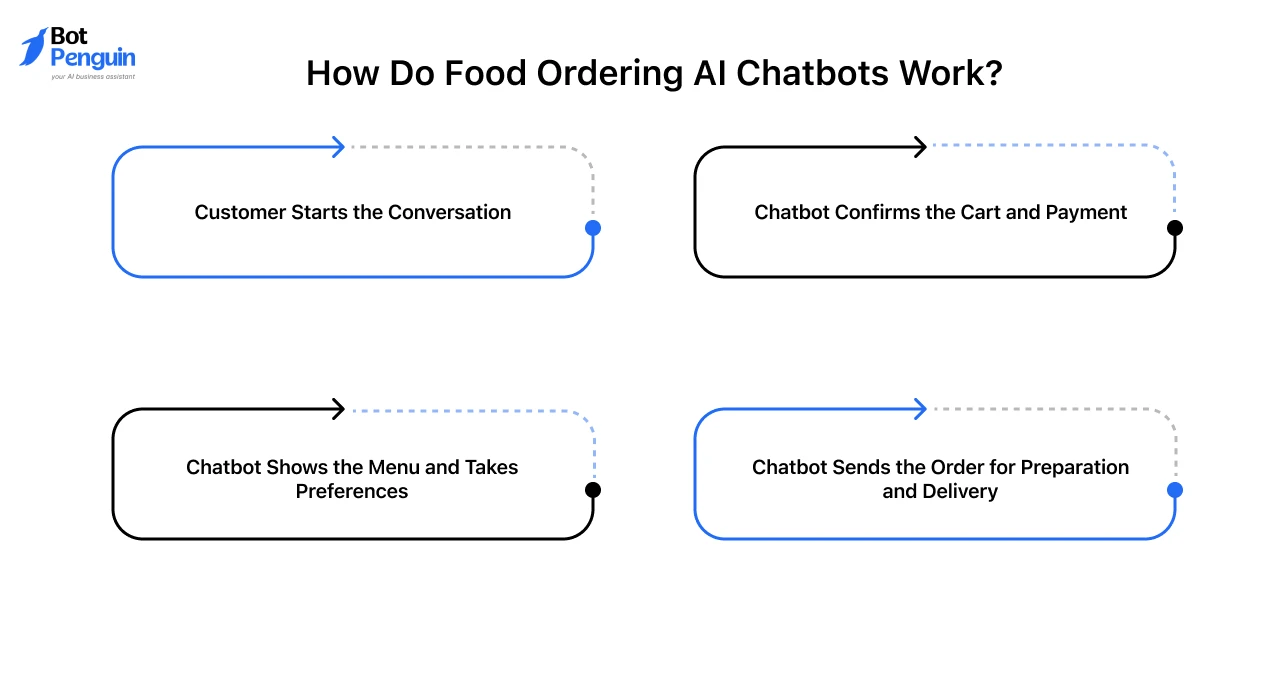
Food ordering chatbots simplify the entire ordering journey into a quick conversation. Here’s how the process usually works:
The chatbot thus handles each part of the customer’s journey - from the first message to the final delivery update in a faster, smarter, and more efficient way.
WhatsApp food ordering lets customers browse a menu, choose items, share delivery details, make or receive payment instructions, and confirm an order inside a WhatsApp conversation. Restaurants can automate these steps with a chatbot, then send confirmations, delivery updates, reorder prompts, and support messages through the same familiar channel.
For restaurants in India, WhatsApp is especially relevant because customers already use messaging heavily for business interactions. Meta reported in 2026, citing Kantar research, that 91% of online adults in India chat with a business weekly. Meta has also introduced Business AI on WhatsApp for eligible small businesses in India, with native-language support and planned UPI payment capabilities.
A WhatsApp food ordering flow can typically handle:
This is useful for Indian restaurants, QSRs, cloud kitchens, cafes, and delivery-first brands that want customers to order through a channel they already use instead of forcing another app download.
BotPenguin built an end-to-end WhatsApp food ordering workflow for BVK Biryani. Customers can browse the menu, choose items and quantities, submit delivery details, receive a payment link, and confirm their order within one WhatsApp conversation.
BVK now processes 2,000+ WhatsApp orders per month through the automated flow, providing a practical example of how conversational ordering can work at scale.
A food delivery chatbot helps businesses manage more than order placement. It can support customers from menu browsing and checkout through delivery tracking, support requests, reordering, and post-order communication.
For restaurants, cloud kitchens, QSRs, and delivery-first businesses, this reduces the number of repetitive conversations that staff need to handle manually.
The table below gives a quick overview of how these chatbots are being used today:
During peak hours, even a few missed calls can mean lost orders.
Food ordering chatbots help restaurants and cloud kitchens accept orders automatically through WhatsApp, websites, or apps without making customers wait.
BotPenguin's BVK Biryani deployment currently handles 2,000+ WhatsApp orders per month through an automated ordering workflow.
See how BVK Biryani automated food orders with BotPenguin →
People ordering coffee, snacks, or quick meals expect speed.
A chatbot for food ordering makes the process smoother by showing the menu instantly, saving repeat orders, and reducing long counter queues.
Customers usually want updates as much as the food itself.
Chatbots for order tracking can automatically share order confirmations, preparation progress, delivery status, and ETA updates without frustrating customers.
Instead of making customers wait for an agent, chatbots can instantly handle common questions, refund requests, missing item complaints, and delivery issues before escalating complex cases.
Good chatbots remember customer behavior.
They can suggest favorite meals, recommend add-ons, and send personalized discounts that encourage repeat orders naturally.
This happens with technologies like order history tracking, AI-based preference mapping, and automated promotional triggers.
The businesses winning at delivery today aren't just faster; they're smarter about where they let automation do the work.
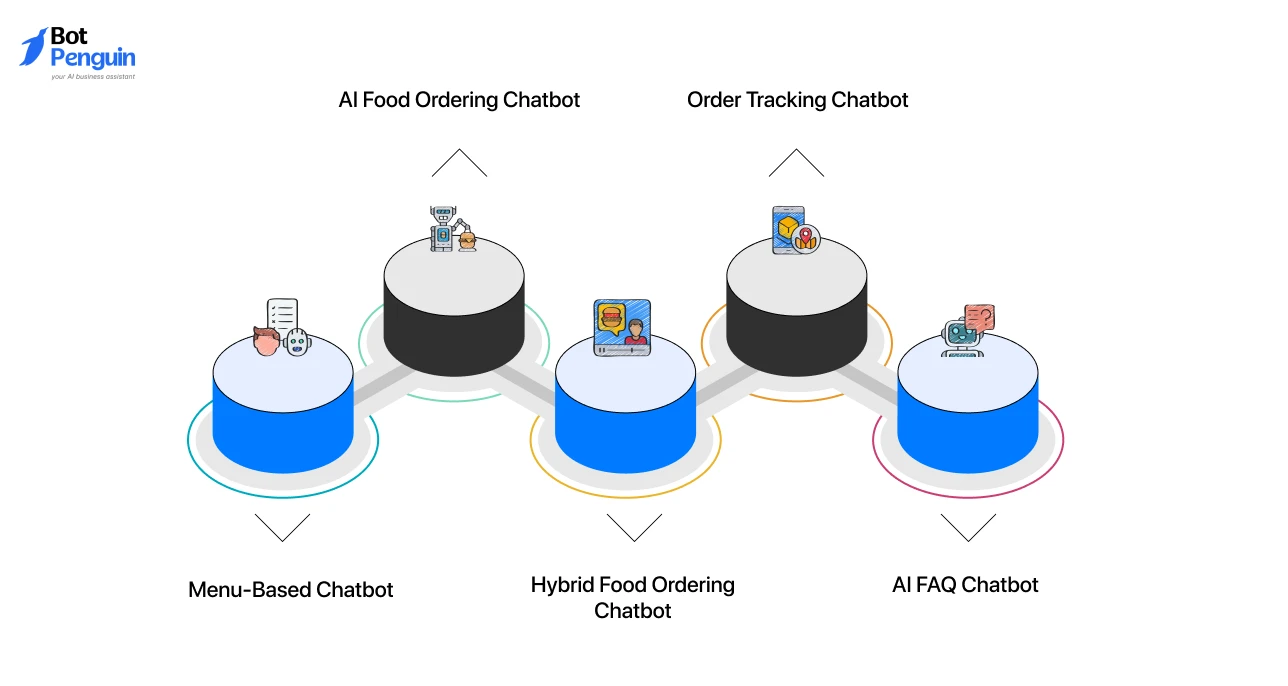
Some chatbots for food ordering are designed for quick menu-based ordering, while others focus on AI conversations, support, or delivery tracking.
Here’s a breakdown of the various types of food ordering chatbots by purpose:
A menu based chatbot works through fixed buttons, categories, and pre-defined responses. Customers tap options instead of typing long messages.
An AI food ordering chatbot understands natural customer messages and responds more conversationally. It can also handle custom requests and recommendations.
Starbucks’ “My Starbucks Barista” is a textbook example of this, handling voice and text ordering, processing payments, and delivering personalized suggestions.
A hybrid chatbot combines menu buttons with AI-powered conversations. Customers can either tap options or type naturally.
Chatbots for order tracking automatically share order status, delivery progress, and ETA updates.
An AI FAQ chatbot answers common customer questions about delivery, refunds, timings, or menu items.
Most delivery businesses do not rely on just one chatbot type. Many combine ordering, tracking, and FAQ automation into a single system to create a smoother customer experience.
G2 reports that chatbots have directly moved the needle on customer satisfaction, lifting support scores by 24% for businesses that use them.
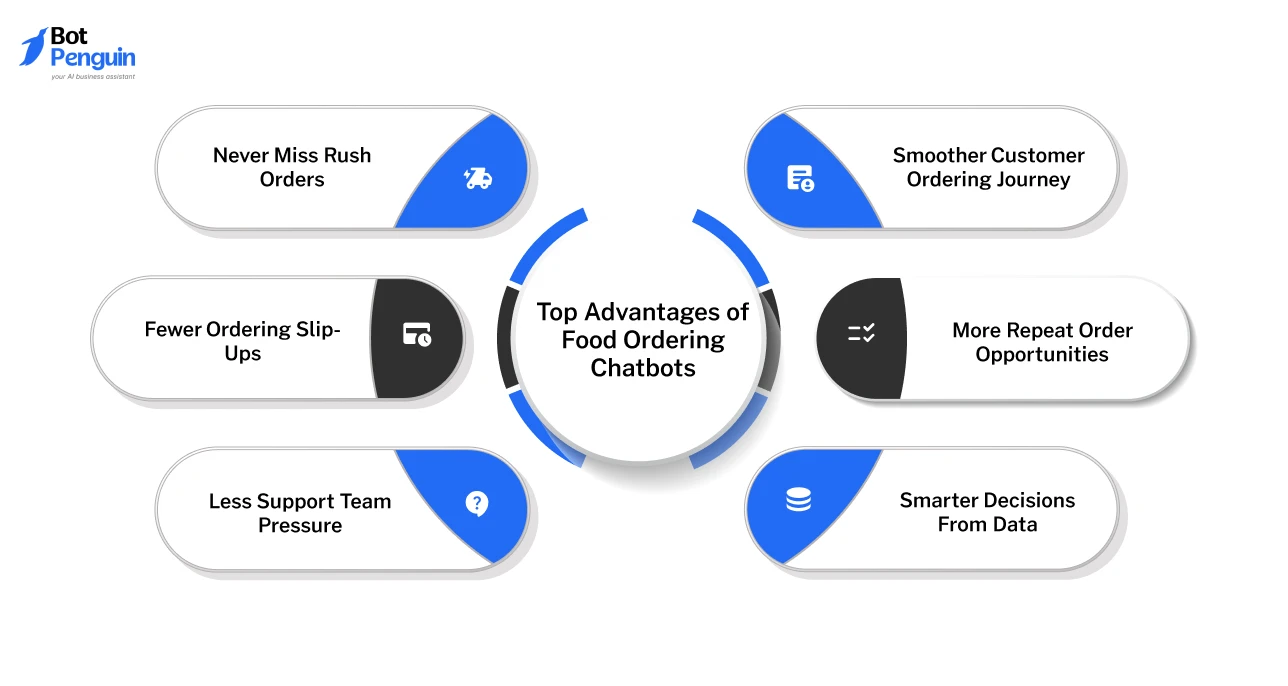
In light of the above, let’s look at the real benefits that a chatbot for food ordering provides businesses:
Together, these benefits ensure better margins, stronger retention, and an operation that scales without breaking.
Your customers probably won't read a features list. But they will stop ordering if something feels off.
Here's what needs to work perfectly behind every smooth chat experience:
Your chatbot should reflect real-time menu changes. If a dish is unavailable, sold out, or limited for the day, customers should see it instantly instead of placing failed orders.
Customers often want extra toppings, spice preferences, combo upgrades, or item changes. A good chatbot should handle these customizations smoothly without confusing the ordering flow.
The chatbot should support secure digital payments, wallets, UPI, cards, and cash-on-delivery options. A complicated checkout process can easily increase cart abandonment.
Customers should be able to choose between delivery, takeaway, or scheduled pickup directly inside the chat experience.
“Where is my order?” is one of the most common support questions in food delivery. Automated tracking updates reduce support pressure while keeping customers informed.
AI chatbots should answer routine questions instantly but also recognize when a frustrated customer needs human support.
Good chatbots track order trends, peak hours, repeat purchases, and customer preferences, helping businesses improve operations and marketing decisions.
A chatbot missing even one of these features can quietly cost you orders, trust, and repeat customers, often without you realizing where things went wrong.
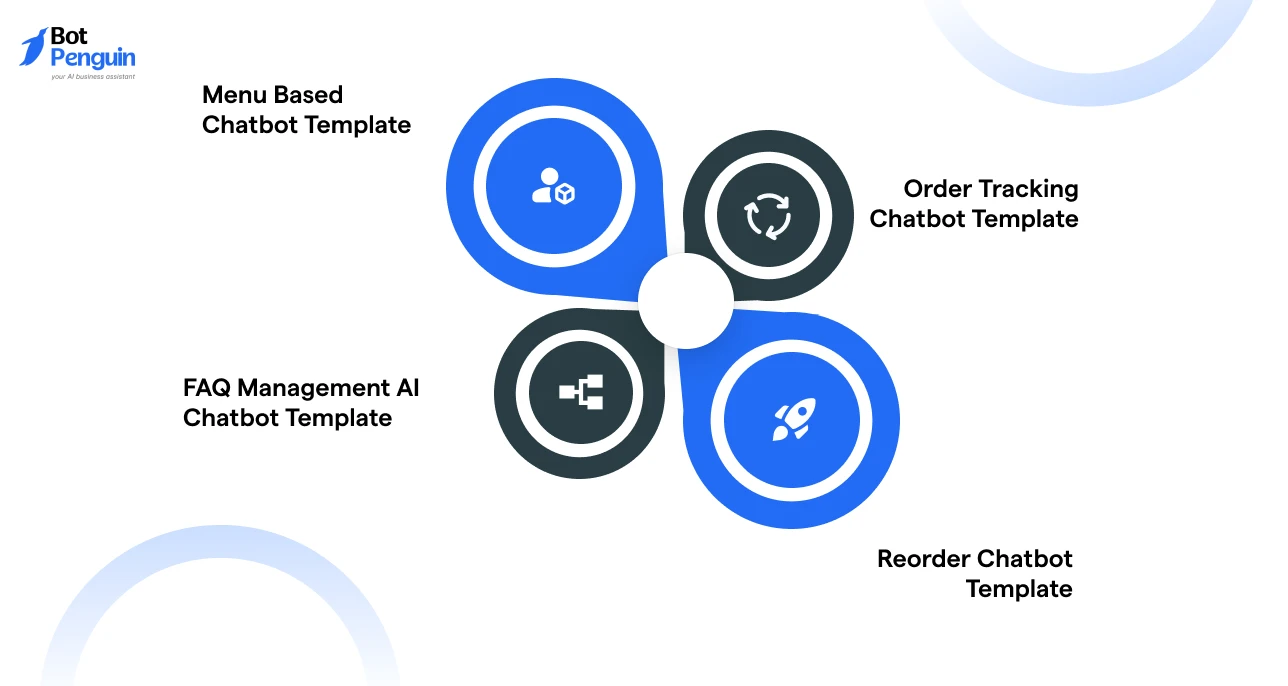
Most food ordering chatbots follow repeatable conversation flows.
These templates help businesses automate common customer interactions while keeping the ordering experience fast and easy:
This type of chatbot flow guides customers through fixed menu options using buttons and categories.
Customer: Show burger menu.
Chatbot: Choose a category: Veg Burgers / Chicken Burgers / Combos
Customer: Chicken Burgers
Chatbot: Added Crispy Chicken Burger. Add fries and a drink?
This chatbot flow automatically shares order preparation, dispatch, and delivery updates with customers.
Customer: Where is my order?
Chatbot: Your order has been dispatched and will arrive in 12 minutes.
An AI FAQ chatbot answers common customer questions related to delivery, payments, timings, credit backs, or menu details.
Customer: Do you deliver after midnight?
Chatbot: Yes, delivery is available until 1 AM in selected locations. Want to place an order now?
Reorder chatbot flows use previous customer history to make repeat ordering faster and more convenient.
Chatbot: Want to reorder your last pasta combo?
Customer: Yes
Chatbot: Done! Added to cart. Proceed to payment?
These aren't just conversation examples; they're revenue flows. Each chatbot template handles a real customer moment that would otherwise need a human, a phone call, or a wait.
A food ordering chatbot without a clear plan is just an expensive FAQ page.
Here's a simple six-step framework to build one that actually works for your business:
Points Worth Remembering
Most food ordering chatbots fail because of bad decisions made before a single line of code is written.
Here are the five mistakes that quietly kill chatbot performance:
Many businesses overload chatbots with too many steps, questions, or menu layers. Customers ordering food usually want speed, not a lengthy conversation.
Showing unavailable dishes or outdated prices creates frustration and increases failed orders. It also damages customer trust quickly.
Not every issue can be solved by automation. Refund disputes, delivery complaints, or payment failures often need human attention.
Robotic or vague answers make the chatbot feel unhelpful, especially when customers need specific delivery or payment information.
Customers share phone numbers, addresses, and payment details while ordering food online.
A chatbot that frustrates customers at checkout is worse than having no chatbot at all. And that is why avoiding or fixing these problems before launch matters.
Food ordering chatbots are slowly becoming smarter assistants that understand how people actually order food in real life.
Here are the top trends shaping the future of chatbots for food ordering:
Typing an order is fine, but it is not always convenient.
In the near future, customers will simply speak to place orders, like “one large veg pizza with extra cheese”. Voice-based ordering will make the experience feel more natural and hands-free.
Think about how often people reorder the same meal.
Instead of making users search again, chatbots will start suggesting “your usual order” or “want to repeat last Friday’s combo?” This makes ordering faster and more personal.
Not every customer is comfortable with English. Future chatbots will switch languages smoothly, letting users order in Hindi, regional languages, or mixed language chats.
This makes food ordering more inclusive and less confusing.
Behind the scenes, chatbots will do more than talk to customers.
They will help kitchens manage prep time and coordinate with delivery partners so food arrives hot, fresh, and on time.
On the whole, the food ordering chatbot of tomorrow won't just take orders. It will anticipate them, speak your customer's language, and keep the entire delivery chain moving effortlessly.
Food ordering and food delivery chatbots are becoming a core part of every modern automated restaurant ordering system. They simplify ordering, decrease errors, and make the customer journey more streamlined.
From taking orders to delivery updates, they improve food order management by keeping everything organized in one place. This reduces manual work and helps staff focus on operations instead of repetitive queries.
For businesses, they work like smart food order management software, improving efficiency, precision, and customer satisfaction.
As expectations grow, adopting chatbot systems is no longer optional. It is a practical step toward faster service, better control, and more consistent customer journeys.
A food ordering chatbot is an AI tool that lets customers browse menus, place orders, pay, and track deliveries through chat platforms like WhatsApp or apps.
A food delivery chatbot helps customers place orders and manage post-order interactions through chat. It can show menus, collect delivery details, support checkout, send preparation and dispatch updates, answer delivery questions, handle reorders, and escalate complaints or complex requests to restaurant staff.
It guides users through menu selection, customization, payment, and sends confirmed orders directly to restaurant systems for preparation and delivery.
An AI food ordering chatbot understands natural language, handles custom requests, recommends dishes, and improves ordering through smart conversations.
Yes, they provide real-time updates like order status, preparation progress, dispatch, and estimated delivery time automatically.
They reduce errors, speed up ordering, improve customer experience, lower support workload, and increase repeat orders through personalization.
A menu-based chatbot uses buttons and structured options to guide customers step-by-step through the ordering process.
Yes, it helps small cafes take orders faster, reduce staff workload, and improve service without needing extra hiring.
Yes, they can connect with POS systems, payment gateways, and food order management software for smooth restaurant order management.
It should include order status, preparation updates, dispatch alerts, ETA, and final delivery confirmation for clear customer communication.
It automates order intake, reduces errors, speeds up processing, and improves coordination between kitchen, delivery, and support teams.
WhatsApp food ordering lets customers browse menus, choose items, share delivery details, receive payment instructions, and confirm orders through a WhatsApp conversation. A chatbot can automate these steps and also send order confirmations, delivery updates, reorder prompts, and support responses.
Improve Food Ordering With AI Chatbots
Handle orders, menu browsing, tracking, and customer queries in one chat. Reduce order delays, cut errors, and improve delivery experience with automated workflows.
Explore Now!Checkout our related blogs you will love.
Updated at Oct 14, 2026
10 min to read
Updated at Oct 1, 2026
12 min to read
Updated at Sep 21, 2026
14 min to read

Updated at Oct 14, 2026
11 min to read
Updated at Oct 14, 2026
10 min to read
Updated at Oct 13, 2026
11 min to read
Table of Contents

