Chatbot for Restaurants: How AI Turns Chats Into Orders and Bookings
Updated at Oct 1, 2026
12 min to read
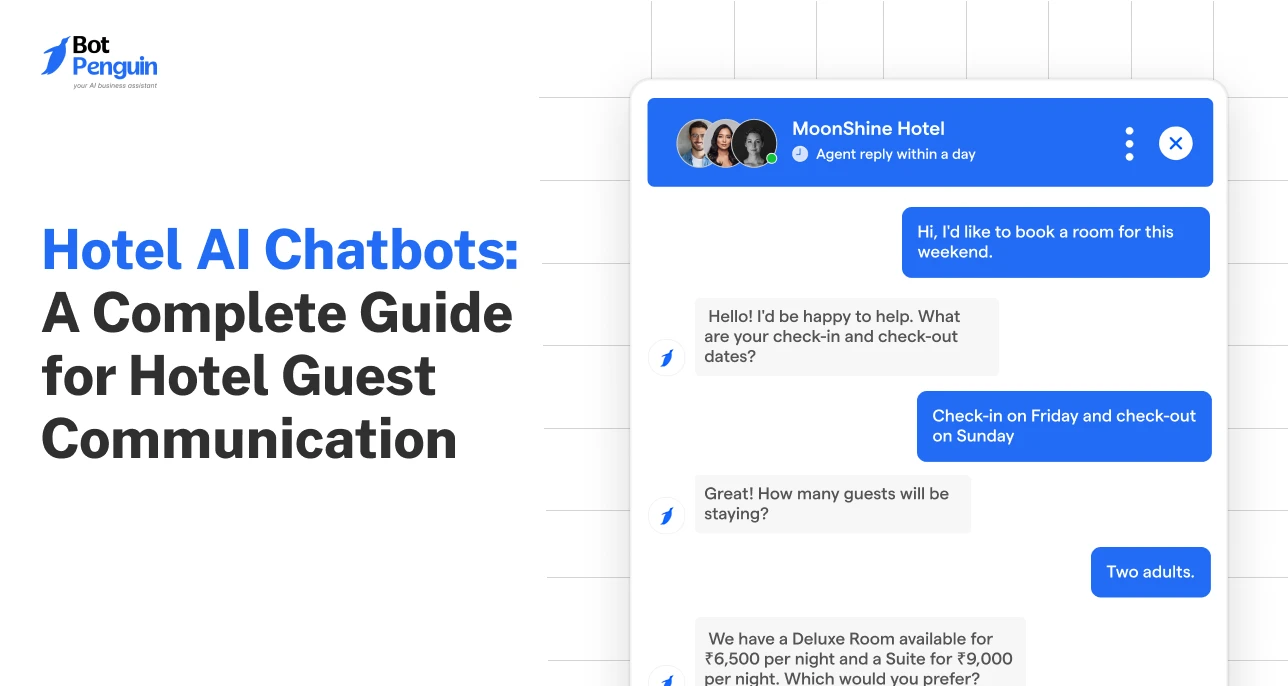
A hotel chatbot is an automated conversational tool that helps hotels respond to guest inquiries, assist with reservations, and provide information about rooms, amenities, and services. It can provide 24/7 support across supported channels, reducing repetitive front-desk questions. Advanced AI chatbots can also personalize responses and transfer complex requests to hotel staff.
A hotel chatbot is becoming a common part of hotel guest communication.
Guests now ask questions across websites, WhatsApp, social media, and booking channels before they ever speak to hotel staff.
They want quick answers about rooms, prices, check-in, amenities, and services.
For the hotel industry, this puts more pressure on guest messaging across channels. This is where hotel chatbots help.
This guide explains what hotel chatbots are, how they work, where they help, key use cases, benefits, and future trends.
By the end, you will understand where an AI chatbot fits into your hotel communication and guest support.
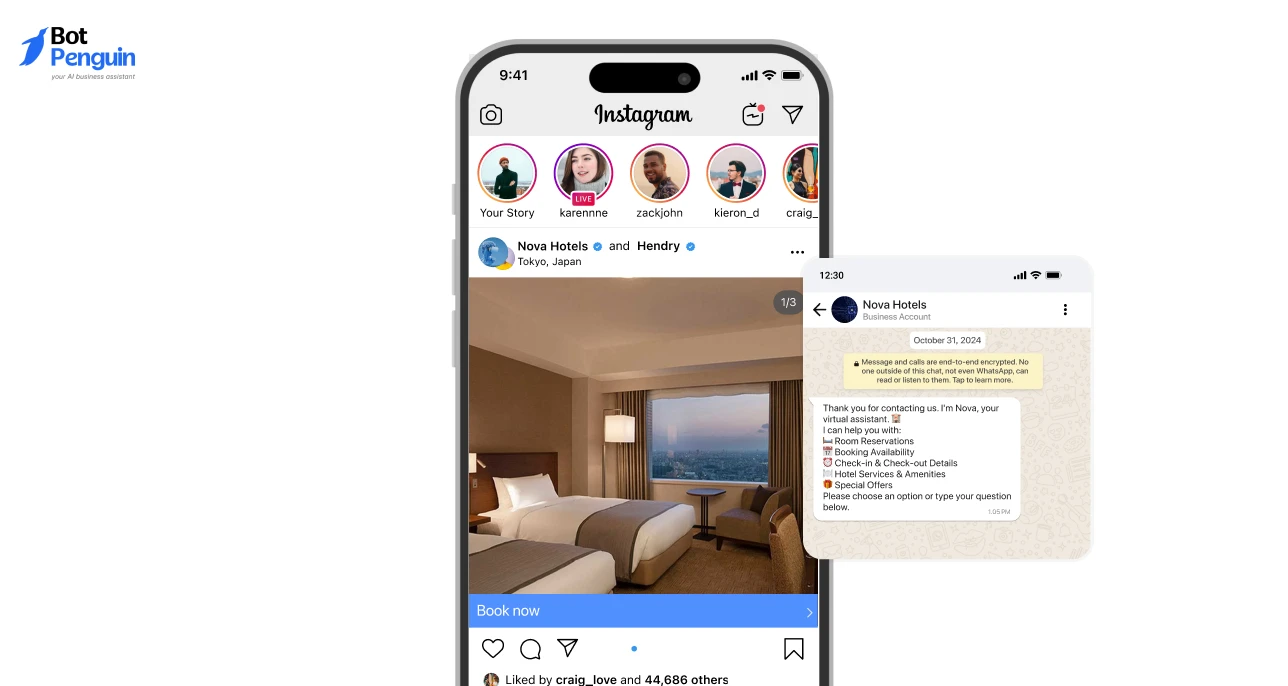
A hotel chatbot is an AI guest assistant that works like a digital concierge for hotel communication.
It helps guests get quick, consistent answers through chat without requiring staff to handle every message manually.
It can appear across key hotel communication channels, such as:
Guests can use it to ask about rooms, prices, check-in times, amenities, policies, directions, and basic service details.
Unlike basic scripted chat, AI-led systems can understand natural language. Guests do not always need to click fixed buttons or type exact keywords.
They can ask questions conversationally, and the system identifies the intent behind the message.
For example, if a guest asks, “Can I check in early if my flight lands before noon?”, the chatbot interprets it as an early check-in request and responds according to the hotel’s approved policy.
In simple terms, it is one example of how chatbots in hospitality can make guest messaging faster, clearer, and easier to manage. Next, let’s look at how AI hotel chatbots process guest questions and generate useful replies.
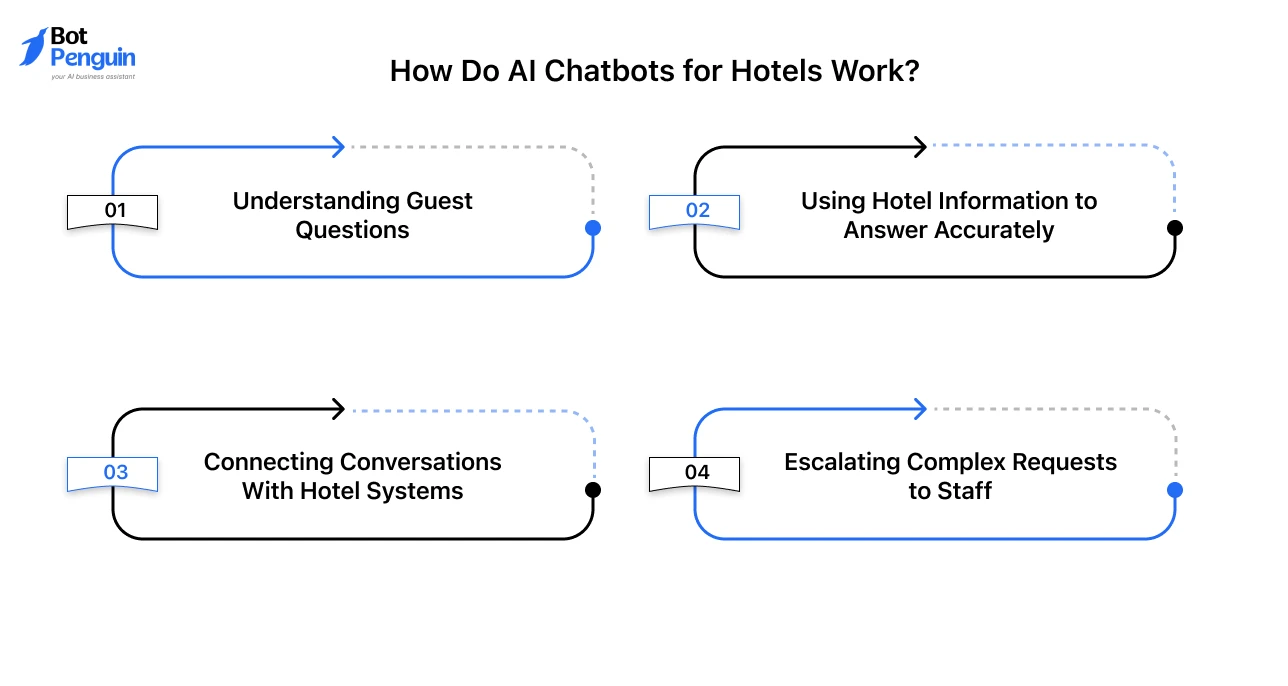
AI chatbots for hotels read a guest message, identify the guest’s intent, check approved hotel information, and respond through the same chat channel.
This keeps guest query handling structured, especially when messages come from different channels.
Here’s a breakdown of the entire process through which chatbots answer guest questions:
An AI-powered hotel chatbot identifies the intent behind each guest message. It doesn't just read the words a guest types.
It looks for the actual request behind the message.
For example, “Can I arrive before 2 PM?” is understood as an early check-in request, not just a question of timing.
The system can identify guest questions related to:
A hotel AI chatbot uses approved hotel information to provide accurate, consistent answers.
The system pulls details from the hotel knowledge base instead of guessing. This keeps guest communication clear across channels.
The hotel knowledge base can include:
For instance, if a guest asks about breakfast, the chatbot uses the hotel’s actual timing, location, charges, or package terms.
A hotel AI chatbot connects guest conversations to hotel systems to support bookings, requests, and service workflows.
This helps the chatbot move beyond simple answers.
Common system connections include:
This makes the conversation more useful for both guests and hotel staff.
AI-powered hotel chatbots route complex or sensitive requests to staff when human support is needed.
This mainly applies to guest issues that need judgment, care, or urgent action.
Common escalation cases include:
For example, when a guest reports a safety issue, the system moves the request to the front desk or the responsible team.
This keeps automation focused on routine support while staff handle situations that need human hospitality.
No-code chatbot platforms like BotPenguin help hotels and hospitality businesses create guest communication flows across digital channels. They support common guest inquiries, booking questions, and customer assistance through automated chat, while making communication easier to manage.
Next, it’s time to understand why hotels are adding these systems to guest communication in the first place.
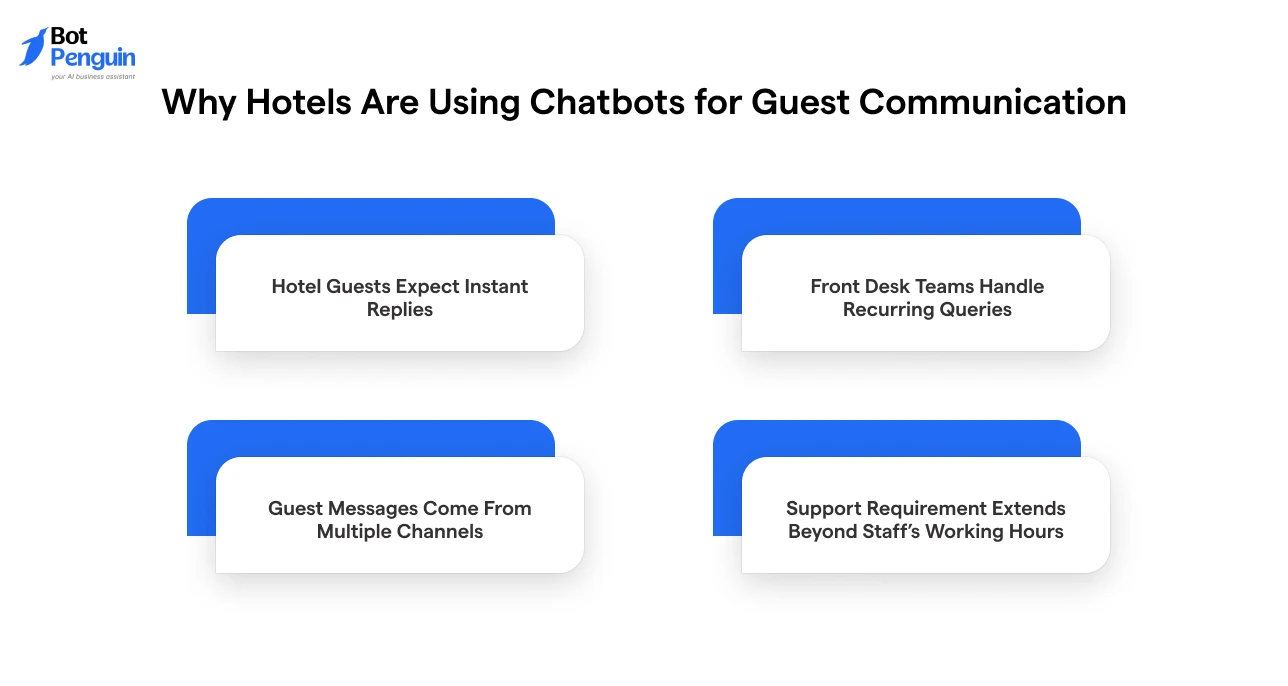
Hotels are using chatbots because guest communication has become faster, more fragmented, and harder to manage manually.
Guests now expect clear answers across more channels and at more moments in their journey.
The table below provides a quick overview of the key operational pressures driving adoption of AI hotel chatbot adoption.
The following sections explain each pressure in more detail. They show why chatbot-based guest communication is becoming essential for hotel operations.
Guests expect fast answers at every stage of the hotel journey.
Before booking, they may ask about rooms, rates, location, or cancellation rules. During the stay, they may need quick help with services or requests.
Slow replies can create doubt, especially when guests are still comparing options.
How chatbots help: They provide routine answers instantly with minimal or no human intervention, so guests don't have to wait for basic information.
Front desk teams often answer the same guest questions throughout the day.
These questions usually cover check-in, checkout, Wi-Fi, parking, breakfast, amenities, and policies. They are simple, but they still take up staff time.
This adds pressure during peak hours and high-occupancy periods.
How chatbots help: They handle recurring questions automatically, so staff don't have to answer every routine inquiry manually.
Hotel guest communication now spans websites, WhatsApp, email, social media, phone calls, and booking platforms.
This creates fragmented communication for hotel teams. A guest may ask one question on the website, follow up on WhatsApp, and later call the front desk.
Without a structured system, messages can get delayed, missed, or answered inconsistently.
How chatbots help: They structure guest queries across channels through a unified inbox, making messages easier to manage.
Late-night travelers, international guests, and peak-season visitors may need basic answers outside regular working hours.
Delayed replies can affect booking confidence, arrival planning, and guest satisfaction.
How chatbots help: They provide basic support outside staffed hours, so routine questions don't go unanswered, and guests stay informed.
These pressures show why hotels are adopting chatbot-based communication support. Next, let’s map where these conversations happen across the guest journey.
Where Chatbots Help Across the Hotel Guest Journey: From Discovery to Return
Chatbots support the hotel guest journey by keeping communication available at each major touchpoint.
They support the movement from discovery to stay completion without making each interaction depend only on manual staff availability.
The table below maps where chatbots fit across the guest journey at a high level.
Each stage creates a different communication need, but the pattern remains the same: guests want quick clarity without extra effort.
This is where chatbots keep the journey more connected without making every interaction depend on manual staff response.
Now that we've seen where chatbot support fits across the journey, the next step is to examine the specific tasks hotel chatbots handle in these guest communication moments.
The primary use cases of hotel chatbots are the specific communication tasks they perform for hotel teams and guests.
For hotel teams, these translate into faster replies, decreased manual workload, better booking support, and clearer service communication.
The table below gives a quick view of the main chatbot tasks:
The sections below explain each use case in more detail. Each one focuses on a practical area where hotel teams already handle repeated guest communication.
1. Answering Guest FAQs
Hotel chatbots answer repeated guest questions with fixed, approved responses. They pull answers from approved hotel information and keep responses consistent.
A hotel AI chatbot can answer FAQs about:
This keeps handling common questions fast, clear, and consistent. It also reduces manual replies for questions that do not need staff judgment.
2. Room Booking Assistance
Hotel chatbots clarify booking details that can slow down reservation decisions. They help guests understand room options, rates, packages, and offer terms before moving forward.
The AI chatbot can support booking assistance by:
This keeps booking-related communication focused and direct. It also reduces back-and-forth for questions that can be answered through approved reservation information.
Hotels looking for a ready-made starting point can also use a hotel booking chatbot template to structure common room, rate, and reservation conversations.
3. Check-In and Check-Out Support
Hotel chatbots share standard arrival and departure instructions through chat. They provide process-related information, links, and basic answers without requiring staff to repeat the same steps manually.
A chatbot for a hotel can support check-in and checkout by:
This keeps the instructions easy to access. It also reduces repeated front-desk questions about routine arrival and departure processes.
4. Room Service and Amenity Requests
Hotel chatbots collect service requests and route them to the appropriate hotel workflow. They capture what the guest needs, request any missing details, and route the request to the appropriate team.
A hotel AI chatbot can process requests for:
This makes handling service requests more structured. It also gives guests a simple way to ask for help without calling or visiting the front desk.
For businesses that want to understand how AI chatbots automate food ordering, order management, and customer interactions, our guide on AI food-ordering chatbot explains this workflow in more detail.
5. Multilingual Guest Support
Hotel chatbots reduce language friction in standard hotel conversations. They help guests ask questions and receive clear answers in their preferred language.
An AI chatbot for hotel communication can support multilingual conversations for:
This makes communication easier for international guests. It also reduces dependence on multilingual staff for routine guest questions.
6. Upselling and Offers
Hotel chatbots, especially for marketing, introduce relevant add-ons when their responses match the guest’s conversation. They present offers based on guest intent, stay context, or the question being asked.
A hotel marketing chatbot can present:
This keeps communication useful instead of interruptive. It also helps hotels surface relevant options without turning every conversation into a sales pitch.
7. Feedback and Surveys
Hotel chatbots turn guest feedback into structured information. They ask guided questions, record responses, collect ratings, and capture comments in a format hotel teams can review.
They can also prompt satisfied guests to leave public reviews after their stay, helping hotels turn positive guest experiences into more online reviews.
An AI chatbot for hotel communication can collect:
This makes feedback easier to compare and act on. It also keeps guest comments from staying scattered across emails, calls, and review platforms.
These use cases show what hotel chatbots do in practice. The next section explains what hotels gain when these tasks are handled faster, more consistently, and at scale.
The real value of these AI-powered tools is not only faster replies but also greater staff capacity, stronger direct-booking support, fewer communication errors, and more relevant guest engagement.
The table below summarizes how each benefit connects to the hotel outcome.
Let’s now look at each of these benefits in detail:
Fast replies matter when guests compare hotels, check rates, or look for stay details. A delayed response can break momentum and make the guest leave the hotel website before taking the next step.
Outcome for Hotels: More answered inquiries; fewer abandoned conversations; stronger website engagement; better inquiry-to-booking potential
Hotel AI chatbots reduce front-desk workload by shifting repetitive questions away from manual handling. This gives hotel teams more room to focus on complex requests, service recovery, and in-person hospitality.
Outcome for Hotels: Reduced manual support workload; improved labor efficiency; faster handling of priority requests; more staff focus on guest satisfaction
Hotel chatbots improve communication accuracy by using approved hotel information across guest conversations. This matters for policies, payment rules, room details, offers, and service instructions.
Reports suggest that 85% of customers expect consistent interactions across departments (Source: Salesforce), underscoring the need for aligned communication across hotel teams and channels.
Outcome for Hotels: Fewer clarification loops; fewer avoidable disputes; less rework for staff; stronger trust in hotel communication
Hotel chatbots support direct bookings by answering questions that can block a reservation.
This proactive engagement can also help hotels capture and nurture potential guests as part of their hotel lead generation strategy.
When guests ask about rooms, rates, policies, or offers on the hotel website, the chatbot can clarify any questions while the guest is still on the hotel's owned channel. This matters because Online Travel Agency (OTA) commissions can materially reduce hotel revenue.
After all, average OTA commission rates now range from 4% to 30% or more. (Source: Cloudbeds)
Outcome for Hotels: Greater direct-booking potential; lower leakage to third-party channels; stronger control over booking communication; more revenue retained through owned channels
AI-powered hotel chatbots make guest conversations more relevant by leveraging interaction context. Responses can reflect the guest’s language, the question, the stay context, or known preferences.
56% of customers expect personalized offers (Source: Salesforce), supporting the value of more context-aware communication.
Outcome for Hotels: Better guest satisfaction; stronger repeat booking potential; more relevant upsell opportunities; improved long-term guest value
These demonstrate the business benefits of using hotel chatbots effectively.
Hotels comparing an AI travel & hospitality chatbot platform should also consider channel coverage, booking workflows, integrations, and human handover.
For hotels ready to reap these benefits, BotPenguin’s AI chatbot supports omnichannel communication, live chat, and agent handover for complex conversations. This makes it useful for hotels that want chatbot automation without losing human support for important guest interactions.
With those advantages in mind, it’s also worth examining how hotel chatbots can create challenges, and the next section covers that.
Hotel chatbots can improve guest communication, but hotels still need the right setup, data, and handoff rules to make them reliable. Most challenges arise when chatbot responses are outdated, disconnected from hotel systems, or used in conversations that require human judgment.
The sections below cover the main areas hotels should manage before relying on chatbot-led guest support.
Hotel chatbots can give incorrect answers when the hotel's knowledge base is not updated regularly.
This can affect replies about room details, pricing rules, breakfast hours, parking, cancellation policies, offers, or service availability. Even a small mismatch can confuse guests and create extra work for staff.
Solution: Keep hotel information up to date in a single approved source. Review policies, timings, offers, and service details regularly so the chatbot always pulls from current information.
Hotel chatbots can frustrate guests when complex issues stay inside automated conversations for too long.
Complaints, billing issues, emergencies, VIP requests, and service recovery cases need human attention. If escalation rules are unclear, guests may feel ignored rather than supported.
Solution: Set clear handoff rules for urgent, sensitive, or unresolved conversations. Route these requests quickly to the front desk, reservations team, or support staff.
Hotel chatbots are limited when they aren't connected to booking, CRM, PMS, or service tools.
Without system context, the chatbot may only answer basic questions. It may not effectively support reservation details, guest history, service requests, or internal task routing.
Solution: Connect the chatbot with the systems that matter most for guest communication. Start with booking, guest messaging, and service workflows, then expand further.
Hotel chatbots can weaken the guest experience when they treat every conversation as routine.
Hospitality still depends on empathy, judgment, and personal attention. Guests may accept automation for simple questions, but they expect human help during stressful or high-value moments.
Solution: Use chatbots for repetitive and structured communication. Keep hotel staff involved for emotional, complex, urgent, or high-touch guest interactions.
Managing these challenges helps hotels use chatbots more reliably and with greater control. With the right setup, the next step is to understand how hotel chatbots may evolve as AI becomes more capable.
Hotel chatbots are likely to evolve from response tools into systems that can complete tasks, coordinate services, and support direct relationships with hotels.
The biggest shift ahead is toward agentic AI in hospitality, where chat systems do more than answer questions.
Agentic AI is described as a force that could reshape travel and hospitality by automating tasks and personalizing travel interactions more deeply. (Source: McKinsey and Skift)
Below, we explore the future-facing shifts shaping how hotel chatbots may support guest communication, service coordination, and direct hotel relationships.
Future hotel chatbots may move from answering questions to completing routine guest actions.
An agentic AI concierge could modify simple booking details, trigger a service workflow, confirm a request, or coordinate with internal hotel systems.
The key shift is from conversation to task completion. As a result, the chatbot becomes part of hotel operations automation, not just a guest messaging tool.
AI systems may help hotels personalize guest communication based on booking details, stay history, preferences, and real-time interactions.
Instead of sending the same messages to every guest, hotels could use AI to tailor recommendations, service updates, check-in instructions, and support responses to individual needs.
As guest expectations evolve, personalized communication may become a key differentiator for hotels seeking to improve satisfaction, engagement, and loyalty.
Future hotel chatbots may detect dissatisfaction signals before guests leave a negative review.
A predictive guest service system could notice repeated unresolved requests, negative wording, delays, or complaint-like patterns. It could then alert staff earlier, before the issue becomes a formal complaint.
This would shift service recovery from a reactive response to early intervention.
Hotels may use AI-led communication to manage guest relationships directly as external AI platforms reshape travel booking.
The signal is clear: guests want more digital control over the hotel experience.
For hotels, a future AI chatbot for communication may become a direct channel for loyalty, repeat engagement, and owned guest relationships.
Hotel chatbots are becoming a practical part of modern hotel guest communication.
This guide covered what they are, how they work, where they fit, and why they matter for hotels managing rising guest communication demands.
It also showed how chatbot use cases connect to booking support, service efficiency, and guest satisfaction.
For hotel teams, the value is clear. Hotel chatbots reduce recurring workload, improve front desk efficiency, and keep guest communication more consistent.
Used well, they strengthen hospitality service rather than replace it.
As guest communication becomes more digital, now is the right time to explore how chatbot-assisted communication can support hotel teams and guests.
A hotel AI chatbot is an AI guest assistant that answers guest questions, supports booking conversations, and manages routine hotel communication through chat.
A hotel chatbot helps hotels manage guest questions, booking support, service requests, and routine communication through automated chat across digital channels.
A hotel chatbot provides faster answers, maintains consistent information, and helps staff manage routine messages without handling every query manually.
Yes. They can answer questions about rooms, rates, policies, and offers while guests are still on the hotel website or booking page.
No. They support staff by handling routine questions. Hotel teams still manage complex requests, complaints, emergencies, VIP needs, and personal service moments.
The front desk, reservations, guest relations, marketing, and operations teams benefit most, as they handle high volumes of repeat-guest communication.
Yes. A multilingual chatbot helps international guests ask questions and get clearer answers in their preferred language across supported channels.
Yes. Small hotels can use chatbots to handle recurring inquiries, reduce front-desk pressure, and support guests without adding staff.
Common hotel chatbot use cases include FAQs, booking assistance, check-in support, room service requests, multilingual guest support, upselling, and feedback collection.
Main challenges include outdated hotel information, weak human handoff, disconnected systems, and over-automation of guest conversations that need staff attention.
Explore Hotel Chatbots
Manage guest inquiries, booking questions, and support conversations faster with BotPenguin’s AI hotel chatbot.
Learn MoreCheckout our related blogs you will love.
Updated at Oct 1, 2026
12 min to read
Updated at Sep 22, 2026
11 min to read
Updated at Sep 21, 2026
14 min to read
Updated at Oct 19, 2026
11 min to read
Updated at Oct 14, 2026
11 min to read
Updated at Oct 14, 2026
10 min to read
Table of Contents