A List of 11 Best Customer Service Chatbots
Updated at Oct 16, 2026
8 min to read
TL;DR
Manual handling of customer queries does not scale; automation and centralization are essential for growing ecommerce stores.
The most effective ecommerce customer support software automates order-driven queries, unifies omnichannel conversations, integrates with ecommerce systems, and scales during peak demand.
Choosing support tools with transparent automation pricing and the right native integrations prevents hidden costs and workflow bottlenecks as your store grows.
Identifying your biggest support bottleneck, whether query volume, channel coverage, or automation gaps, guides you to the right ecommerce customer support software for long-term growth.
Handling customer queries manually does not scale in ecommerce.
As order volumes grow, support requests multiply across chat, email, and social media. Salesforce reports that AI already resolves around 30% of service cases — and that number is expected to hit 50% by 2027. Most of these are routine, repetitive queries your team handles every day.
This is where ecommerce customer service software becomes essential. It automates common queries, centralizes conversations, and improves response time — so your team can focus on complex, high-value interactions.
Want the broader strategy behind ecommerce support? Check out our complete guide on ecommerce customer service. This blog focuses specifically on the tools that help you implement and scale that strategy.
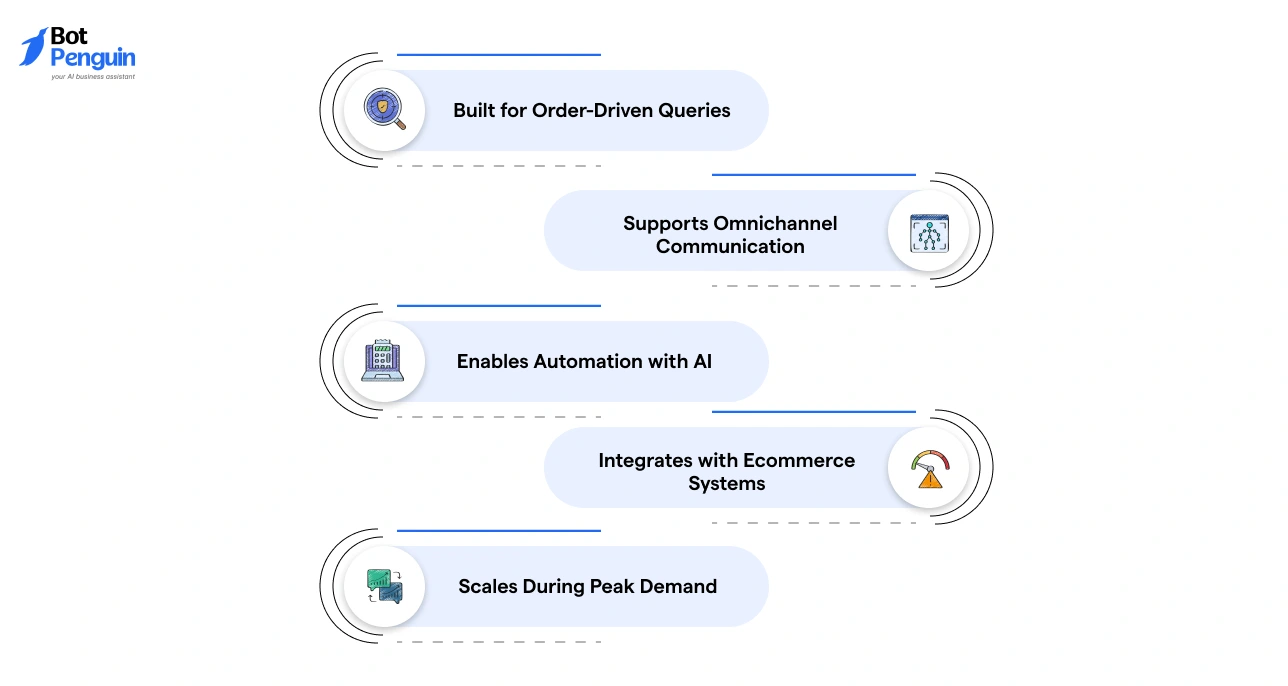
Good ecommerce customer service software must handle order-driven queries, support omnichannel communication, automate with AI, integrate with ecommerce systems, and scale during peak demand. These five capabilities define whether a tool is genuinely built for ecommerce or just a generic helpdesk solution.
Each capability addresses a specific challenge ecommerce support teams face daily. Here is what to look for in each one:
Ecommerce support revolves around order status, returns, refunds, cancellations, and delivery timelines.
A strong system fetches order details automatically, sends real-time updates, and resolves common queries without manual effort. This cuts ticket volume and speeds up response time.
Customers reach out across live chat, email, WhatsApp, and social media.
A unified system manages all conversations in one place. Agents view past interactions and respond consistently — without switching between tools.
AI handles a large share of repetitive queries instantly. It answers FAQs, guides users through processes, and routes complex issues directly to the right human agent — so nothing falls through the cracks.
Integration with CRM, order management, and payment systems gives agents real-time access to customer and transaction data. This removes the need for manual lookups and speeds up issue resolution.
Ecommerce businesses see sharp spikes during sales and seasonal events. A good system absorbs that volume without delays — keeping response times fast and customer experience consistent.
These five capabilities separate tools genuinely built for ecommerce from generic helpdesk software. Use them as your benchmark when reviewing the options below.
The fastest way to evaluate ecommerce customer service tools is to compare them based on automation capabilities, channel support, and core strengths. This way, you can shortlist the right solution without reviewing every platform individually.
Not sure which category fits you? The next section breaks down each tool in detail, so you can evaluate features, strengths, and fit before making a decision.
These seven tools stand out for their automation capabilities, ecommerce integrations, scalability, and ease of use. They were evaluated based on ecommerce relevance, automation, integrations, scalability, usability, and G2 ratings.
Each one solves a specific support challenge, so whether you run a small Shopify store or a high-volume enterprise operation, there is a fit here for you.
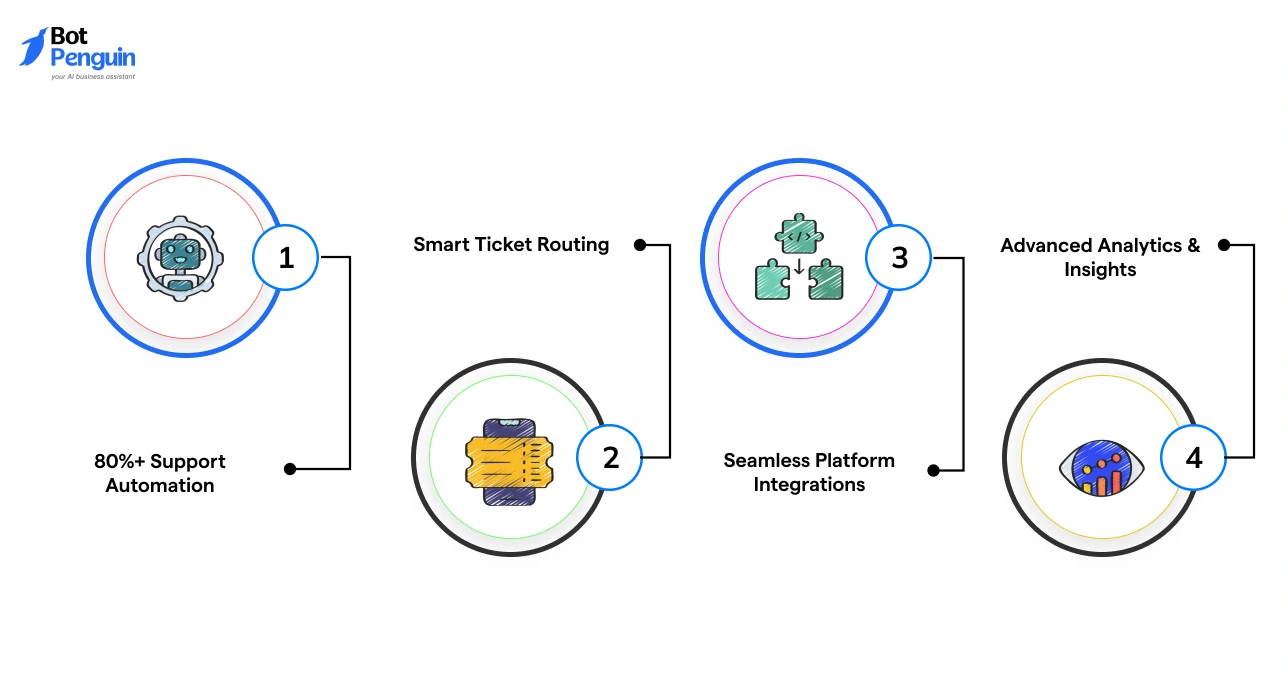
BotPenguin is a generative AI-powered customer service chatbot platform trusted by 80,000+ businesses worldwide. It delivers 24/7 automated support across multiple channels, answering FAQs, creating tickets, routing complex chats to live agents, and sharing files, all without manual effort.
Key Features:
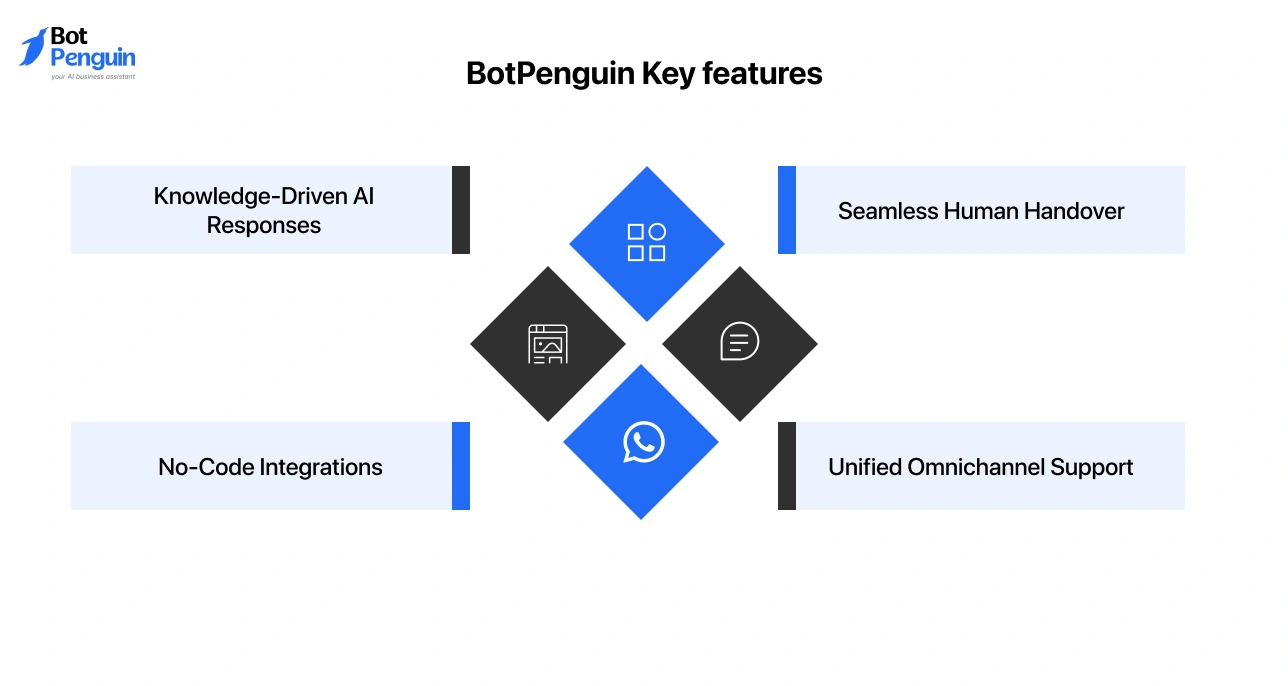
Best For: Ecommerce businesses that need 24/7 AI-powered customer support with live agent handoff across multiple channels — without expanding their support team.
Pricing: Free forever plan available. Paid plans start at $29/month (Little Plan). King Plan at $99/month for high-volume teams. A 7-day free trial with full King Plan access is available, no credit card required.
Limitation: Lower plans share message limits across AI and regular bot messages; high-volume teams will likely need paid add-on packs.
⭐ G2 Rating: 4.6/5
Gorgias is a support automation platform built exclusively for online stores. It pulls order data, shipping details, and customer history directly into the support dashboard, so agents resolve queries faster without switching tabs.
Key Features:
Best For: Shopify-focused brands that want deep ecommerce integrations and centralized support in one platform.
Pricing: Starts at $10/month (Starter, 50 tickets). Scales by ticket volume, not by agent seats.
Limitation: AI automation is billed separately, and seasonal ticket spikes can unexpectedly double your monthly bill.
⭐ G2 Rating: 4.6/5
Zendesk is an enterprise-grade help desk solution built for large support operations. It combines advanced ticketing, AI-powered automation, and robust reporting, giving large support teams the structure and visibility they need to manage high volumes efficiently.
Key Features:
Best For: Enterprise ecommerce teams that need advanced ticketing, deep customization, and reliable scalability.
Pricing: Starts at $19/agent/month (Support Team). Suite plans start at $55/agent/month, billed annually.
Limitation: Real-world spend is typically 2–3x the advertised base rate once AI, QA, and automation add-ons are factored in.
⭐ G2 Rating: 4.5/5
Freshdesk is a multichannel support tool that balances automation, affordability, and ease of use. It gives growing online store teams the features they need to manage increasing query volume, without the enterprise price tag.
Key Features:
Pricing: Free plan available for up to 2 agents. Paid plans start at $15/agent/month (Growth), billed annually.
Limitation: Freddy AI sessions are sold as add-ons with session-based billing — costs become unpredictable during high-volume periods.
Intercom is a conversational support solution that leads with real-time messaging. It engages customers proactively through chat and in-app messaging, resolving queries faster and creating a more connected support experience.
Key Features:
Pricing: Starts at $29/seat/month (Essential), billed annually. Fin AI charges an additional $0.99 per resolved conversation.
Limitation: WhatsApp, SMS, and phone are pay-as-you-go add-ons; costs climb fast for high-volume teams using multiple channels.
Tidio is a live chat and automation platform designed for small and mid-sized online stores. It helps teams respond faster, engage visitors in real time, and handle repetitive queries without a complex setup.
Key Features:
Pricing: Free plan available. Paid plans start at $24.17/month. Note: Lyro AI and Flows automation are billed separately as add-ons.
Limitation: Running all three modules (chat, Lyro AI, and Flows) typically costs $105–$150/month in practice, well above the advertised entry price.
HubSpot Service Hub is a CRM-connected support platform that ties every customer interaction to a unified contact record. Agents get full context on purchase history, past queries, and preferences before they respond, making every conversation more informed and efficient.
Key Features:
Pricing: Free plan available for up to 2 users. Starter plans from $15/seat/month. Professional plans start at $90/seat/month with a mandatory $1,500 onboarding fee.
Limitation: Businesses not already using HubSpot CRM may find the mandatory onboarding fees and ecosystem dependency hard to justify.
Now that you have a clear picture of what each tool offers, the next step is narrowing down the right fit for your specific business. The section below walks you through the key decision factors to help you choose with confidence.
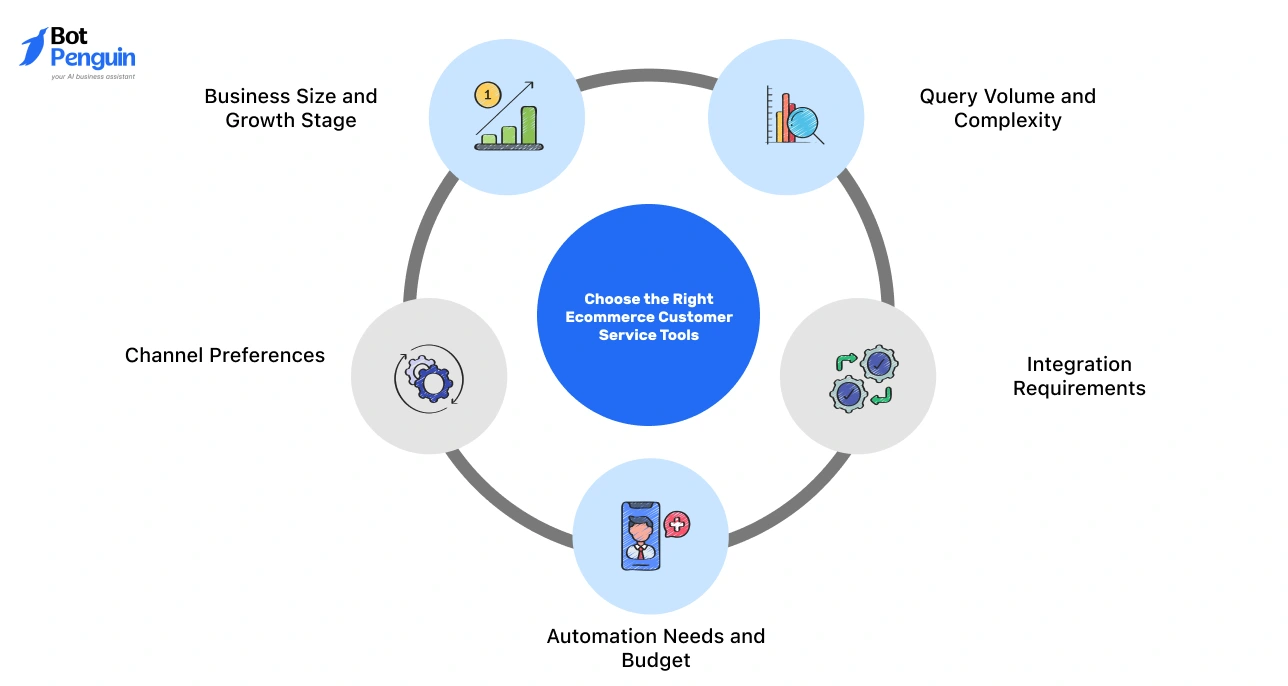
The right ecommerce customer service tool depends on five factors: your business size, query volume, channel preferences, integration requirements, and automation budget.
Start with query volume and budget as your primary filters; they eliminate the most options the fastest. Then use the remaining factors to narrow further.
Small stores need simplicity and fast setup. Scaling brands need multi-agent support, advanced automation, and room to grow without switching platforms mid-growth.
⚠️ Watch out for: Tools that look affordable at small scale but jump sharply in price as your team or ticket volume grows.
High-volume stores with repetitive queries get the most value from automation-first tools. If more than 50% of your queries are routine, automation delivers meaningful ROI from day one.
⚠️ Watch out for: Tools that advertise AI automation but charge separately per resolved conversation — costs compound quickly at high volumes.
Your software should natively cover the channels your customers use — WhatsApp dominates in South Asia and the Middle East, Instagram DMs are rising for lifestyle brands, and email remains the default in Western markets.
Map your touchpoints first, then shortlist tools that cover them out of the box.
⚠️ Watch out for: Tools that list a channel as "supported" but require a paid add-on to actually activate it.
Support software works best when it connects directly to your ecommerce platform, CRM, and order management system — without native integration, agents switch tools manually, slowing resolution.
Before committing, verify that the integrations you need are included in your plan tier.
⚠️ Watch out for: Tools that advertise integrations in their marketing but restrict key ones to enterprise plans or charge extra.
The right question is not how cheap a tool is — it is how much it saves at your actual query volume. A tool at $99/month that deflects 60% of tickets delivers stronger ROI than a $40 tool that handles 10%.
⚠️ Watch out for: Session-based or per-resolution AI billing that looks cheap upfront but scales unpredictably during peak periods.
Scaling ecommerce customer service without the right software means slower responses, higher costs, and frustrated customers. The seven tools covered in this blog each solve that problem differently; the right one depends on your store size, channels, and support volume.
Start by identifying your biggest bottleneck (query volume, channel gaps, or lack of automation) and let that guide your shortlist. If you need omnichannel automation with live agent handoff and a free plan to get started, BotPenguin is worth exploring.
Most tools on this list offer a free plan or trial: use it. Real-world testing tells you far more than any comparison table can.
For a deeper look at building your ecommerce support strategy, check out our complete guide on ecommerce customer service.
Ecommerce customer service software helps online stores manage customer queries, automate repetitive support tasks, and handle conversations across multiple channels from one platform. It connects to ecommerce systems to give agents real-time access to order data, enabling faster, more accurate issue resolution.
The best ecommerce customer service software depends on your business size, query volume, and channel preferences. For Shopify-focused brands, Gorgias is a strong fit. For omnichannel automation with WhatsApp support, BotPenguin stands out. For enterprise operations, Zendesk offers the most depth. Use the Quick Decision Guide in this blog to find the right match for your specific situation.
AI chatbots handle repetitive queries like order status, returns, and delivery timelines instantly and around the clock. This reduces ticket volume for human agents, improves first response time, and keeps support running during peak periods without adding headcount.
Pricing varies widely by tool and model. BotPenguin and Tidio offer free forever plans. Paid plans start from $10/month (Gorgias) to $29/month (Intercom) for entry tiers. Enterprise tools like Zendesk can run significantly higher once AI add-ons are factored in. Most tools offer a free trial; the best approach is to test before committing.
A helpdesk centralises conversations and ticket management across channels; it is where human agents work. A customer service chatbot automates responses to routine queries before they reach an agent. Most modern ecommerce support tools combine both: automating what they can and escalating what they cannot.
Subscribe to Our Newsletter
Get the latest business insights straight into your inbox.
Checkout our related blogs you will love.
Updated at Oct 16, 2026
8 min to read
Updated at Oct 15, 2026
7 min to read

Updated at Oct 13, 2026
17 min to read

Updated at Oct 12, 2026
15 min to read
Updated at Oct 12, 2026
15 min to read

Updated at Oct 6, 2026
9 min to read
Table of Contents