


What Is a White Label Partnership? Models, Programs & How It Works
Updated at Oct 9, 2026
8 min to read
How do agencies scale white label services profitably? Use a flat-fee platform so that margins grow as you add clients, package services into tiered plans, and expand each account with chatbot, WhatsApp, voice AI, and AI agents. This land-and-expand model grows revenue per client without rebuilding delivery.
Choosing a white label service model is the easy part. The harder part is what comes after.
Agencies need to turn a resold service into a scalable business that grows without having to chase new clients every month.
This playbook explains how to scale white label services for agencies through higher margins, tiered packages, and channel expansion.
It is not a platform comparison. For comparison-specific research, review our guide to choosing the right white-label chatbot platform for your agency.
Agencies exploring other partnership models, channels, and growth strategies can also review our white label partner resources.
This guide focuses on what happens after selection: building a recurring-revenue model across chatbots, WhatsApp, voice AI, and AI agents.
White label services for agencies are products that agencies resell under their own brand. The agency owns the client relationship, while the provider manages the backend technology.
A successful white-label partnership also provides the agency with a repeatable framework for branding, delivery, support, and long-term client growth.
The focus is not on one chatbot offer. It is a multi-product white-label service model that expands across chatbots, WhatsApp, voice AI, and AI agents.
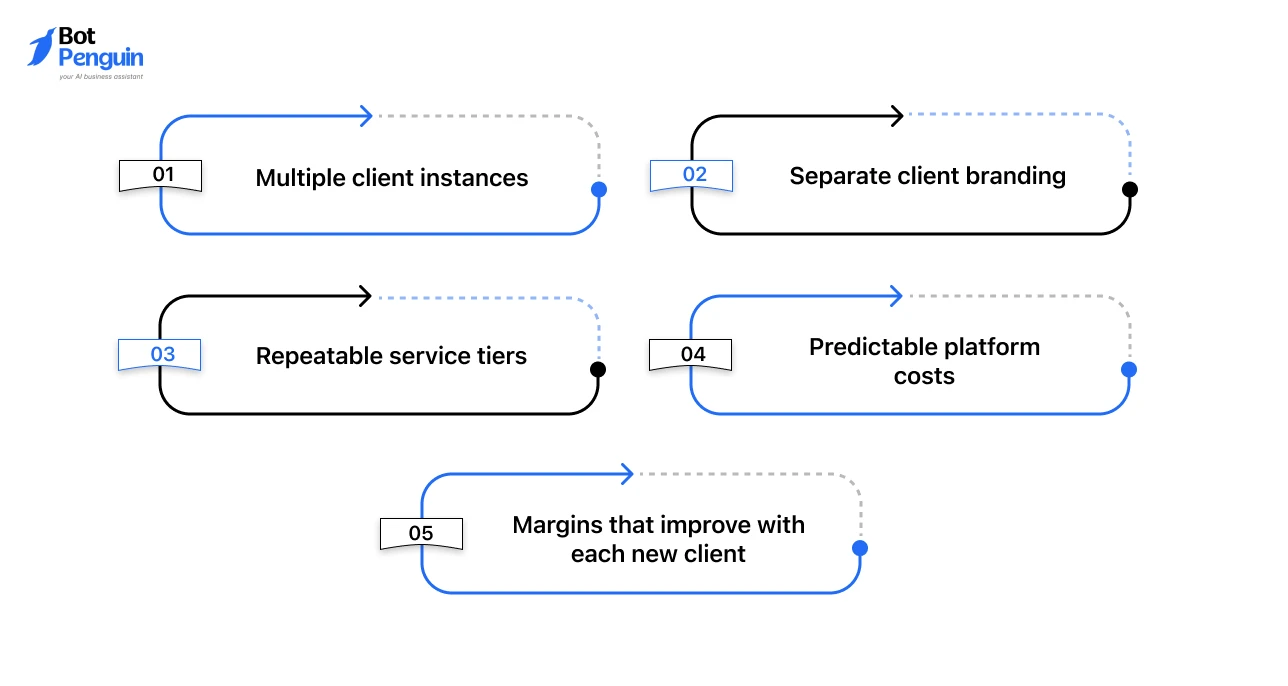
At a small scale, this is simple. One client needs one bot, and delivery stays manageable. At scale, the model changes.
Agencies need clear pricing, repeatable packages, and client-level operations.
That means managing:
The real goal is not just resale. It is about building a service model in which each new account is easier to deliver and more profitable to retain.
Next, the economics behind that model decide how far the agency can scale.
A cost model decides how far an agency can scale. If platform costs rise with every client, margins weaken. If costs stay fixed, each new account improves the business model. That is why pricing matters before features.
Agencies should also separate platform costs from delivery costs, such as setup, chatbot flows, onboarding, reporting, and support.
When platform costs are predictable, agencies can protect margins and avoid underpricing as client usage grows.
The two sections below explain how cost structure affects margins and how those margins compound as client count grows.
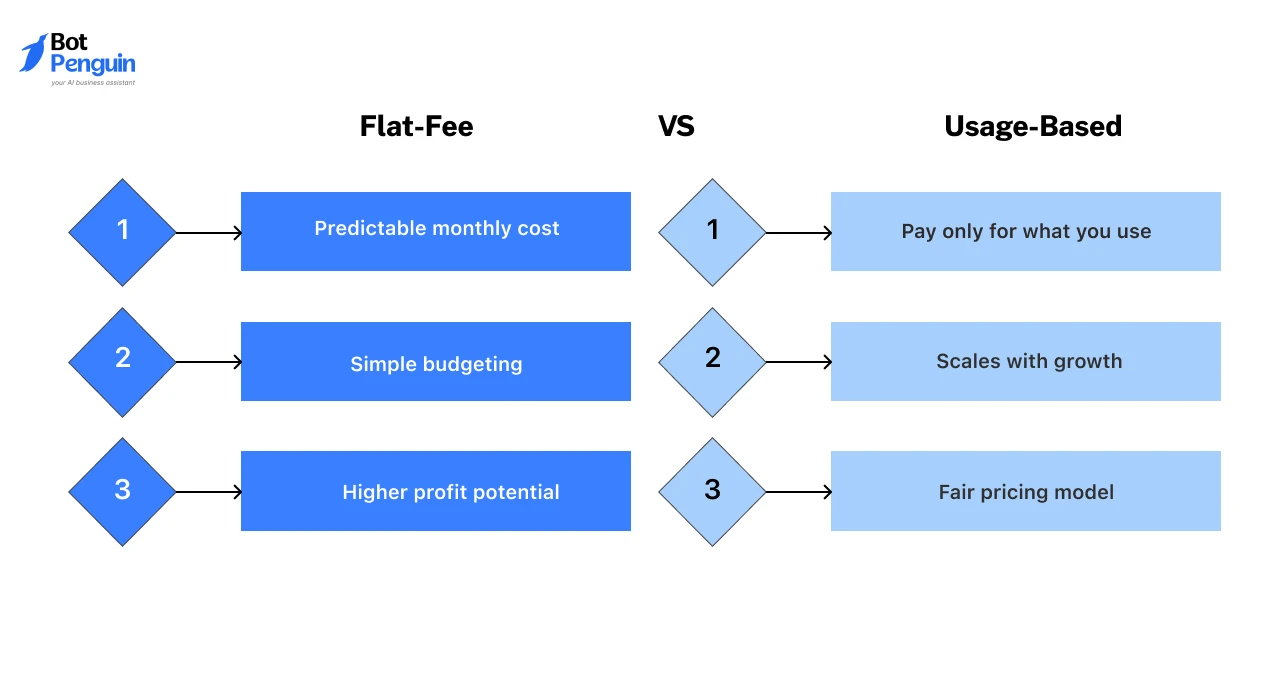
Usage-based platforms charge by volume. That may mean conversations, seats, minutes, contacts, or campaigns.
The problem is simple. As clients grow, costs grow with them. That makes success more expensive. It also makes profit harder to forecast.
Flat-fee platforms work differently. The agency pays a fixed platform fee and then sells multiple services to multiple clients.
This gives agencies stronger control. More clients, more channels, and more service tiers can increase revenue without increasing platform cost at the same pace.
That structure helps an agency scale its service line with cleaner margins and fewer pricing surprises.
Consider a flat $1,500/year platform cost.
(Note: The figures in this table are hypothetical examples used to illustrate how margin dynamics can change under a flat-cost reseller model. Actual revenue, pricing, and profitability will vary based on your platform costs, service packages, client mix, and pricing strategy.)
The platform cost stays the same. The revenue grows with every new client. That is the margin advantage.
A recurring revenue agency needs fixed costs, predictable packages, and room to expand each account.
This is where white label chatbot pricing becomes important. It helps agencies check whether their resale model can protect margin as client volume grows.
For chatbot-specific pricing and packaging, review our white label chatbot for agencies guide.
The next step is not just adding more clients. It is growing revenue from the clients already won.
The most profitable agencies not only acquire more clients. They grow revenue from existing accounts. That is the land-and-expand agency model applied to white-label services.
An agency starts with one clear service, proves value, then adds adjacent channels. Each expansion increases account value and improves retention.
For a recurring revenue agency, this matters more than constant acquisition. Existing clients are easier to expand than new clients are to close.
The sections below show how agencies can move from chatbot resale to WhatsApp, voice AI, and autonomous AI agents.
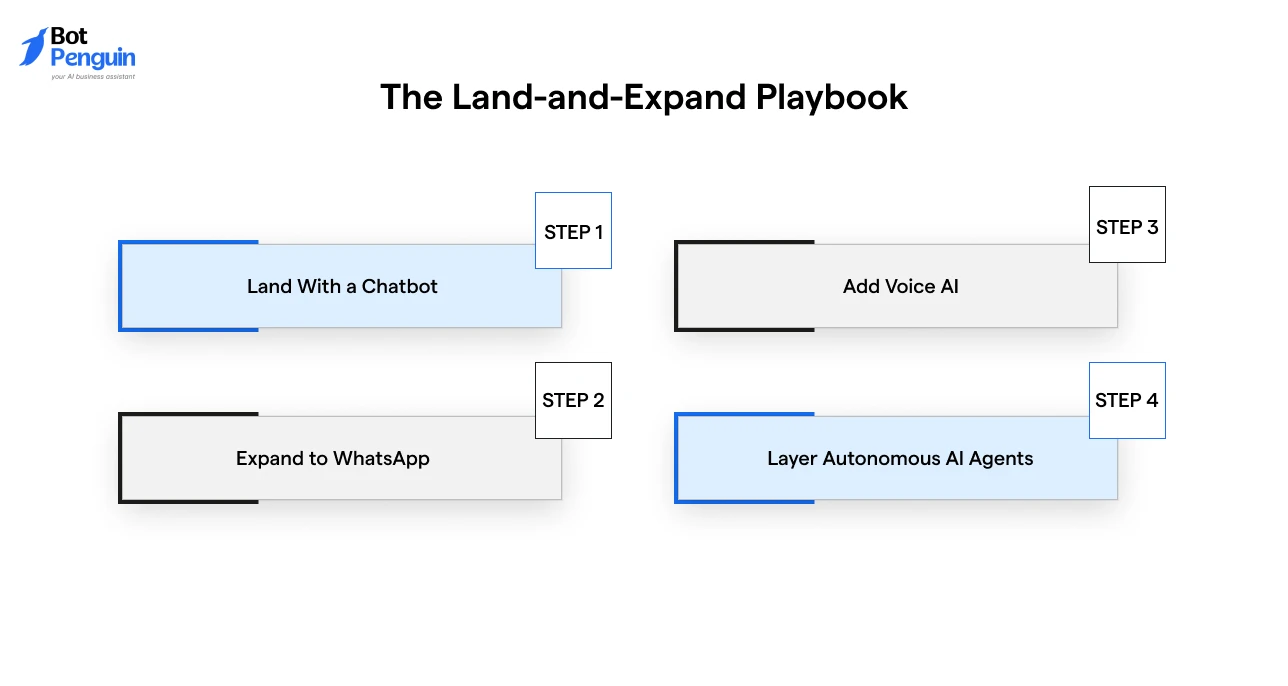
A website chatbot is the easiest entry product. It is fast to deploy, visible to the client, and low-risk to approve.
Agencies can use this first chatbot service to quickly prove value. The chatbot can capture leads, answer FAQs, book appointments, or route support requests.
This creates the base relationship. Once the client sees value, expansion becomes easier.
WhatsApp is the next natural channel once the chatbot is up and running.
This is especially true in MENA, India, LATAM, and Southeast Asia. In these markets, WhatsApp is often the primary channel for business communication.
Agencies can expand the same client relationship with:
This turns a simple chatbot project into a higher-value communication stack.
Voice AI is the premium expansion layer. It fits clients who handle many calls, follow-ups, and booking requests. These clients often need a faster response without adding more staff.
Good-fit industries include:
Agencies can offer voice AI for inbound call handling, outbound campaigns, and live transcription. It adds differentiation because fewer agencies offer voice-led automation.
For agencies building premium communication packages, our white label voice AI program fits this expansion stage.
Autonomous AI agents are the highest-value layer for AI automation agencies.
They do more than respond to questions. They can follow goals, use tools, trigger workflows, and act across multiple steps.
This turns a chatbot retainer into an operational automation system.
For example, an AI agent can qualify a lead, update a CRM, send a follow-up, and escalate the conversation when needed.
That creates a stronger premium tier. It also makes the client harder to replace because the agency now supports deeper business workflows.
Agencies planning to build a broader service model around these workflows can follow this guide to starting and scaling a white label AI automation agency.
The next step is packaging these layers into clear pricing tiers.
Package the service instead of itemizing every feature.
As the agency grows, one-off pricing becomes harder to manage. Tiered pricing gives clients a clear upgrade path. For a multi-product white-label service model, it also keeps pricing simple.
The client buys an outcome tier, not a scattered list of features.
(Note: This tier structure is only an example. Agencies should adjust packages, pricing, and channel combinations based on client needs, delivery costs, and margin goals.)
This structure makes expansion easier. The client upgrades a tier rather than negotiating a new contract, and pricing remains tied to the value delivered.
Clear white label marketing also helps agencies position each tier consistently and communicate its value under their own brand.
When platform costs stay flat, every tier upgrade improves margins. Agencies can also separate setup work from monthly retainers to protect delivery effort and recurring revenue.
Setup pricing can cover chatbot buildout, flow planning, branding, and launch support. Monthly pricing can cover hosting, reporting, optimization, and channel expansion as client usage grows.
The next challenge is operational control. As the client count grows, delivery must stay manageable.
Scaling usually breaks operationally before it breaks commercially. Multi-client agency operations decide whether a white-label service line stays profitable at scale.
Running 20 client bots from separate logins creates avoidable friction. It slows delivery, reporting, support, and client management.
Agencies need one place to manage every client account. A multi-client reseller dashboard makes that possible.
The right agency partner program also provides onboarding, account management, training, and ongoing support as the client base grows.
The goal is simple. Each client should stay separate, but the agency should stay in control.
Agencies can explore BotPenguin’s partner programs to compare white-label, reseller, and affiliate opportunities based on their preferred service model.
This matters most as the client count grows. Without structure, every new account adds more manual work.
A strong setup should enable agencies to clone proven chatbot flows, manage branded instances, and track client activity from a single place.
This is where the BotPenguin white label chatbot partner program fits the operational side of scaling. It supports agencies that need branded delivery and multi-client control.
BotPenguin works with 250+ partners and serves businesses across 193 countries, demonstrating the operating scale behind its white-label ecosystem.
Agencies should also build repeatable operating procedures. That includes reusable onboarding checklists, bot launch templates, reporting formats, and escalation rules. These systems reduce delivery time as the client count grows.
The goal is not to rebuild every client setup manually. The goal is to turn successful deployments into reusable assets.
With the right operational setup, scaling becomes repeatable rather than chaotic, and each new client is easier to onboard, manage, and retain.
White-label services allow an agency to resell a provider’s product under its own brand. These services can include chatbots, WhatsApp automation, voice AI, and AI agents. The agency owns pricing and the client relationship, while the provider maintains the technology. This lets agencies add recurring revenue service lines without having to build software.
By choosing a flat-fee platform (predictable margins), packaging services into tiered pricing, and growing revenue per client through channel expansion — starting with a chatbot, then adding WhatsApp and voice. A flat platform cost means each new client and each added channel increases margin.
With a flat-fee platform model, an agency serving 20 clients at $250/month can generate $60,000/year against a fixed $1,500/year platform cost. Adding WhatsApp, voice AI, or AI agents to existing clients can increase revenue per account without rebuilding the service from scratch.
Land a client with one service (usually a website chatbot), prove value, then expand into adjacent channels — WhatsApp, voice AI, autonomous agents. Each expansion increases revenue per client and deepens retention, which is more profitable than constantly acquiring new clients.
Through a multi-client reseller dashboard with client isolation, letting the agency manage every client's bots, branding, and billing from one login. BotPenguin provides this with separate, client-branded instances.
Scaling white label services for agencies means building recurring revenue around a repeatable delivery model.
Flat-fee economics protect margins, tiered packaging creates clear upgrade paths, and land-and-expand growth increases revenue from existing clients.
That is how agencies move from one resold service to a scalable channel stack across chatbots, WhatsApp, voice AI, and AI agents.
BotPenguin supports this model with flat-fee pricing, multi-channel delivery, and multi-client control. That gives agencies the structure to grow recurring revenue without having to rebuild operations for every new client.
Subscribe to Our Newsletter
Get the latest business insights straight into your inbox.
Checkout our related blogs you will love.
Updated at Oct 9, 2026
8 min to read

Updated at Oct 9, 2026
12 min to read
Updated at Oct 8, 2026
10 min to read
Updated at Oct 7, 2026
15 min to read
Updated at Oct 6, 2026
9 min to read

Updated at Oct 1, 2026
11 min to read
Table of Contents
