


In March 2025, Baidu launched ERNIE Bot X1, a reasoning model that rivals DeepSeek R1 at half the price, while ERNIE 4.5 outperforms GPT-4o on multimodal benchmarks at roughly 1% of GPT-4.5's cost. A year later, Chinese AI isn't catching up anymore. It's competing head-on.
But does that make ERNIE Bot X1 the better choice over ChatGPT for your needs? This guide breaks down benchmarks, pricing, language performance, and use cases so you can decide.
What is ERNIE Bot, and who makes it?
ERNIE Bot is an AI chatbot developed by Baidu, China's dominant search engine company. Built on Baidu's ERNIE (Enhanced Representation through Knowledge Integration) series of large language models, it launched publicly in August 2023 after receiving approval from Chinese regulators. By April 2024, it had crossed 200 million users.
How has ERNIE Bot evolved from version 3.5 to X1?
ERNIE hasn't stood still. Here's how the model family has progressed:
Each generation has pushed Baidu closer to the global frontier, but X1 is where the story gets genuinely interesting, which we'll cover in the next section.
Is ERNIE Bot the same as Baidu AI?
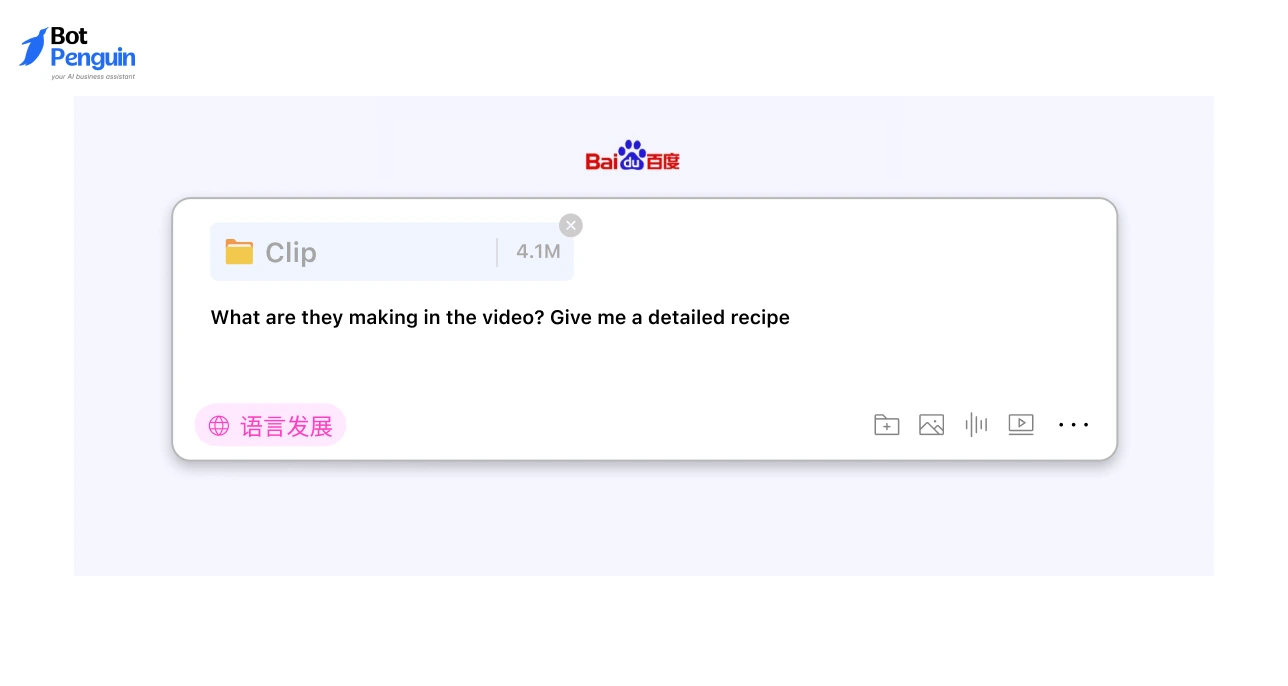
Not exactly. Baidu AI is the broader umbrella covering all of Baidu's artificial intelligence products and research — including search, autonomous driving, and cloud services.
ERNIE Bot is specifically the conversational chatbot interface built on top of Baidu's ERNIE language models. Think of it the way ChatGPT relates to OpenAI: I am one product within a much larger AI operation.
Here it is:
What is ERNIE Bot , X,1, and how is it different from previous versions?
ERNIE Bot X1 is Baidu's first deep-thinking reasoning model, launched in March 2025.
Unlike earlier ERNIE versions that focused on general conversation and knowledge retrieval, X1 is built specifically for tasks that require multi-step logical reasoning, complex problem solving, and structured thinking — making it a direct competitor to OpenAI's o3 and DeepSeek R1.
What can ERNIE Bot X1 do that ChatGPT can't?
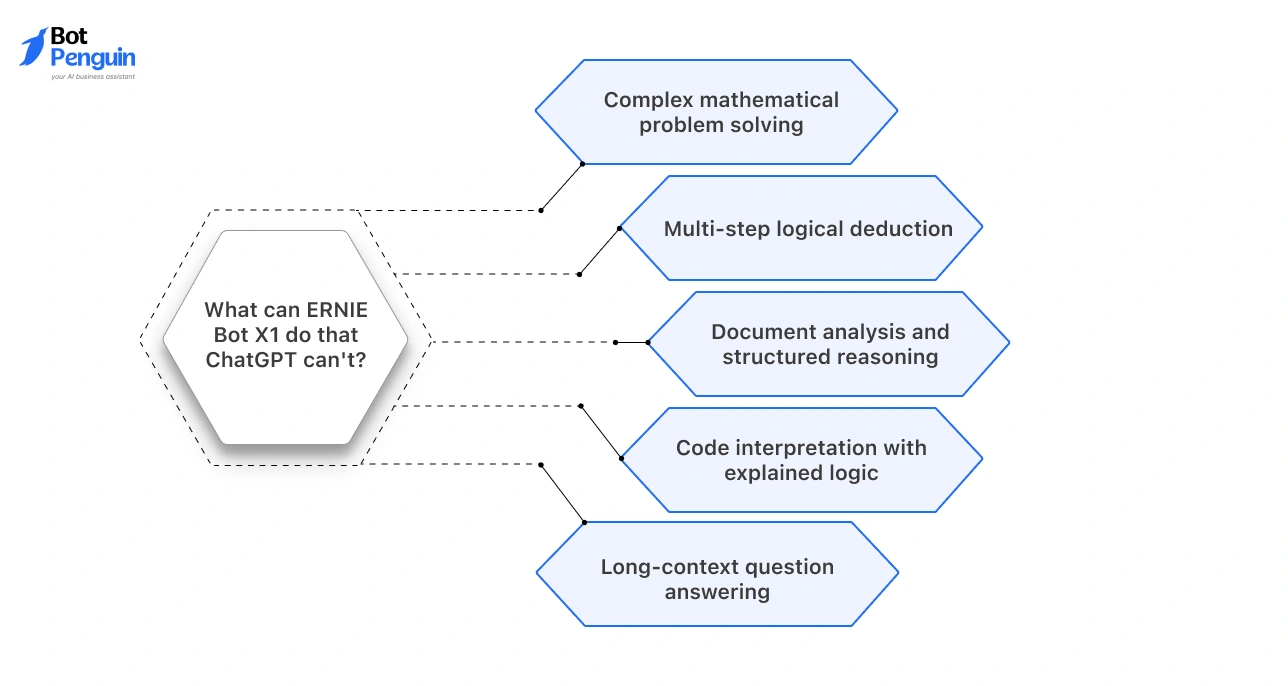
X1's biggest differentiator is its Chain-of-Thought reasoning — it shows its thinking process step by step before delivering an answer, similar to how DeepSeek R1 operates. This makes it significantly stronger than standard ChatGPT (GPT-4o) in tasks like:
- Complex mathematical problem solving
- Multi-step logical deduction
- Document analysis and structured reasoning
- Code interpretation with explained logic
- Long-context question answering
Standard ChatGPT gives you the answer. X1 shows you how it got there — which matters enormously in business, research, and developer contexts where you need to verify reasoning, not just trust an output.
How does ERNIE X1 compare to DeepSeek R1?
Both are reasoning-first models, but X1 has a clear cost advantage. Baidu positioned X1 at roughly half the price of DeepSeek R1 with comparable reasoning performance.
For teams already evaluating DeepSeek R1 as a ChatGPT alternative, X1 is worth putting directly in that comparison.
What is ERNIE Bot X1 Turbo?
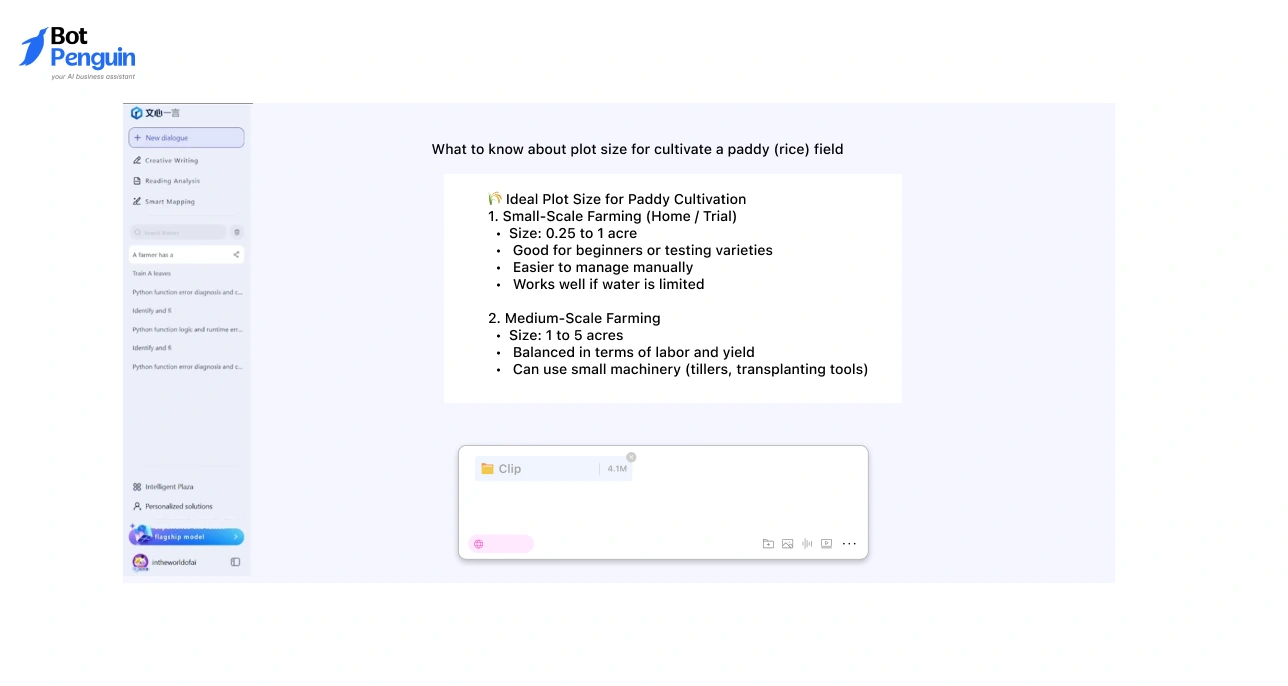
X1 Turbo is the optimized version that Baidu released in April 2025, one month after the original X1 launch. It delivers the same reasoning capabilities at faster response speeds and lower operational costs — essentially the production-ready version of X1 for teams building on top of it via API.
ERNIE Bot X1 vs ChatGPT: how do they compare at a glance?
If you're evaluating both tools and need a quick answer, here it is. ERNIE Bot X1 wins on reasoning depth and cost.
ChatGPT wins on English fluency, ecosystem maturity, and global accessibility. Everything else depends on your specific use case — which we break down in detail later in this guide.
Here's the full side-by-side:
Which is faster — ERNIE Bot X1 or ChatGPT?
For standard queries, GPT-4o is marginally faster in response time for English-language inputs. However, ERNIE X1 Turbo — released April 2025 — was specifically optimized to close that gap, with Baidu targeting faster response times at lower cost. For Chinese-language queries, ERNIE X1 is consistently faster given it's trained predominantly on Chinese data infrastructure.
How does ERNIE Bot X1 perform on benchmarks vs GPT-4o?
On paper, ERNIE Bot X1 and ERNIE 4.5 don't just compete with GPT-4o — they beat it on several key benchmarks. This isn't marketing from Baidu. These are third-party evaluated scores across standardized tests that the AI industry uses to measure model capability.
Here's how ERNIE 4.5 stacks up against GPT-4 on text-based reasoning and problem solving:
On multimodal benchmarks — tasks involving images, documents, and mixed media inputs — ERNIE 4.5 scores an average of 77.77 against GPT-4o's 73.92. That's a meaningful gap, not a marginal one.
Is ERNIE Bot X1 better than ChatGPT for maths and reasoning?
For pure reasoning tasks, yes — X1 has a clear edge. Its Chain-of-Thought architecture is purpose-built for mathematical deduction and multi-step logic, the same approach that made DeepSeek R1 a breakthrough model.
Where GPT-4o gives you a direct answer, X1 works through the problem visibly, which not only produces more accurate results on complex maths but also lets you catch errors in the reasoning chain before acting on the output.
For straightforward maths queries — basic calculations, quick conversions, simple equations — GPT-4o is perfectly capable , and the difference is negligible.
Which model is better for Chinese-language tasks?
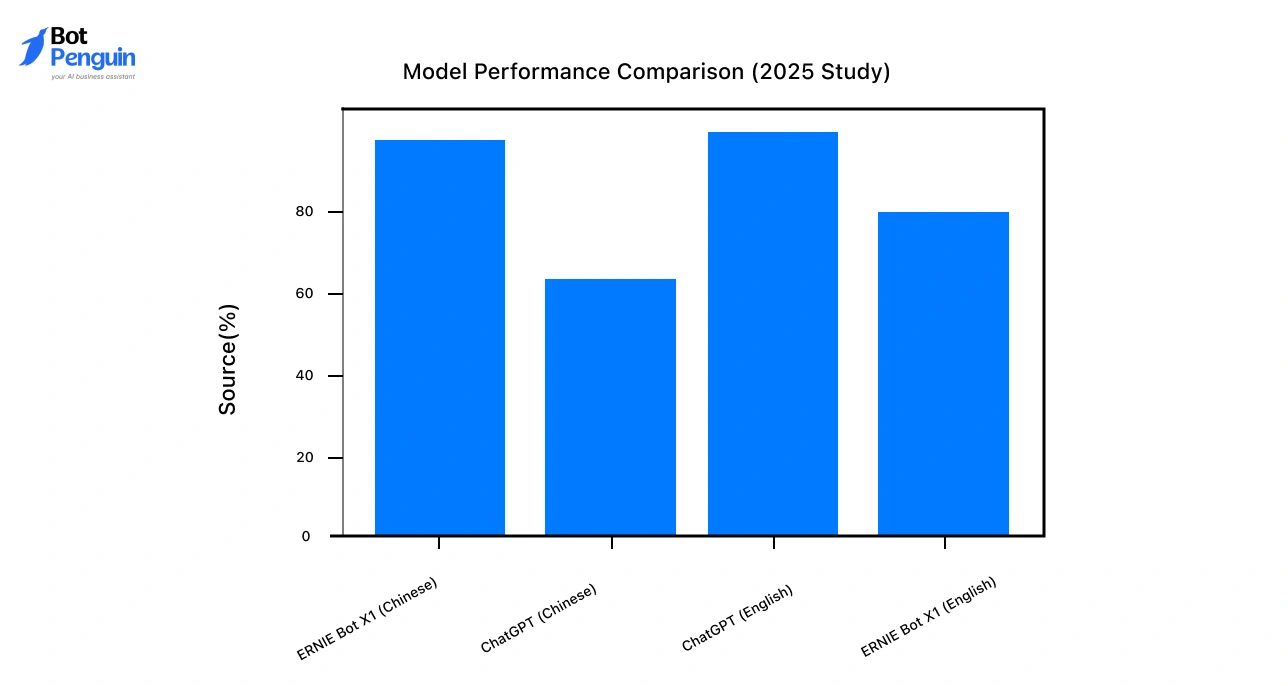
ERNIE Bot X1, unambiguously. This has been independently verified beyond Baidu's own claims — a 2025 study published in a peer-reviewed medical journal evaluated both models on specialized domain questions in Chinese and English.
ERNIE Bot scored 89.47% at the highest rating tier for Chinese-language responses versus ChatGPT's 57.89%. In English, the result flipped — ChatGPT led with 92.11% versus ERNIE's 73.68%.
The pattern is consistent across general and specialized domains: ERNIE dominates Chinese, ChatGPT dominates English. If your use case is bilingual or Chinese-first, that gap is significant enough to drive your model choice on its own.
Here it is:
How much does ERNIE Bot X1 cost compared to ChatGPT?
This is where ERNIE Bot's 2025 releases genuinely changed the conversation. Baidu didn't just launch competitive models — it launched them at prices that make OpenAI's pricing look difficult to justify for high-volume use cases.
Here's the breakdown:
To put the ERNIE 4.5 figure in plain terms — if you're spending $1,000 a month on GPT-4.5 API calls, the equivalent workload on ERNIE 4.5 would cost around $10. For teams running AI at scale, that's not a marginal saving. It's a budget reallocation.
Is ERNIE Bot free to use in 2026?
Yes, partially. ERNIE 3.5 remains free for individual users through the ERNIE Bot chatbot interface at yiyan.baidu.com.
ERNIE 4.5 is also accessible for free to individual users on the same platform following Baidu's decision to open access ahead of its planned April 2025 release date. ERNIE X1 and X1 Turbo are available on paid tiers.
The catch — and it's a significant one — is that the chatbot interface currently requires a Chinese phone number for registration, which locks out most international users from the free tier entirely.
What is ERNIE Bot's API pricing vs OpenAI?
For developers accessing models via API, ERNIE 4.5 is available through Baidu's cloud platform Qianfan at a fraction of OpenAI's equivalent rates. ERNIE X1 via API is in the process of being rolled out on the same platform — at launch, it was not yet fully available, but Baidu has confirmed API access is coming.
For international developers, Qianfan is currently the only reliable access route to ERNIE models given the chatbot's regional restrictions.
If cost efficiency at scale is your primary concern and your workload suits ERNIE 4.5's capabilities, the API price difference alone makes it worth evaluating seriously.
What are the key differences between ERNIE Bot and ChatGPT?
Beyond benchmarks and pricing, ERNIE Bot and ChatGPT are fundamentally shaped by the companies and ecosystems that built them.
Those differences show up in ways that matter for real-world use — language capability, data access, content restrictions, and how far each tool's integrations actually reach.
Does ERNIE Bot have censorship restrictions?
Yes, and this is a non-negotiable limitation you need to know going in. As a product operating under Chinese government regulations, ERNIE Bot is subject to content censorship that ChatGPT is not.
This doesn't affect the majority of business and developer use cases — coding, document analysis, reasoning tasks, and Chinese-language content generation are entirely unaffected.
But if your use case involves open-ended research, journalism, political analysis, or any topic that intersects with Chinese government policy, ERNIE Bot is not the right tool.
Which model has better English language understanding?
ChatGPT, clearly. Here's how the two models compare across language dimensions:
For English-language content generation, customer-facing copy, or any output that native English speakers will read critically, ChatGPT consistently produces more natural results.
ERNIE Bot's English capability has improved significantly with each version — but the gap with GPT-4o on English fluency remains, and independent benchmark results confirm that pattern holds in 2026.
Does ERNIE Bot support real-time internet access?
Yes. Here's how both models compare on data access and connectivity:
For queries requiring up-to-date information, both models now support web access — but ChatGPT's plugin and tool ecosystem is significantly broader, giving it an edge for teams that rely on third-party integrations.
ERNIE Bot's integrations are predominantly within Baidu's own product suite, which matters less for developers accessing it via API but is a real constraint for non-technical business users.
Can you use ERNIE Bot outside China?
This is one of the most searched questions about ERNIE Bot and one of the least clearly answered across existing content — so here's the direct answer: it depends on whether you're an individual user or a developer.
For individual users accessing the chatbot interface at yiyan.baidu.com, registration currently requires a Chinese phone number. That means users in India, the US, Europe, and most of the rest of the world cannot create an account and access ERNIE Bot directly through the standard interface. There is no official workaround for this at the consumer level.
For developers, the situation is different — and significantly more accessible.
How do developers outside China access ERNIE Bot via API?
The access route for international developers is Baidu's AI cloud platform, Qianfan. Here's how it works:
A few practical notes for international developers are worth knowing upfront. Qianfan's documentation is more complete in Chinese than in English, so expect some friction if you're navigating it without Mandarin.
Payment processing on the platform works with international credit cards for most regions, but this has been inconsistently reported — verify before committing to a production integration.
Response latency from outside mainland China can also be higher than what Baidu quotes in its benchmark specs, since the infrastructure is China-hosted.
None of these are dealbreakers for a team serious about evaluating ERNIE X1 — but they're friction points worth knowing about before you start, not after.
Here it is:
When should you use ERNIE Bot X1 instead of ChatGPT?
Neither model is universally better. The right choice comes down to what you're building, who your users are, and what your budget looks like at scale. Here's a clear decision matrix so you're not guessing.
Is ERNIE Bot X1 good for business use?
Yes — with the right kind of business. ERNIE Bot X1 is particularly well-suited for:
- Businesses operating in or serving Chinese-speaking markets
- Teams running AI at scale where API cost is a meaningful line item
- Companies building reasoning-heavy applications — legal document review, financial analysis, technical research
- Development teams evaluating DeepSeek R1 who want a cheaper alternative with comparable reasoning output
It is less suited for businesses whose core use case is English-language customer interaction, teams that rely heavily on ChatGPT's plugin ecosystem, or organizations that need fully unrestricted content generation across all topics.
If you're building an AI-powered chatbot for a Chinese-speaking audience specifically, ERNIE Bot X1 via API is arguably the strongest technical choice available in 2026, at a price point that makes the decision easier.
Which AI is better for coding tasks in 2026?
Competitive, but ChatGPT holds a narrow edge for most developers. GPT-4o scores competitively on HumanEval+ and benefits from a significantly larger community of developers — meaning more Stack Overflow answers, more GitHub examples, and more third-party tooling built around it.
The exception is if you're writing code with Chinese-language documentation or comments, or building within a Chinese-language developer environment — in that context , ERNIE X1's language advantage carries over directly into coding tasks.
What are the limitations of ERNIE Bot X1 you should know about?
No model is without its weaknesses, and ERNIE Bot X1 is no exception. Understanding where it falls short is just as important as knowing where it excels — especially if you're evaluating it for a production environment or a business-critical application.
Geographic access — the biggest practical barrier
For individual users outside China, the chatbot restriction is a hard wall.
There is no official consumer-facing version of ERNIE Bot available internationally, and unlike ChatGPT, which is accessible in most countries with a standard email signup, ERNIE Bot requires infrastructure and regulatory compliance that Baidu has not yet extended globally.
This is the single biggest adoption barrier for ERNIE Bot X1 outside of Asia.
Censorship — know your use case before committing
The censorship limitation is unique among major AI models and deserves more than a footnote. It isn't a bug Baidu is working to fix — it's a legal requirement of operating in China.
For the vast majority of business and developer use cases,s this will never come up. But for teams in media, research, policy, or any domain adjacent to geopolitics, it is a firm constraint that needs to be factored into your model selection before you build, not after you've shipped.
English output quality — real but manageable
The English fluency gap is genuine but often overstated in Western coverage of ERNIE Bot. For structured outputs — data extraction, classification, summarisation, reasoning chains, code — the quality difference between ERNIE X1 and GPT-4o in English is marginal.
Where the gap becomes noticeable is in free-form English writing that requires cultural nuance, humor, idiomatic phrasing, or a distinctly natural voice. If your application generates English prose that users read directly, test ERNIE X1 outputs carefully before committing.
ERNIE Bot X1 vs ChatGPT: which one wins in 2026?
After benchmarks, pricing, language performance, limitations, and use cases — here's the honest verdict.
There is no universal winner. But there are clear winners for specific situations, and if you've read this far, you have everything you need to make the call.
The bigger story here isn't which model wins — it's what ERNIE Bot X1's existence means for the market. Twelve months ago, the default assumption was that OpenAI set the price floor and everyone else paid it.
ERNIE 4.5 at 1% of GPT-4.5's cost, and X1 at half the price of DeepSeek R1, has permanently changed that assumption. Enterprises evaluating AI spend in 2026 now have a legitimate, benchmark-verified alternative that wasn't credible eighteen months ago.
For most Western businesses building in English, ChatGPT remains the safer, more accessible, better-integrated choice.
For businesses operating in Chinese-speaking markets, building reasoning-heavy applications, or running AI at a scale where API cost is a real constraint , ERNIE Bot X1 deserves serious evaluation, not a footnote.
The bottom line in one sentence: Use ChatGPT if English fluency and ecosystem depth are your priority. Use ERNIE Bot X1 if reasoning performance, Chinese-language strength, or cost efficiency at scale are yours.
Building an AI-powered chatbot for your business in 2026?
Whether you're integrating ChatGPT, ERNIE Bot, or any other LLM into your customer experience, BotPenguin makes it straightforward.
Our platform supports custom AI chatbot development across WhatsApp, website, Facebook, and more — so you can deploy the right model for your audience without building the infrastructure from scratch.
Wrapping up
ERNIE Bot X1 and ChatGPT are both serious AI models in 2026 — but they're built for different strengths, different markets, and different budgets.
ERNIE X1 wins on reasoning depth, Chinese-language performance, and cost efficiency at scale. ChatGPT wins on English fluency, global accessibility, and ecosystem maturity.
The decision isn't complicated once you know your use case. If your business operates in Chinese-speaking markets or needs high-volume reasoning at a fraction of OpenAI's price —, RNIE Bot X1 is worth more than a passing look. If English-first output quality and integration breadth are what matter most, ChatGPT remains the benchmark.
Either way, the gap between the two has narrowed significantly in the past year. That's good for everyone building with AI.
Frequently Asked Questions (FAQs)
Is ERNIE Bot X1 better than ChatGPT in 2026?
For reasoning tasks, Chinese-language applications, and high-volume API use, ERNIE Bot X1 holds a clear edge over ChatGPT. For English-language output quality, global accessibility, and third-party integrations, ChatGPT (GPT-4o) remains stronger.
Neither model is universally better — the right choice depends entirely on your use case.
Is ERNIE Bot X1 free to use?
ERNIE Bot X1 is available on a paid tier through Baidu's platform. The free tier covers ERNIE 3.5 and ERNIE 4.5 for individual users — but only through the chatbot interface at yiyan.baidu.com, which currently requires a Chinese phone number for registration.
International users can access ERNIE models, including X1, via API through Baidu's Qianfan cloud platform.
Can I use ERNIE Bot outside China in 2026?
Not through the standard chatbot interface — that requires a Chinese phone number and remains regionally restricted.
However, developers outside China can access ERNIE Bot models, including ERNIE 4.5 and ERNIE X1, via API through Baidu's Qianfan platform, which supports international registration and accepts international payment methods.
What is the difference between ERNIE Bot X1 and ERNIE 4.5?
ERNIE 4.5 is Baidu's general-purpose model — designed for broad tasks including conversation, content generation, and multimodal inputs, where it outperforms GPT-4 on several benchmarks.
ERNIE Bot X1 is Baidu's reasoning-specialist model — built specifically for complex multi-step logic, mathematical problem solving, and structured thinking using Chain-of-Thought architecture. Think of ERNIE 4.5 as the everyday model and X1 as the deep thinker.
Is ERNIE Bot X1 better than DeepSeek R1 for reasoning tasks?
Both are reasoning-first models with comparable performance on complex logic and mathematical tasks. The primary differentiator is cost — ERNIE Bot X1 is priced at approximately half of DeepSeek R1, making it the more cost-efficient choice for teams running reasoning-heavy workloads at scale.
For teams already evaluating DeepSeek R1 as a ChatGPT alternative, X1 belongs in that same shortlist.
