

Chatbot Compliance in Financial Services: A Complete Guide
Updated at Oct 19, 2026
11 min to read
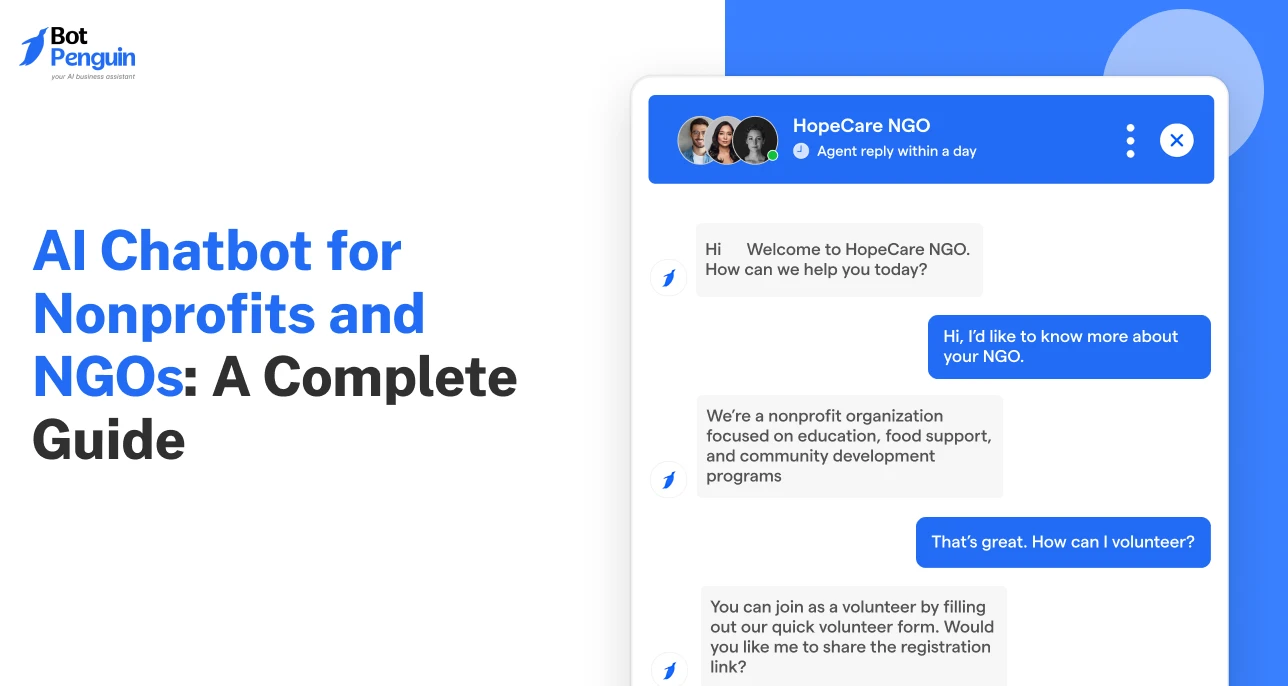
Nonprofits are often the last to get access to powerful technology.
They are expected to manage donors, volunteers, campaigns, and community support with small teams and limited budgets. At the same time, delayed responses and limited staff capacity can reduce impact.
This is where an AI chatbot for nonprofits is changing operations. It can solve queries quickly, automate communication, support beneficiaries, and help organizations stay available 24/7.
In this guide, you’ll learn how chatbots for nonprofits work, their benefits, use cases, templates, features, and how NGOs can use AI chatbots to improve outreach and efficiency.
A chatbot for nonprofits is a rule-based or AI-powered assistant that automates donor communication, volunteer support, beneficiary help, and community outreach across any digital channel.
A great example of this is Clara, the American Red Cross blood donation chatbot, which answers donor questions instantly, helping them with information & appointment management.
Here's a simple breakdown of how an AI chatbot for nonprofits processes every interaction, from the first message to the final resolution.
At this stage, it’s also worthwhile to see which nonprofit areas get covered with chatbot automation.
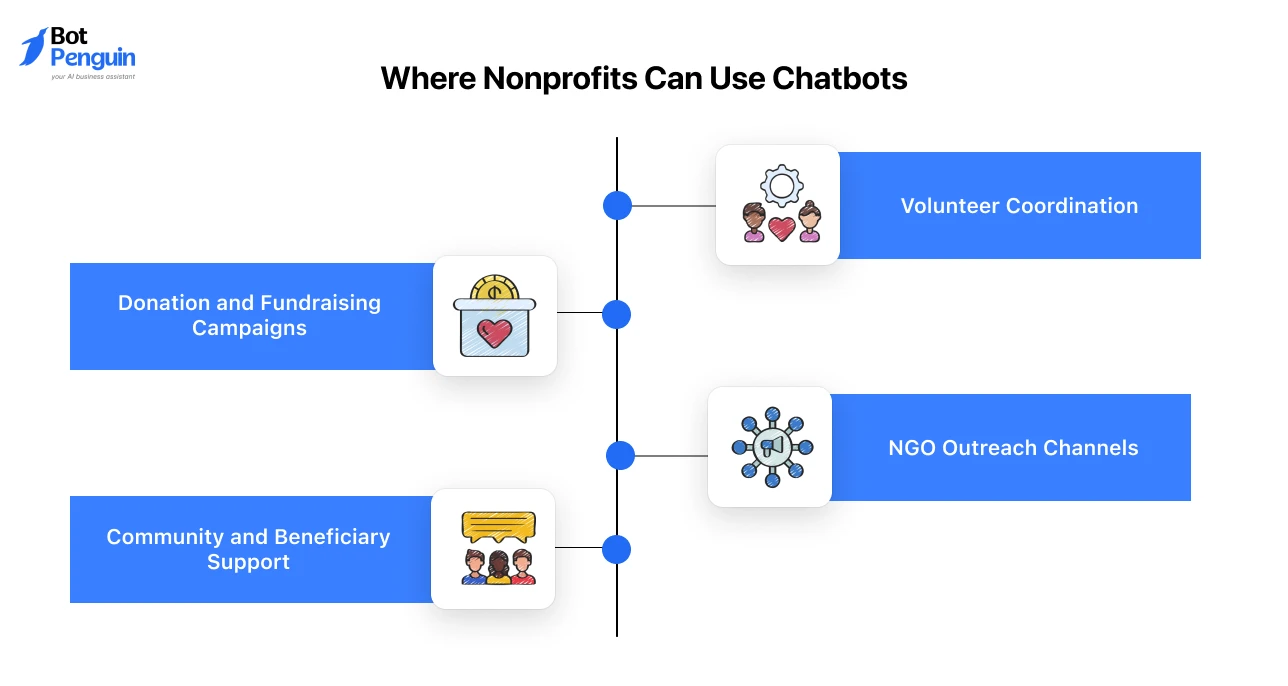
Most nonprofit teams build a chatbot for donors and stop there. But the organizations driving the most impact are using chatbots across every stakeholder, not just one.
Thus, every area where your team repeats the same task manually is an area a chatbot can own. And when those tasks are covered, your people get back to the work that actually moves the mission forward.
Platforms like BotPenguin are built for exactly this kind of multi-stakeholder deployment, supporting donor flows, volunteer coordination, and community outreach from a single no-code interface.
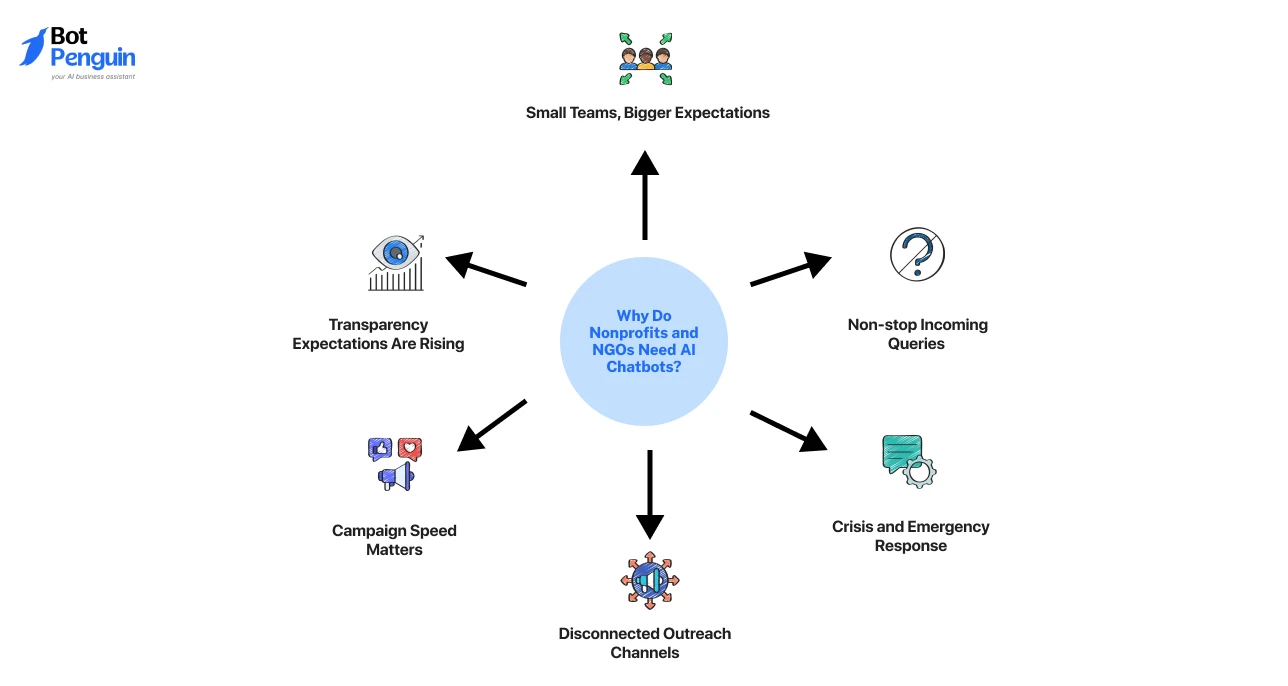
As per a recent survey, 67% of online donors agree that nonprofits should use AI to assist in their marketing, administrative, and fundraising tasks, yet most organizations are still catching up.
Here's why that gap needs to close:
In a sector where every hour counts, automation isn't a luxury; it's a necessity.
Business chatbots are built for convenience. NGO chatbots are built for impact, and that requires an entirely different design philosophy.
NGO chatbots are designed to reach the people most organizations miss: those with limited connectivity, low digital literacy, or urgent needs that can't wait for a staff member to become available.
The true ROI of a nonprofit chatbot isn't in one use case. It's in how many workflows it touches simultaneously, across donors, volunteers, beneficiaries, and communities.
Here’s a quick overview of the real use cases that NGO and nonprofit chatbots are serving today:
Now, let’s look at each of these use cases in detail:
AI chatbots for nonprofits can engage donors during active campaigns, answer recurring funding questions, and keep contribution journeys uninterrupted across channels.
The World Wildlife Fund uses a Facebook Messenger chatbot assistant to decrease response time to donor questions and direct supporters to programs aligned with their giving priorities (Source: CCS Fundraising)
Chatbots help nonprofit teams manage volunteer pipelines efficiently during events, awareness drives, disaster response programs, and recurring community initiatives.
This means automating intake forms, sending shift reminders, confirming attendance, and routing volunteers to the right program coordinators.
Nonprofit organization chatbots can send automated confirmations, live updates, location details, and follow-up reminders before and after events.
Chatbots for NGOs can distribute educational content, explain causes clearly, and keep supporters informed throughout long-term advocacy campaigns.
UNICEF's U-Report chatbot engages young people worldwide on issues like education, health, and human rights, and has amassed over 10 million registered users globally.
AI chatbots for NGOs can simplify access to welfare programs, healthcare information, legal aid resources, and local support services.
Chatbots for community NGOs can improve accessibility by supporting multilingual conversations and low-friction communication across mobile-first audiences.
Easy, no-code chatbot building platforms like BotPenguin help you build non-profit-ready AI chatbots with FAQ and multilingual capabilities.
Organizations can gather real-time community feedback and continuously measure program participation, satisfaction, and campaign engagement levels.
Internal nonprofit teams can use chatbots to access operational guidelines, volunteer information, training resources, and program-related updates faster.
Every one of these use cases represents hours saved, gaps closed, and communities better served, at a fraction of the cost of expanding your team.
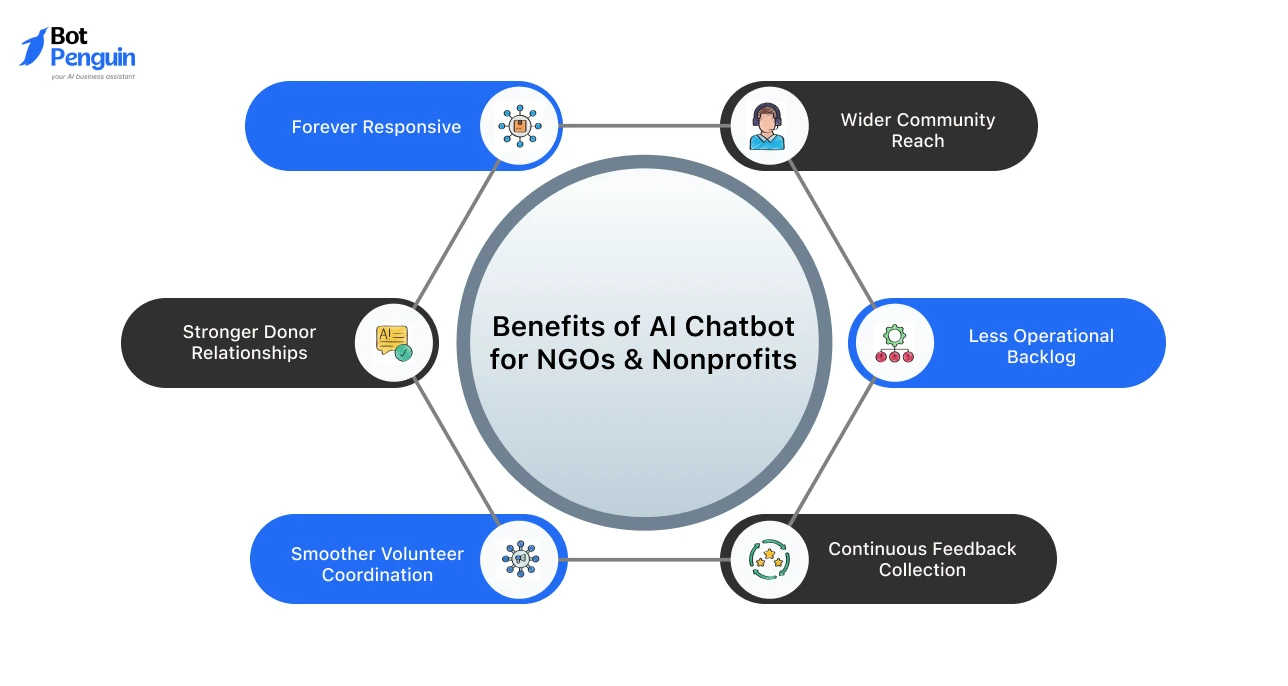
The real benefit of a nonprofit chatbot isn’t automation. It’s what your team can do with the hours, resources, and bandwidth that automation gives back.
AI chatbots for nonprofits ultimately help organizations stay accessible, organized, and scalable while handling growing communication demands.
A donor, a volunteer, and a beneficiary all interact with your organization differently. The right chatbot deployment reflects that. Here's what that looks like in practice:
When each stakeholder feels heard and supported, organizational trust grows. That's the deeper impact of audience-specific chatbot deployment, and it compounds over time.
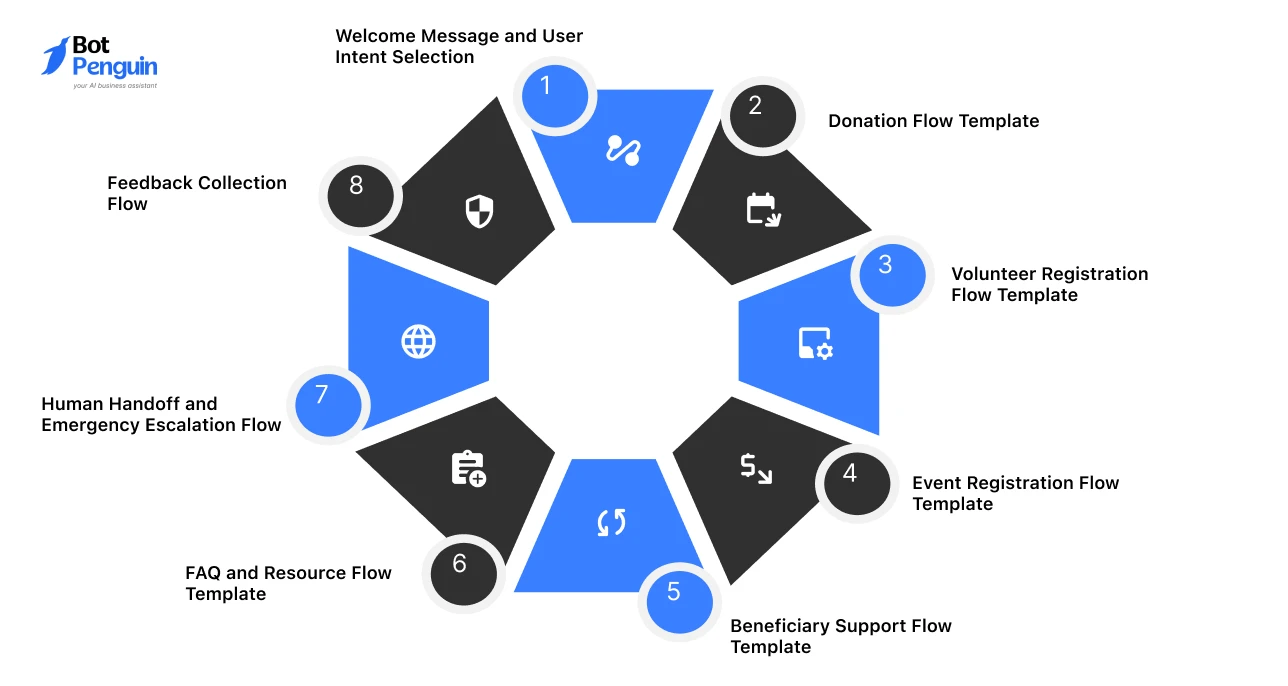
A nonprofit organization chatbot template should guide users quickly while supporting stakeholders across different interaction flows.
The following templates help nonprofits and NGOs structure every key stakeholder interaction:
Start with a clear greeting and simple options based on user intent.
Example: “How can we help you today? Donate, volunteer, attend an event, or get support.”
Guide donors through campaign details, payment steps, recurring donations, and confirmation updates.
Example: “Would you like to make a one-time or monthly contribution?”
Collect volunteer details, interests, availability, and preferred event participation automatically.
Example: “Select the volunteer activity you’d like to join this month.”
Handle registrations, confirmations, reminders, and event-related FAQs.
Example: “Your seat for the fundraising event has been confirmed.”
Help beneficiaries access eligibility details, resources, and assistance programs faster.
Example: “Please choose the support service you need.”
Answer common nonprofit questions and share useful resources instantly.
Example: “Here are our food distribution center timings.”
Transfer urgent or sensitive conversations to nonprofit staff when needed.
Example: “Connecting you with our support coordinator now.”
Collect donor, volunteer, and community feedback after interactions or campaigns.
Example: “How would you rate your experience today?”
These eight flows cover every critical nonprofit stakeholder interaction, so your chatbot always has an answer, and your team never gets buried in requests it shouldn't be handling manually.
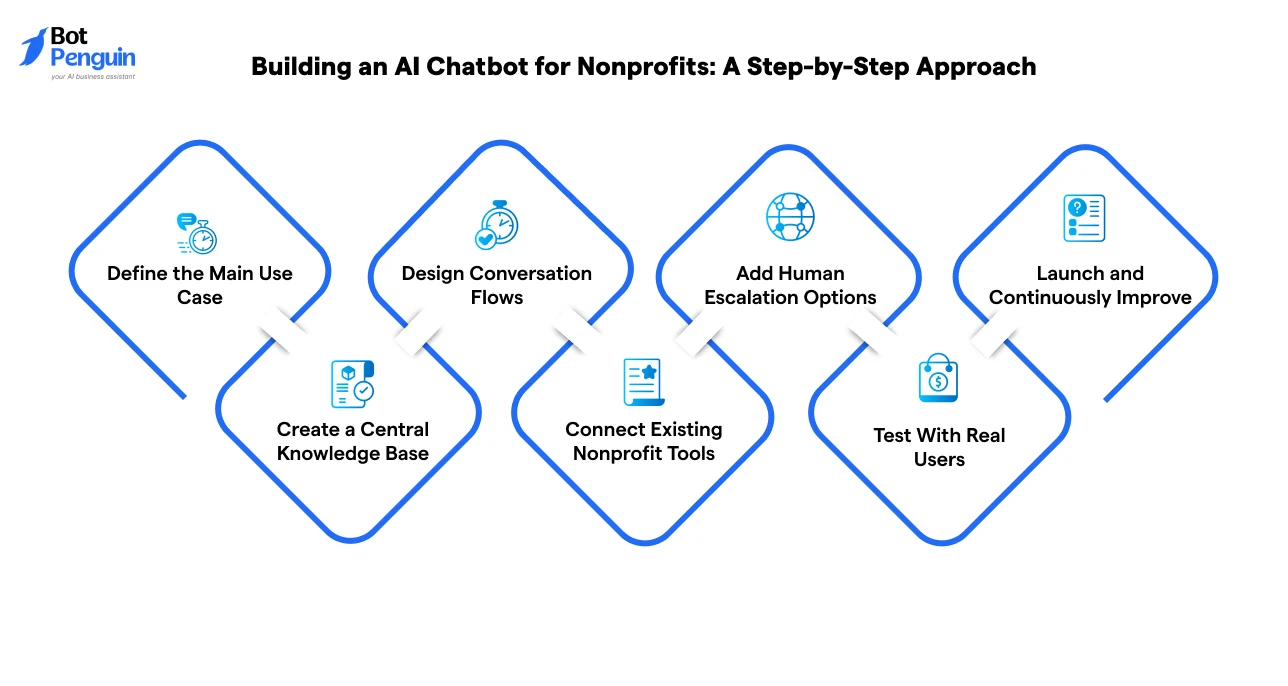
Building a chatbot for nonprofits starts with identifying communication gaps and creating simple workflows that support donors, volunteers, and beneficiaries effectively.
Here’s what that includes:
The setup takes effort upfront. But once deployed, a well-built nonprofit chatbot runs, responds, and improves. That's the operational leverage most small teams have been missing.
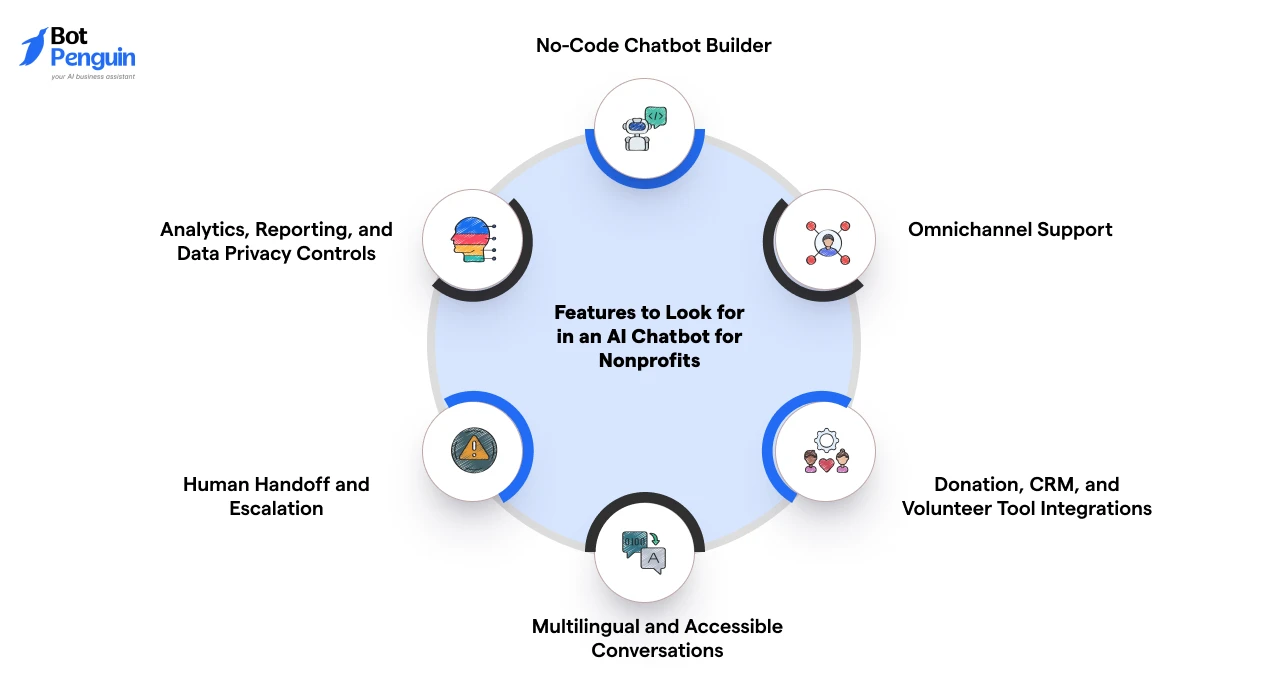
The right platform should support outreach, fundraising, accessibility, and operational coordination together.
These features help you choose a platform that supports nonprofit growth without extra workload:
The right nonprofit chatbot platform doesn't just check feature boxes; it fits the way your organization actually operates, across every audience, channel, and campaign.
No-code chatbot platforms like BotPenguin cover every feature on this list - from omnichannel support to multilingual conversations, purpose-built for teams that need results without the technical overhead.
AI chatbots for nonprofits can improve communication and outreach, but organizations still need the right safeguards and operational planning in place.
Addressing the following challenges early prevents larger operational setbacks later:
Outdated program details or incorrect responses can create confusion.
Nonprofits often handle sensitive personal information like donation records, health status, and contact details.
Too much automation can make interactions feel impersonal and lead to reduced donor trust and disengagement.
Beneficiaries may share urgent or emotional concerns like mental health struggles, financial hardship, or safety issues.
Solution: Chatbots should include escalation workflows that quickly transfer conversations to trained staff members.
Complex chatbot flows can exclude some users, especially low-literacy or low-connectivity community members.
Chatbot data is only useful when teams understand it or know how to act on it.
The risks of deploying a nonprofit chatbot are real, but entirely manageable. With the right safeguards in place, the operational upside far outweighs the challenges.
Handling constant communication with nonprofit stakeholders is difficult, especially with limited staff and growing outreach demands.
AI chatbots help NGOs and nonprofits stay responsive across websites, WhatsApp, SMS, and other channels. They can answer questions, guide donations, support volunteers, share resources, and collect feedback.
But good chatbots for nonprofits are not just automated tools. They need clear workflows, accurate information, accessible communication, and human support when conversations become sensitive.
Used correctly, a chatbot for nonprofits can strengthen outreach, improve engagement, and help organizations focus more time on real impact.
A chatbot for nonprofits is an AI-powered tool that automates donor communication, volunteer support, beneficiary assistance, FAQs, and community outreach across digital channels.
Nonprofits use AI chatbots for donations, volunteer registration, event reminders, beneficiary guidance, campaign awareness, surveys, and multilingual community support.
Yes. Many AI chatbot platforms offer no-code tools, making them accessible for small nonprofits and NGOs with limited technical resources or staff.
AI chatbots for nonprofits can work across websites, WhatsApp, Facebook Messenger, SMS, mobile apps, and other digital communication channels.
Yes, if the platform includes secure data storage, consent management, privacy controls, and human escalation for sensitive beneficiary or donor conversations.
Chatbots for NGOs help improve response speed, donor engagement, volunteer coordination, community outreach, accessibility, and operational efficiency without expanding teams.
Yes. Many nonprofits use WhatsApp chatbots for donor communication, volunteer coordination, beneficiary support, campaign updates, and multilingual community outreach.
Subscribe to Our Newsletter
Get the latest business insights straight into your inbox.
Checkout our related blogs you will love.
Updated at Oct 19, 2026
11 min to read
Updated at Oct 14, 2026
11 min to read
Updated at Oct 14, 2026
10 min to read
Updated at Oct 14, 2026
10 min to read
Updated at Oct 13, 2026
11 min to read
Updated at Oct 9, 2026
10 min to read
Table of Contents

