





Best Chatbots for Education for Schools, Colleges, and Online Learning Platforms
Updated at Oct 9, 2026
12 min to read
An AI chatbot for education is a conversational AI system that helps students, educators, and institutions get information or complete routine tasks through natural-language chat. It can support tutoring, course navigation, admissions, reminders, FAQs, and administrative queries across websites, learning platforms, and messaging channels, with human escalation when needed.
Students are already learning from machines. What’s missing is structure.
From homework help to late-night doubts, AI tools are becoming the first place students turn to for answers.
Institutions are noticing this shift. They are now exploring ways to guide, control, and improve these interactions instead of ignoring them.
In this guide, we break down what AI chatbots for education are, how they work in education, where they add value, and what institutions need to consider before adopting them.
Unlike a basic scripted chatbot, an AI chatbot can interpret natural-language questions, use context, retrieve information from approved knowledge sources, and generate relevant responses.
Educational institutions can connect these chatbots to websites, learning management systems, student portals, knowledge bases, and messaging channels. Depending on the use case, they can support learning, answer student questions, assist with admissions, surface course information, or route complex issues to staff.
Example: A first-year student, unsure about credit transfer rules, messages the university portal at 11 PM. The AI chatbot instantly pulls up the exact policy, confirms eligibility, and directs them to the right form.
A rule-based bot can’t handle a question like “Can I defer my semester due to a medical emergency?” An AI chatbot can; it understands context, not just keywords.
Here’s how to visualize that difference in practice:
So while a traditional chatbot sticks to a script, the AI-powered chatbot for education adapts. Next, we’ll look at how these chatbots are supporting education stakeholders.
Educational chatbots aren’t just student-facing tools. They support the entire institution. These chatbots:
AI chatbots are thus moving beyond basic automation to become a core part of modern education delivery.
If you’re exploring what an AI chatbot could look like for your institution, BotPenguin offers a purpose-built education chatbot designed to handle real institutional needs from day one.
AI chatbots in education follow a structured process to understand queries, retrieve information, and deliver accurate responses in real time.
Here’s what that entails:
Step 1: Understand the Query
The chatbot receives a student or staff question and uses natural language processing to identify the user’s intent and context.
Step 2: Retrieve Relevant Information
It searches approved knowledge sources such as FAQs, policies, course details, schedules, or academic content.
Step 3: Connect With Institutional Systems
Where integrated, the chatbot can retrieve relevant information from LMS platforms, student portals, CRMs, or other approved systems.
Step 4: Generate a Response or Escalate
The chatbot answers the query when it has sufficient information. Complex, sensitive, or unresolved questions are routed to a human.
Step 5: Monitor and Improve
Interaction data helps institutions identify unanswered questions, knowledge gaps, and workflows that need improvement.
Process Flow of an AI-Powered Educational Chatbot: User query → intent detection → data retrieval → response generation → escalation (if needed) → continuous learning
Today, AI chatbots for education support every stage of the student journey, from the first admissions query to post-graduation alumni engagement.
Here are the most impactful use cases institutions are already deploying:
Each of these use cases of educational chatbots has been explained hereunder:
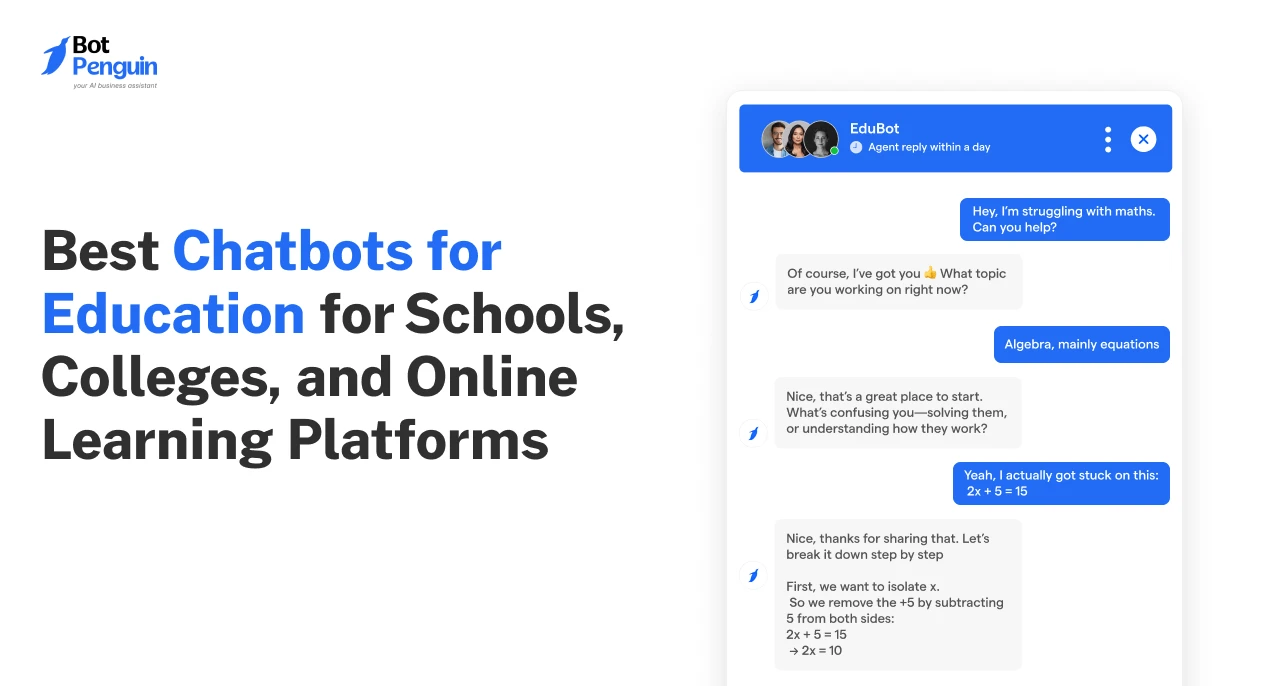
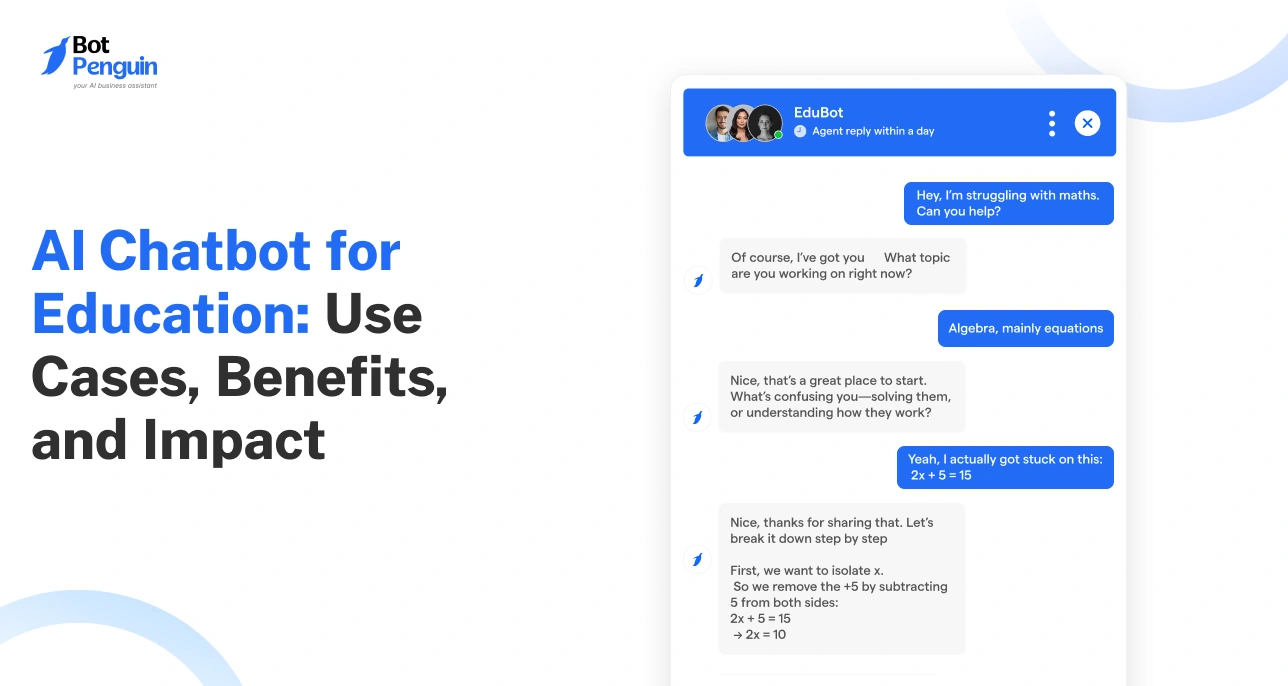
AI chatbots act like on-demand tutors. For example, a student struggling with algebra can ask for step-by-step explanations or simpler examples until the concept is clear.
Socratic by Google is a prominent educational chatbot that helps students understand concepts across subjects, breaking down problems step-by-step through conversational, AI-powered guidance.
Students can upload or type questions and get guided solutions.
For instance, a chatbot can explain a physics problem or help structure an essay instead of just giving the answer.
Chatbots help students find lecture notes, deadlines, or recorded classes.
This is particularly helpful for students who are new to the platform, juggling multiple courses, or returning after a break and need to quickly get back on track.
They send alerts for upcoming exams, submission deadlines, or events.
Think: Reminding a student to submit an assignment before the deadline helps save last-minute panic, grade penalties, and unnecessary back-and-forth with faculty.
Prospective students can ask about eligibility, required documents, or deadlines. A chatbot can guide them step-by-step through the application process.
Chatbots answer common questions like fee breakdowns, payment deadlines, or scholarship criteria without requiring admin support.
Students can check grades, get feedback summaries, or understand performance trends after exams or assignments.
Prominent examples like Gradescope’s AI assistant, which helps students understand where they lost marks and what to improve, turning raw scores into actionable feedback.
Educators can use chatbots to generate lesson outlines, quiz questions, or examples for class topics quickly.
If a student expresses stress or confusion, the chatbot can guide them to counselors or support teams based on the issue.
This is especially critical during exam season or major life transitions, where timely routing to the right support can make a meaningful difference in student wellbeing.
The Istanbul Ticaret University BotPenguin chatbot case study shows how educational institutions can automate student queries →
AI-powered chatbots for higher education institutions handle complex workflows like course registration, credit requirements, research queries, and campus services across departments.
Ivy & Ocelot from Gravyty is a higher-education student engagement platform used for areas such as admissions, enrollment, financial aid, campus services, and student support.
Institutions can use chatbots to share updates, event invites, or donation campaigns with alumni, keeping them engaged long-term.
While these use cases clarify the picture, the real impact becomes clear when you look at the measurable benefits AI chatbots are delivering to institutions that have already made the shift.
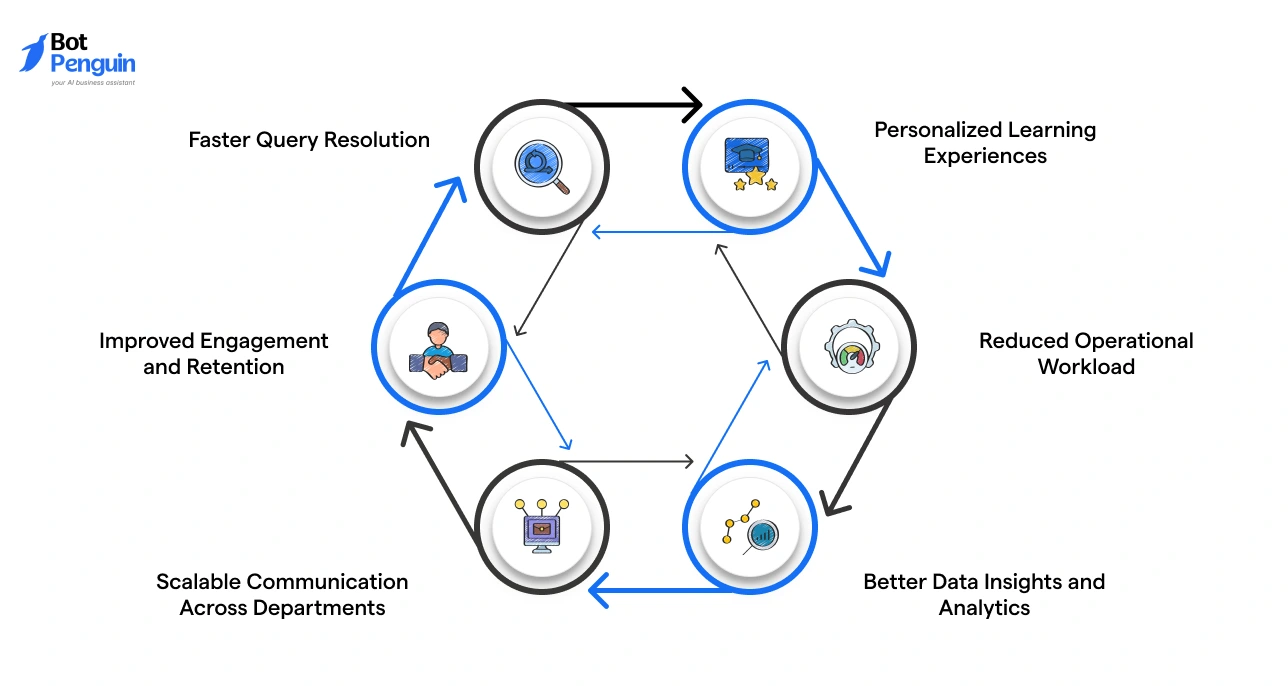
The advantages of AI chatbots in education go far beyond convenience.
From slashing response times to surfacing actionable student data, here’s the real impact institutions are seeing on the ground:
Real deployments provide a clearer picture of what education chatbots can achieve when they are trained on institutional information and tied to specific student workflows.
These results are institution-specific rather than universal benchmarks. Outcomes depend on the chatbot’s use case, knowledge quality, integrations, traffic, and implementation.
Together, these benefits don’t just improve day-to-day operations. They shift how institutions think about student support, communication, and learning at scale.
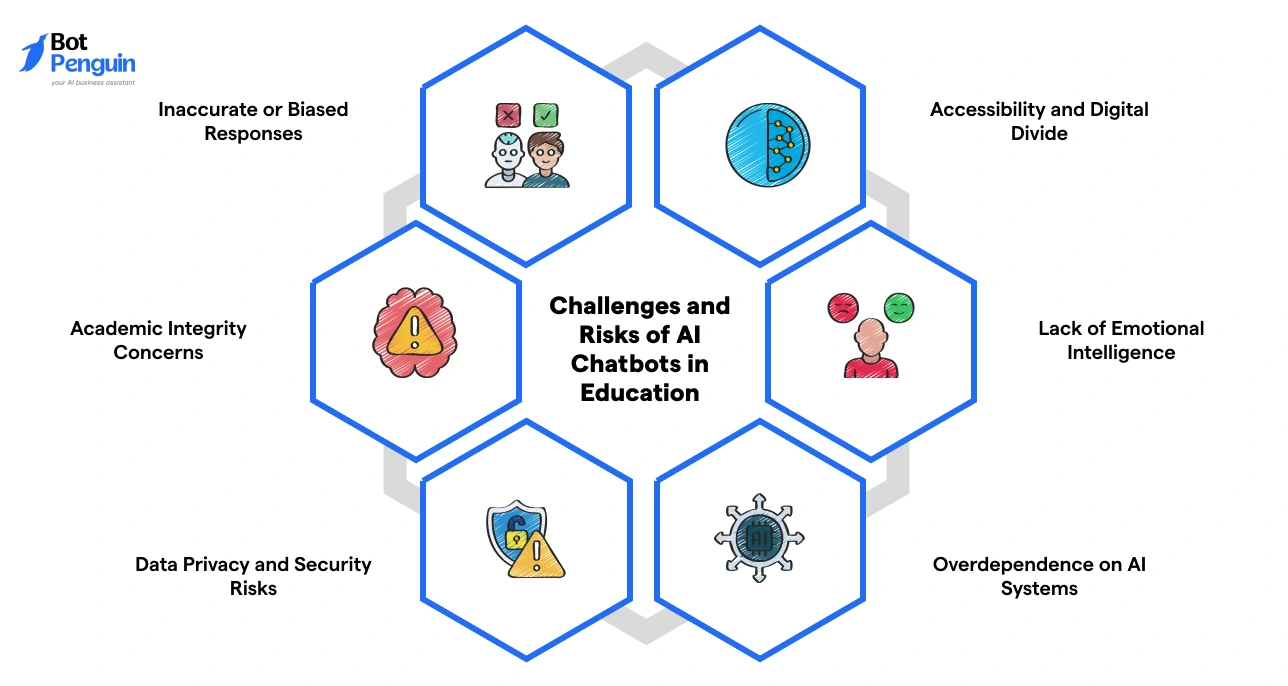
No technology is perfect, and AI chatbots are no exception.
The institutions that benefit most are the ones that go in with eyes open, aware of the risks and equipped with the right safeguards.
Here are some notable challenges that may occur for AI chatbots in education:
Chatbots can sometimes provide incorrect, outdated, or biased answers, especially if trained on incomplete or skewed data sources.
Students may misuse chatbots to generate direct answers for assignments, which can impact learning outcomes and assessment integrity.
Set clear usage guidelines, use an AI detector for teachers when reviewing written submissions, and design chatbots to guide problem-solving instead of simply providing final answers.
Handling student data raises concerns around privacy breaches, misuse of information, and compliance with data protection regulations.
Excessive reliance on chatbots may reduce independent thinking, problem-solving skills, and meaningful human interaction over time.
Chatbots may struggle to understand context in emotionally sensitive situations or provide appropriate support for student well-being concerns.
Not all students have reliable access to devices, internet connectivity, or digital tools required to use chatbot systems effectively.
All these challenges are manageable. With the right guardrails, governance, and human oversight in place, institutions can deploy AI chatbots confidently and reap the benefits without the risks.
Awareness is the first step. The next is knowing exactly how to deploy AI chatbots safely, which is what the next section covers in detail.
Using AI chatbots in education requires clear guardrails. A structured approach helps institutions reduce risks while ensuring reliable and responsible usage.
Here’s what to consider when using an AI-powered educational chatbot:
A well-governed chatbot system not only reduces risks but also strengthens trust, making it more effective for long-term educational use.
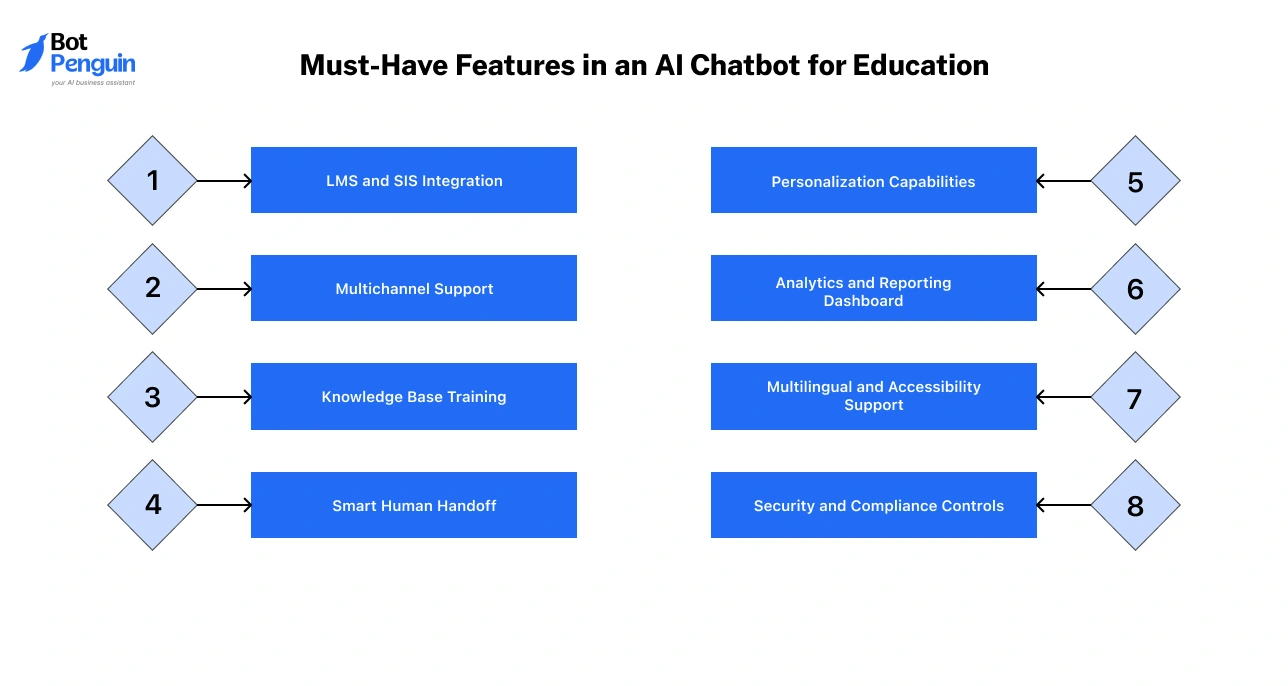
Choosing the wrong chatbot can mean broken integrations, frustrated students, and compliance headaches.
These are the non-negotiable features every educational chatbot must have before you deploy:
These chatbot features aren't nice-to-haves; they're the baseline. Any educational chatbot missing one or more of these will struggle to deliver consistent, trustworthy results at scale.
Different institutional needs in the education sector have given rise to different chatbot types, each solving a distinct problem across the student journey.
The table below shows the key chatbot categories currently deployed across educational institutions, along with verified real-world examples:
These examples represent just a fraction of what’s being deployed across institutions today. Each of these chatbots is purpose-built, designed around a specific user need rather than a generic, plug-and-play tool.
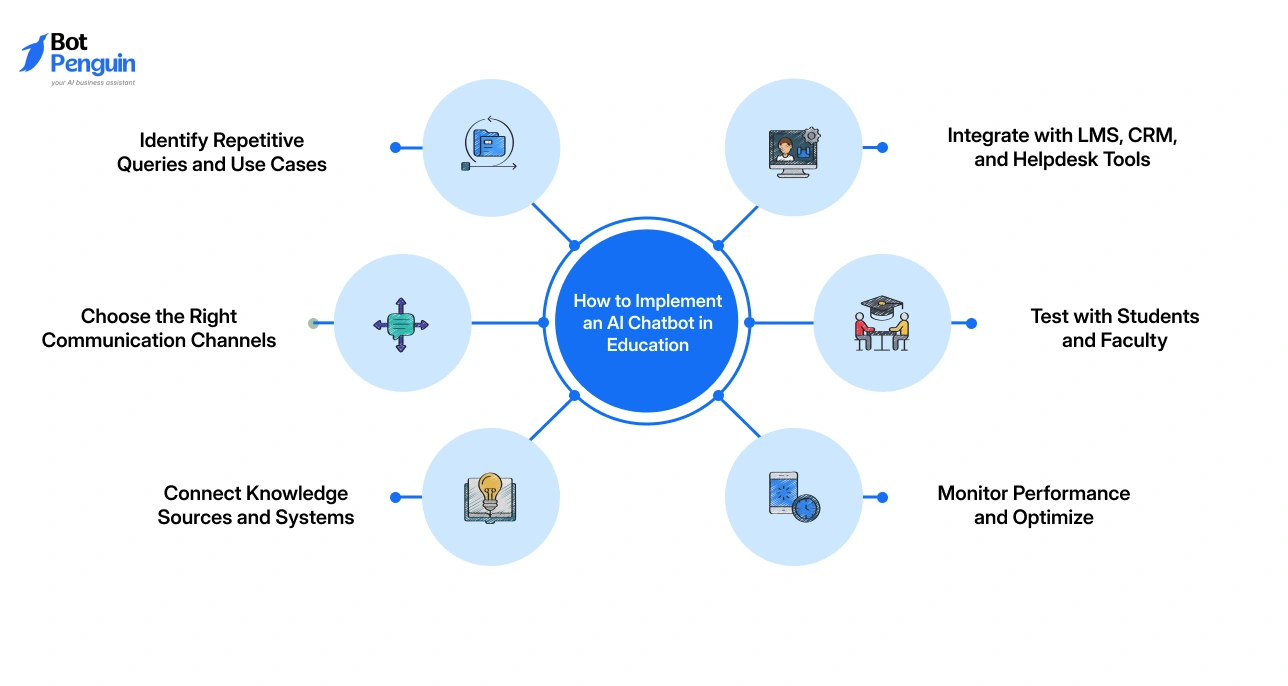
A clear, step-by-step approach helps institutions deploy chatbots effectively without unnecessary complexity.
Here’s a step-by-step process of how to implement AI chatbots for the education industry:
A structured rollout ensures smoother adoption, better accuracy, and long-term effectiveness.
At this stage, it’s also worthwhile to see how your chatbot is actually performing once it goes live, and which numbers to pay attention to.
Deploying AI-powered educational chatbots is only half the work. Tracking the right metrics tells you whether it’s actually delivering value or just adding noise.
These metrics should be evaluated against the institution’s own baseline rather than treated as universal benchmarks. A chatbot used for admissions may have very different resolution and escalation patterns from one used for tutoring, campus services, or student wellbeing.
If tracking these metrics feels overwhelming, BotPenguin simplifies it, giving your team a single dashboard to monitor performance, spot gaps, and improve continuously.
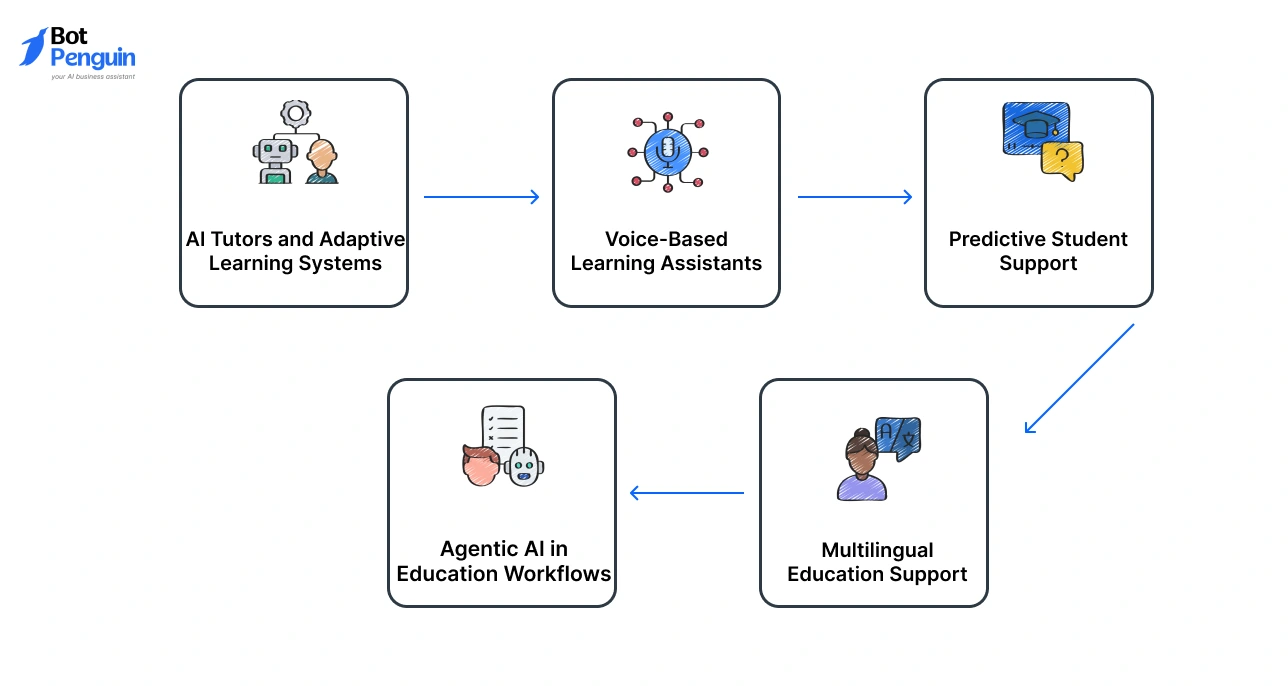
AI chatbots in education are evolving rapidly, moving beyond support tools to become active participants in the learning experience.
Here’s how the future trends are reshaping what AI chatbots will look like in classrooms and campuses:
AI chatbots are evolving into intelligent tutors that adapt to each student’s pace and learning style. They will offer personalized explanations, track progress, and adjust difficulty levels in real time.
Voice-enabled chatbots will make learning more interactive and accessible. Students will be able to ask questions, get explanations, and navigate content using simple voice commands.
Chatbots will use data to identify at-risk students early. They can flag low engagement, missed deadlines, or poor performance and trigger timely interventions.
Future chatbots will support multiple languages seamlessly, helping institutions reach diverse student groups and improve accessibility across regions.
AI chatbots will act more independently, managing tasks like scheduling, follow-ups, and academic workflows with minimal human input, improving overall efficiency.
These trends show that while the chatbot of today handles queries, the chatbot of tomorrow shapes outcomes.
AI chatbots are quickly becoming a core part of modern education. They help students get instant support, simplify daily tasks, and improve how institutions communicate at scale.
But they are not a complete solution on their own. Success depends on how well they are implemented, monitored, and used alongside human support.
For institutions, the focus should be clear: start small, solve real problems, and build from there.
With the right approach, an AI chatbot for education can improve learning experiences, reduce workload, and create a more responsive and accessible system.
For institutions evaluating a deployable platform for admissions and student support, see BotPenguin’s education chatbot solution.
An AI chatbot for education is a conversational AI system that understands natural-language questions and helps students, educators, or institutions with learning and administrative tasks. Common uses include tutoring, course navigation, admissions support, FAQs, reminders, and student services across websites, learning platforms, and messaging channels.
AI chatbots are used for tutoring, answering student queries, managing admissions, sending reminders, and supporting administrative tasks across learning platforms and communication channels.
A higher education chatbot supports universities by handling admissions, course queries, campus services, and student support across departments, improving efficiency and response time.
No, AI chatbots cannot replace teachers. They assist with support and repetitive tasks, while educators handle teaching, guidance, and complex student interactions.
AI chatbots are safe when built with proper data protection, access controls, and usage policies. Institutions must ensure privacy, security, and responsible AI implementation.
Yes, AI chatbots can integrate with LMS platforms to provide course updates, assignment reminders, grades, and personalized academic support directly within the learning environment.
AI chatbots improve response time, personalize learning, reduce workload, increase engagement, and provide data insights, helping institutions deliver better student experiences at scale.
Enhance Student Support With AI Chatbots
Handle queries, learning support, admissions, and reminders in one place. Reduce response time, ease workload, and improve student experience with AI-powered automation
Explore Now!Checkout our related blogs you will love.
Updated at Oct 9, 2026
12 min to read
Updated at Sep 25, 2026
11 min to read
Updated at Sep 25, 2026
11 min to read
Updated at Oct 9, 2026
10 min to read
Updated at Oct 7, 2026
12 min to read
Updated at Oct 7, 2026
13 min to read
Table of Contents