How to Add a WhatsApp Link to Your Instagram Profile
Updated at Oct 8, 2026
14 min to read
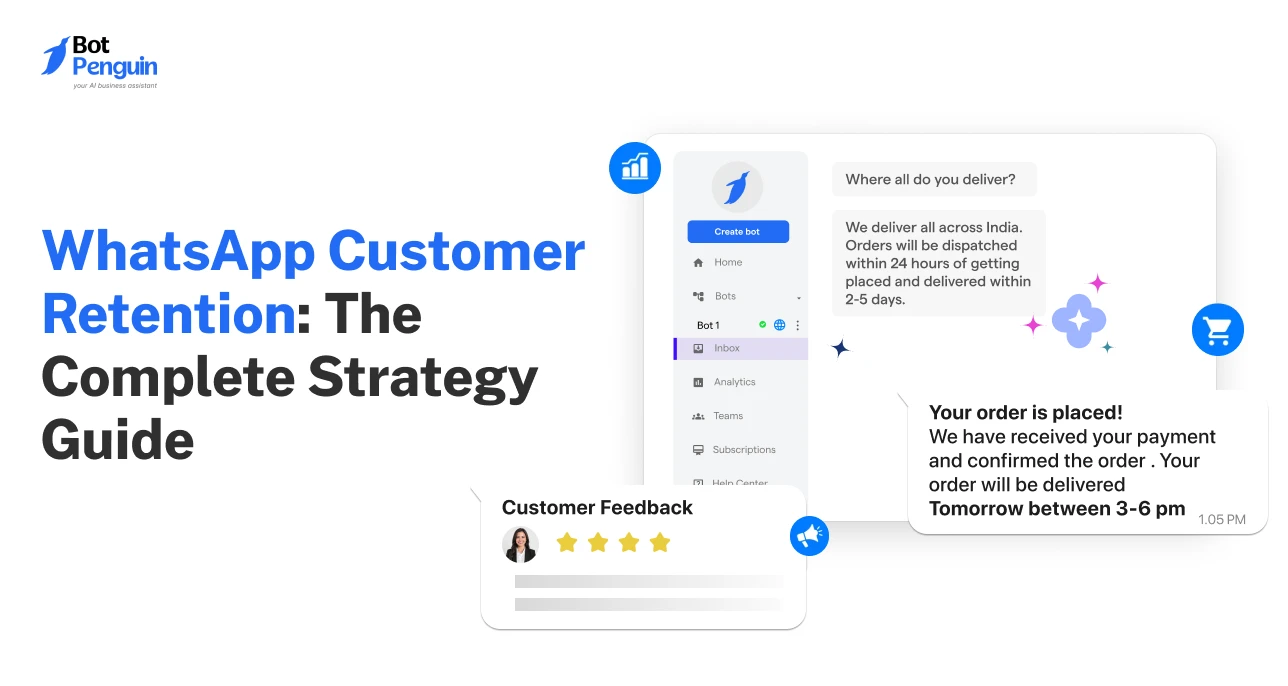
Customer retention depends on what happens after the first purchase.
Follow-ups, support, delivery updates, personalized offers, and timely engagement decide whether a customer comes back or forgets your brand. Most businesses lose customers because they stop showing up after the sale.
This is where WhatsApp becomes a powerful retention channel. Customers already use it to ask questions, track orders, respond to updates, and connect with businesses in real time.
Unlike email or generic ads, WhatsApp keeps communication direct, fast, and personal.
This guide explains the top strategies for WhatsApp customer retention, how to measure WhatsApp retention rate, run proactive flows, track KPIs, and avoid mistakes that hurt customer loyalty.
WhatsApp customer retention is the process of keeping existing customers engaged, active, and connected with your business through WhatsApp. It includes support follow-ups, reorder reminders, feedback requests, product updates, personalized offers, and post-purchase conversations.
Customer retention on WhatsApp matters because most repeat purchases happen after the first sale. If a brand stays helpful, visible, and relevant, customers are more likely to return. If communication stops, customers may switch to another brand.
A strong WhatsApp retention strategy can help businesses:
Well, that clears the air around what WhatsApp user retention is. Now, let’s see the best approach towards it.
WhatsApp retention strategies work best when support, post-purchase updates, offers, loyalty, feedback, and community engagement flow from a single, connected customer journey.
The table below breaks it down further:
Let’s now look at each of these strategies in detail:
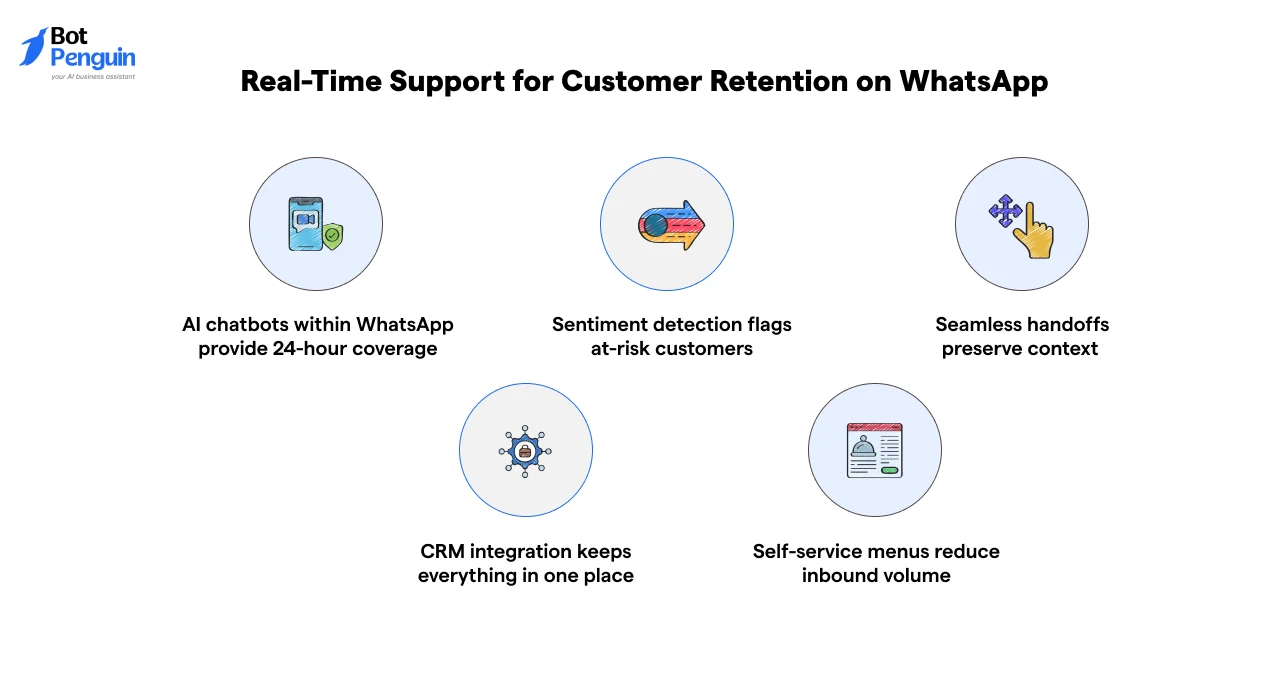
Poor support causes churn. WhatsApp customer retention improves when customers get fast answers without calls, queues, or repeated explanations.
WhatsApp works better than traditional support because:
Real-world Application: Mercedes-Benz Türk launched a WhatsApp communication line for truck and bus customers, including chatbot-supported help for sales, after-sales, and second-hand queries.
Platforms like BotPenguin help businesses build this support layer without coding. BotPenguin offers an AI-powered WhatsApp chatbot with live chat, approved templates, CRM integration, unified inbox, broadcast campaigns, and 24/7 FAQ handling for WhatsApp support and automation.
This makes it useful for brands that want to combine AI responses, human handover, customer history, and retention workflows within a single WhatsApp system.
The highest impact retention window starts immediately after purchase. Most brands lose trust when they go silent after payment.
Build a post-purchase WhatsApp flow like this:
Customers expect proactive delivery communication. Abandoned cart recovery should also run through WhatsApp. Send the first reminder within 1 hour of abandonment.
Keep the message helpful, not pushy:
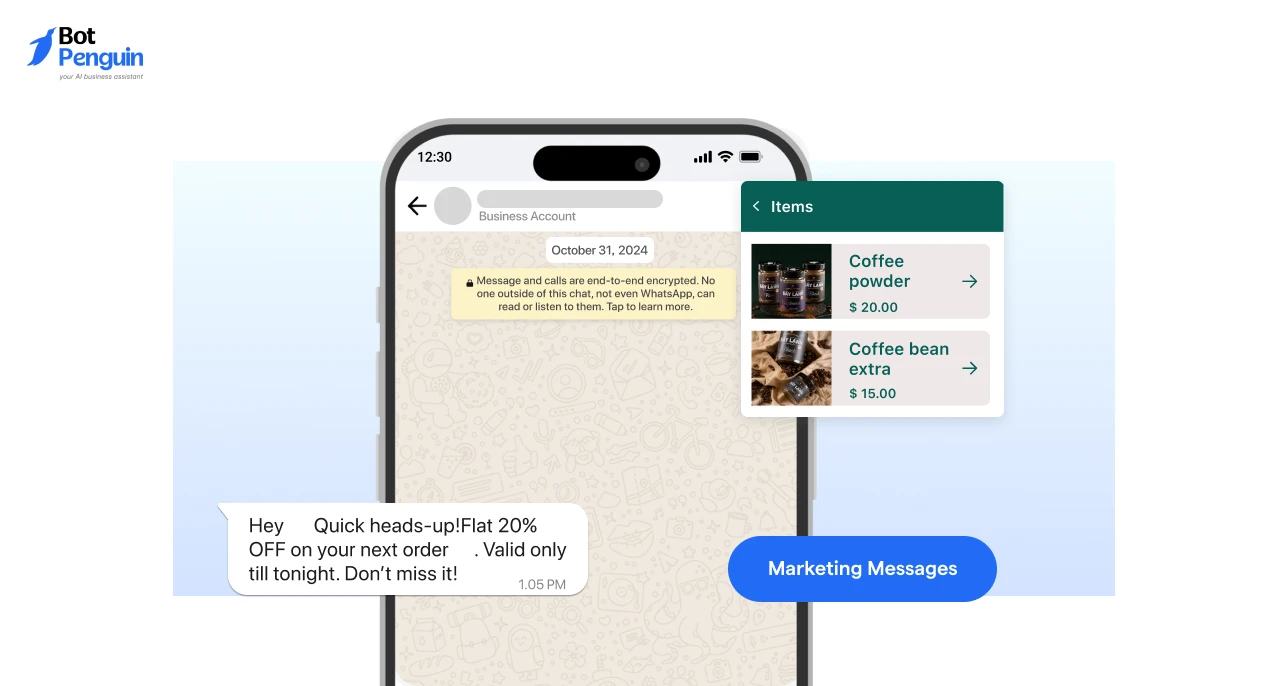
WhatsApp retention marketing works because messages land in a private space. Unlike social feeds, there is no competing content.
Therefore, it’s important that you use WhatsApp for high-intent offers, not generic discounts.
Strong retention offers include:
Members-only broadcast lists work well here. They create exclusivity without the noise of group chats.
At the same time, personalization matters more than frequency. Segment customers by purchase history, browsing behavior, location, cart activity, and loyalty tier.
Also, avoid sending the same promotion to every contact. Irrelevant offers train customers to mute, ignore, or opt out.
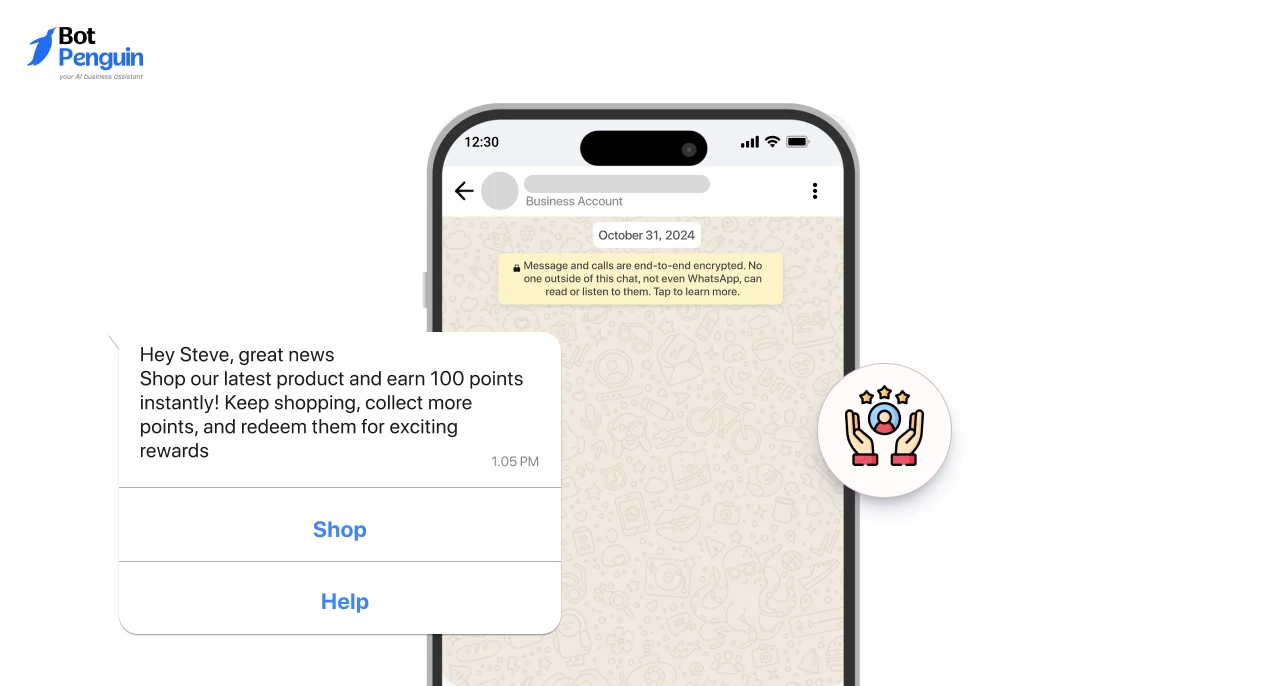
Loyalty programs become stronger when rewards are visible in everyday customer conversations.
Use WhatsApp as the delivery layer for loyalty actions:
WhatsApp also supports lightweight gamification. Use quizzes, polls, challenges, and interactive messages to keep members engaged between purchases. This is especially useful for the non-purchasing leads.
This turns retention from a discount-only strategy into an ongoing engagement loop.
Community helps customers feel connected beyond the product. That emotional connection can reduce churn and increase word of mouth.
Use WhatsApp Groups for two-way dialogue. Use Broadcast Lists when you want one-to-many updates without group chat clutter.
Here’s what that looks like in practice:
Share content that gives customers a reason to stay:
The key rule is simple. Value must be higher than promotion. If every message sells, customers leave. If every message helps, customers stay.
WhatsApp is useful for feedback because customers already use it for quick replies. In fact, studies have found that 56% of online shoppers prefer staying in touch with brands via WhatsApp.
Use WhatsApp native feedback methods:
Do not force customers to open long external forms. Keep the feedback action inside WhatsApp wherever possible.
Connect feedback with review platforms such as Judge.me or Loox. Positive reviews can support social proof, while negative feedback can trigger recovery workflows.
A simple recovery flow can include:
These strategies only work when the right message reaches the right customer. That starts with segmentation, which we'll learn in the next section.
Generic broadcasts drive opt-outs. Segmentation keeps messaging relevant and lists healthy.
Here are the four core segments you should focus on for greater WhatsApp retention:
Knowing which segment a customer belongs to is only half the work. The other half is knowing what signal to act on.
Note: Retention lift from personalization is 10-20% across industries (McKinsey). On WhatsApp, which is an inherently personal channel, the impact is amplified.
That means, something like “Hey Priya, your favorite shade just restocked.” outperforms the generic “We have new arrivals”.
You can use AI in WhatsApp chat flows to enable real-time personalization by analyzing conversation history, purchase signals, and engagement patterns, moving beyond segment-level targeting to individual-moment relevance.
Tracking open rates alone is not enough. A WhatsApp retention marketing program should connect message engagement with business outcomes such as repeat purchases, customer lifetime value, reduced churn, and increased satisfaction. This is where WhatsApp Retention Rate becomes important.
WhatsApp Retention Rate measures how many customers remain active and engaged, or purchase again, on WhatsApp over a specific period.
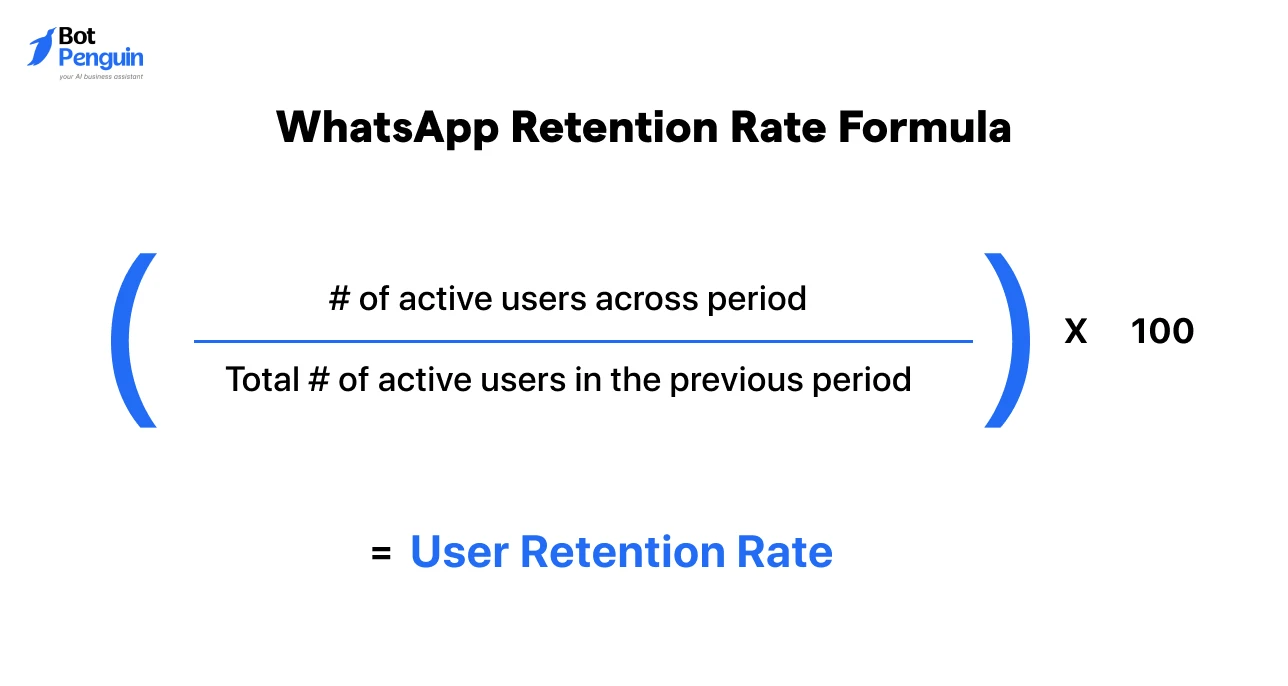
WhatsApp Retention Rate is calculated by measuring how many existing customers stayed active during a specific period.
WhatsApp Customer Retention Rate = [(E – N) ÷ S] × 100
Where E is end-period customers, N is new customers acquired, and S is start-period customers.
For example, if you started with 100 customers and 70 stayed engaged, purchased again, or interacted by month-end, your retention rate is 70%.
This shows how many existing customers were retained during that period.
Besides the above, core WhatsApp retention metrics show whether your messages are driving engagement, loyalty, and repeat revenue.
Use these numbers as reference points, not fixed guarantees. Results can change based on industry, list quality, message timing, segmentation, offer relevance, and campaign type.
Note: The above numbers are an aggregate of the actual research done by different BSPs and VSPs of WhatsApp.
These metrics should be reviewed together. For example, high open rates with low repeat purchases may mean your WhatsApp retention marketing is visible but not persuasive.
If performance is below benchmark, review your opt-ins, customer segments, message timing, CTA clarity, offer relevance, and follow-up flow.
A/B testing helps improve WhatsApp retention campaigns by showing which message version performs better.
Businesses can test message timing, CTA text, offer type, template format, follow-up delay, campaign frequency, and personalization level.
Test one variable at a time. This keeps results clear and helps improve future WhatsApp retention strategies.
All of these strategies depend on how intelligently your WhatsApp operates at scale, and that is where AI chatbots come in.
WhatsApp AI chatbots and agents help businesses scale customer retention on WhatsApp without managing every conversation manually.
WhatsApp chatbots handle repeatable tasks. AI agents manage more flexible conversations that need context and decision-making.
Together, they help businesses automate WhatsApp retention strategies while keeping human agents available for complex cases.
In short, automation can improve retention, but poor execution still damages trust when consent, relevance, cadence, and response quality are ignored repeatedly.
If you want to dive deeper into understanding the workings of a WhatsApp Chatbot, check our full guide on What Is a WhatsApp Chatbot & How It Works.
Strategy helps. Execution matters. But there is a whole category of retention damage that comes from what you do wrong rather than what you fail to do.
These mistakes are common, preventable, and costly.
Points to Note
With the common challenges clear, the next step is understanding how a platform like BotPenguin is purpose-built for compliant, segmented, and automated WhatsApp customer retention workflows.
BotPenguin is a no-code WhatsApp AI chatbot platform with a dedicated WhatsApp module, covering everything from WhatsApp AI agents and broadcast campaigns to in-chat payments and catalog management.
It connects directly to the WhatsApp Business API and slots into your existing stack without developer overhead.
Every WhatsApp retention flow, be it post-purchase, win-back, loyalty, or support, can be built, deployed, and measured inside BotPenguin without writing a line of code. The bot feeds data into the CRMs and e-commerce platforms your team already uses, so retention gets smarter over time.
In essence, WhatsApp is a customer relationship management channel. It has multiple proven ways to nurture customers in the post-purchase stage.
A typical WhatsApp customer retention flow looks like this: segment your audience by behavior and lifecycle stage, support customers in real time with bots and human agents, run proactive messaging flows at every key moment, build loyalty mechanics that create belonging, measure what matters, and iterate.
However, customer retention on WhatsApp cannot be scaled without Business API automation. To get started, a WhatsApp chatbot platform like BotPenguin helps you automate customer conversations end-to-end. You can utilize broadcast and drip campaigns, industry-specific chat flows, Agentic AI, live chat, CRM integrations, and WhatsApp retention flows in one place.
WhatsApp customer retention is using WhatsApp messaging to retain customers through post-purchase communication, personalized offers, loyalty programs, real-time support, and automated messaging flows that strengthen long-term relationships.
WhatsApp improves customer retention by keeping communication fast, personal, and proactive. Businesses can use it to send order updates, answer support questions, share personalized offers, collect feedback, run loyalty campaigns, and re-engage inactive customers before they churn.
WhatsApp retention marketing is consent-based, personalized, and lifecycle-driven using segmentation and automation. Bulk messaging sends generic broadcasts, resulting in lower engagement and weaker long-term customer relationships.
The WhatsApp Business App works for small volumes. For scalable customer retention with automation, segmentation, CRM integration, analytics, and campaigns, the WhatsApp Business API is required.
Measure WhatsApp retention rate using [(E – N) / S] × 100. Track open rate, CTR, replies, opt-outs, repeat purchases, and compare with non-WhatsApp cohorts.
Send two to four WhatsApp messages weekly for active users. For re-engagement, start with one. Transactional updates are flexible. Relevance and personalization matter more than frequency.
Boost Customer Retention with WhatsApp Automation
Engage customers with timely updates, personalized messages, and proactive follow-ups on WhatsApp. Reduce churn, increase repeat purchases, and build long-term relationships with automated retention workflows.
Get Started NowCheckout our related blogs you will love.
Updated at Oct 8, 2026
14 min to read
Updated at Oct 7, 2026
12 min to read
Updated at Oct 6, 2026
13 min to read
Updated at Oct 6, 2026
10 min to read
Updated at Oct 5, 2026
11 min to read
Updated at Oct 1, 2026
9 min to read
Table of Contents