
WhatsApp Chatbot for Ecommerce: Use Cases, Examples, and Setup
Updated at Oct 7, 2026
12 min to read
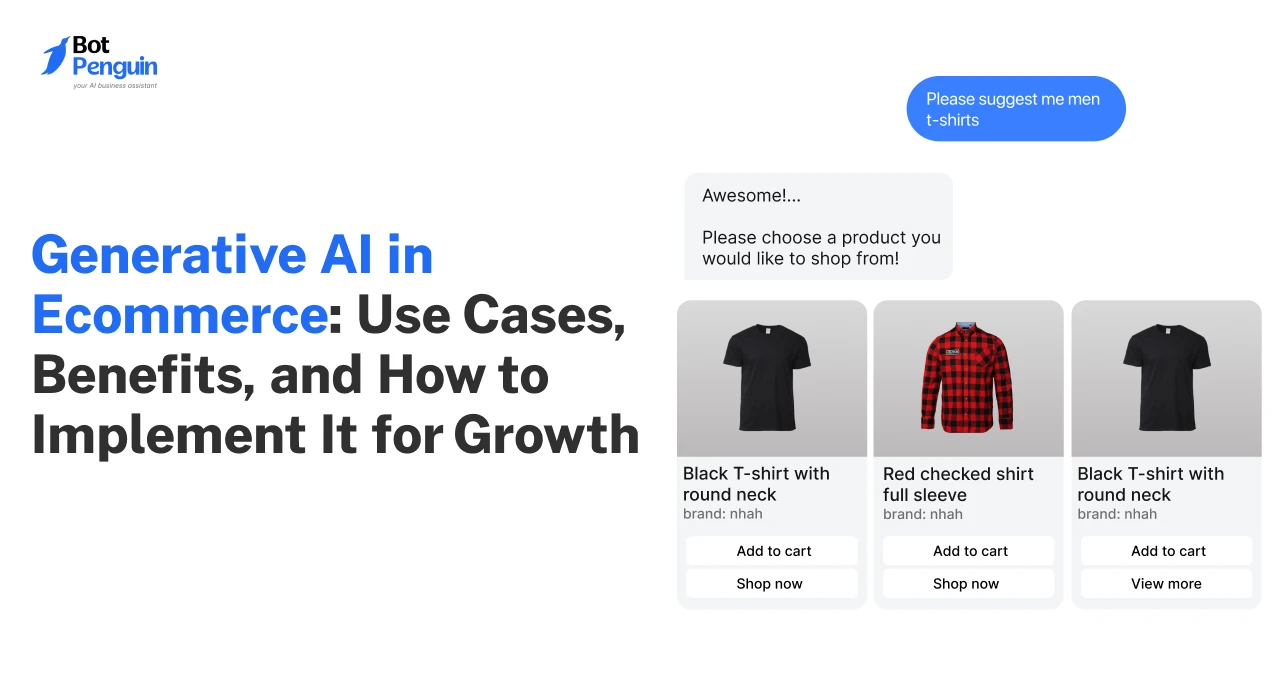
Nearly 70% of online shopping carts are abandoned before purchase (Baymard Institute).
Most of these drop-offs occur due to poor experiences, such as a lack of personalization, delayed responses, or unclear product information. Shoppers expect faster, more relevant interactions at every step.
This is where generative AI in ecommerce is changing how online stores operate. It enables businesses to create content, guide users, and automate engagement in real time, turning passive browsing into active conversion.
In this blog, you will explore what generative AI in ecommerce is, its high-impact use cases, measurable benefits, and implementation process to drive conversions and scale efficiently.
Generative AI for online stores refers to AI systems that can create content and respond to user inputs in real time based on context.
It builds on traditional AI in ecommerce, but removes the dependency on fixed workflows. Instead of following predefined rules, it understands intent and generates responses dynamically.
For example, if a shopper searches for “a lightweight jacket for travel,” a generative AI system can recommend relevant products, explain features, compare options, and even generate personalized suggestions based on weather, location, or past behavior.
In ecommerce, the difference between generative AI and traditional automation shows up during product discovery, support, and checkout.
Rule-based systems follow fixed flows. They handle simple queries like FAQs or order status. But they fail when shoppers ask complex or unexpected questions. This often leads to drop-offs.
Generative AI works differently. It understands shopper intent. It adapts in real time. It continues the interaction without breaking the journey.
The difference is easier to see side by side.
In practical terms, this shift allows ecommerce systems to move from rigid automation to more adaptive, context-aware interactions that can handle real user behavior.
To understand its real impact, let’s look at how generative AI is transforming growth in ecommerce businesses.
Generative AI is transforming ecommerce growth by making systems more responsive, personalized, and efficient across the customer journey.
Ecommerce growth today depends less on traffic and more on how effectively stores convert, engage, and retain users.
Generative AI drives this shift by:
These capabilities allow businesses to scale performance without increasing operational complexity.
In the next section, we break down where generative AI is applied across the ecommerce journey to help you make smarter decisions at every stage of the customer lifecycle.
Generative AI is applied across ecommerce to improve conversions, automate operations, and enhance customer experience across the shopping journey.
Here are the most impactful key use cases:
Let’s look at each of these use cases below in detail:
Generative AI automatically generates product descriptions, ad copy, and SEO content, removing content bottlenecks and enabling faster product launches.
Ecommerce teams struggle with scaling content across large catalogs. Generative AI solves this by standardizing and accelerating content creation without increasing team workload.
This ensures content production keeps pace with catalog growth.
Generative AI delivers real-time product recommendations by interpreting shopper intent during active sessions, making suggestions more relevant and timely.
Instead of relying only on past data, it reacts to in-session behavior. This allows recommendations to evolve as the shopper explores.
This makes recommendations more actionable, not just personalized.
Conversational AI, a layer of generative AI, enables chat-based interactions that guide users through decisions while resolving queries in real time across the buying journey.
It acts as both a sales assistant and support layer, reducing friction at high-intent moments.
This ensures no interruption in the purchase flow.
Generative AI for ecommerce improves search by interpreting natural language inputs, helping users find relevant products even when queries are unclear or incomplete.
This shifts the search from keyword matching to intent understanding.
For instance, platforms like Amazon use AI-driven search to interpret queries such as “comfortable running shoes under $100 for daily use” and return highly relevant, filtered results instead of generic listings.
This improves discovery for users who are not product-specific.
Generative AI produces product visuals and creatives, enabling faster design cycles and scalable content production across marketing channels. Tools like an online video editing tool can complement this by helping teams quickly edit and repurpose that visual content into polished videos for different platforms.
This reduces dependency on traditional design workflows.
This enables faster experimentation in marketing.
Generative AI enables behavior-driven engagement, allowing businesses to interact with users at the right moment without manual intervention.
Instead of scheduled campaigns, engagement becomes event-triggered.
This ensures communication is timely and relevant.
Generative AI identifies fraudulent activity by detecting anomalies in transaction behavior, thereby improving real-time decision-making.
It strengthens fraud prevention without slowing down legitimate transactions.
This reduces false positives while maintaining security.
These use cases show where generative AI creates immediate impact, but their full value becomes clearer when translated into measurable business benefits. Let’s check them out next.
Generative AI improves revenue, reduces costs, and enhances customer experience by making ecommerce operations more efficient and interactions more relevant in real time.
These benefits directly impact how online stores convert, operate, and retain customers.
Generative AI improves conversions by reducing friction in the buying process, helping shoppers make faster, more confident decisions.
It influences key moments in the journey during which drop-offs typically occur.
AI-driven personalization is expected to increase conversion rates by up to 20% for ecommerce businesses (Forrester).
Generative AI reduces operational costs by automating repetitive tasks across content creation, customer support, and marketing workflows.
This allows teams to operate more efficiently without scaling headcount. The technology:
In 2026, AI automation is projected to reduce customer service costs by up to 30% in digital commerce environments (Gartner).
Generative AI improves customer experience by making interactions faster, more relevant, and consistent across all touchpoints.
It ensures that users receive support and guidance without delays.
In 2026, 80% of customer interactions in ecommerce are expected to be AI-assisted (Gartner), reflecting a major shift toward AI-driven engagement.
These benefits become more relevant when viewed in the context of broader industry shifts, especially across retail and ecommerce.

Generative AI is shifting ecommerce from reactive systems to predictive, experience-driven commerce. The focus is no longer just automation, but how intelligently systems respond across the customer journey.
Key trends shaping this shift include:
These trends signal a move toward intent-driven commerce, where systems anticipate needs and respond in real time. For businesses, this means rethinking how data, systems, and customer interactions connect into a continuous experience.
The shift toward intent-driven commerce is clear, but real impact comes from how these capabilities are implemented within your ecommerce operations.
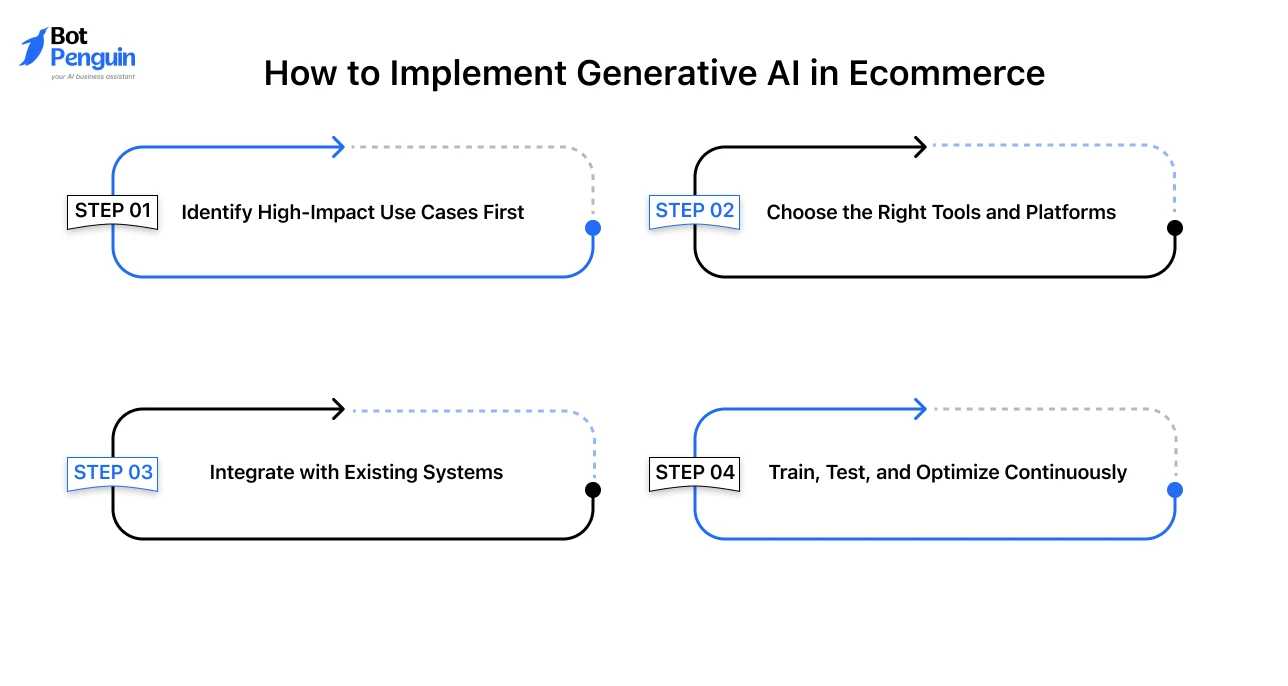
Ecommerce businesses need a structured approach to implement generative AI. It needs to focus on high-impact use cases, the right tools, seamless integration, and continuous optimization.
Adoption is not about adding AI everywhere. It is about applying it where it delivers measurable outcomes.
Here is a practical framework for effectively implementing generative AI in ecommerce.
Start by identifying use cases that directly influence revenue or efficiency for your ecommerce brands. Avoid broad adoption without clear outcomes.
Focus on areas where AI can create an immediate impact.
This ensures your AI implementation strategy is aligned with business goals, not experimentation.
The effectiveness of AI depends heavily on the tools you choose. Not all platforms are built for e-commerce-specific use cases.
Evaluate tools based on:
Choosing the right ecommerce AI platforms reduces implementation complexity and speeds up deployment.
Generative AI works best when connected to your existing systems. Without integration, outputs remain disconnected from actual business operations.
Ensure AI is linked with:
This allows generative AI to deliver accurate, real-time responses and maintain consistency across workflows.
Implementation does not end at deployment. Continuous improvement is required to maintain performance and relevance.
Start by training the system on real business data. Then refine it through testing and feedback.
This creates a feedback loop that improves the system over time, ensuring sustained impact.
A structured implementation approach ensures that generative AI delivers consistent results.
Platforms like BotPenguin make this easier by helping ecommerce businesses deploy generative AI chatbots and AI agents without complex setup. They help reduce cart abandonment, drop-offs and improve conversion consistency across the buying journey.
However, even with the right platform, understanding the challenges involved is critical to long-term success. Let’s look at them next.
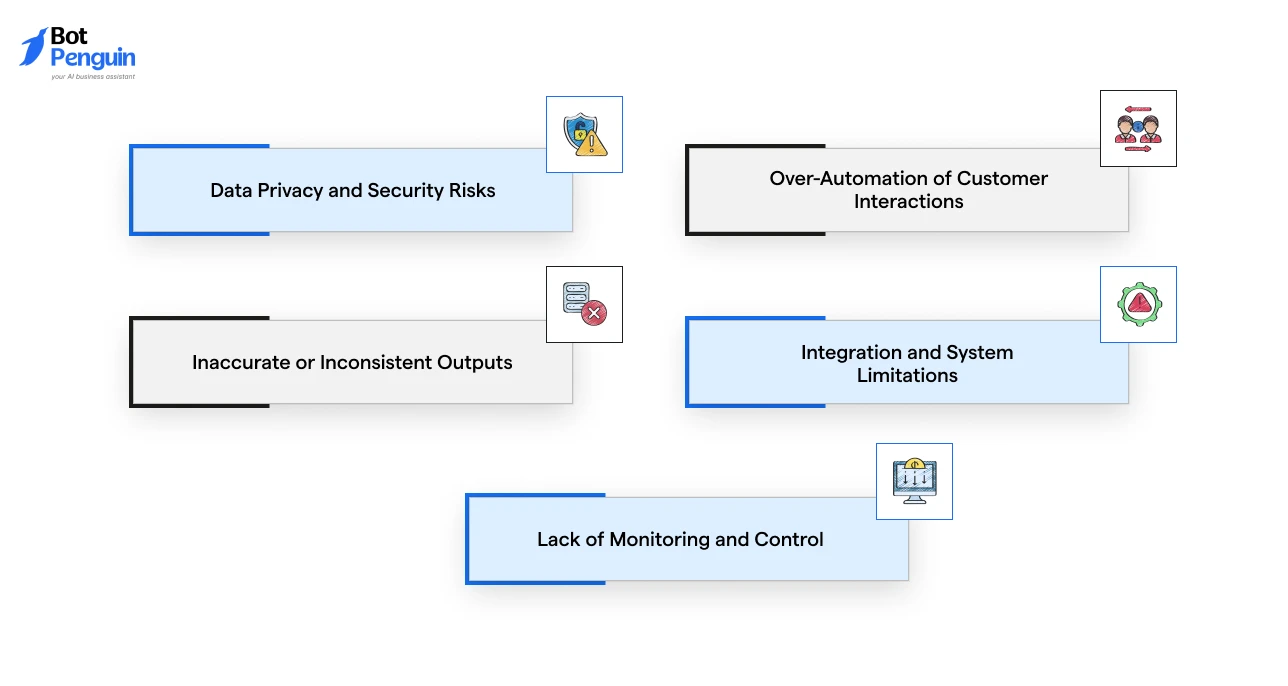
Generative AI introduces risks around data privacy, accuracy, and over-automation, making it important for ecommerce businesses to balance efficiency with control and reliability.
While the benefits are significant, ignoring these challenges can impact customer trust and business outcomes.
Key generative AI challenges in ecommerce include:
AI relies on customer data, which can lead to compliance and trust issues if mishandled.
Solution: Use secure, compliant platforms and follow data protection standards like GDPR to ensure safe data handling.
Generative AI can produce incorrect responses if trained on outdated or irrelevant data.
Solution: Continuously update training data and implement validation layers to improve response accuracy.
Excessive reliance on AI can remove the human touch in critical or complex situations.
Solution: Combine AI with human escalation to handle sensitive queries and maintain customer experience quality.
Poor integration can result in outdated or inaccurate recommendations and responses.
Solution: Connect AI systems with CRM, inventory, and backend tools for real-time, accurate outputs.
Unmonitored AI systems can scale errors quickly across interactions.
Solution: Set up continuous monitoring, analytics, and feedback loops to track and improve performance.
Addressing these AI risks in retail requires strong data governance, human fallback mechanisms, and regular performance monitoring.
Understanding these limitations is critical, but thereafter choosing the right solution can significantly reduce these risks.
Choosing the right generative AI solution is not just about features. It requires a structured approach that moves from evaluation to decision and then to capability assessment.
Most ecommerce teams jump directly into comparing tools.
A more effective approach is to break the process into three steps: filtering options, deciding the approach, and evaluating capabilities.
Start by filtering options based on practical fit. This helps eliminate tools that do not align with your workflows or constraints.
Ask critical questions like:
This step ensures you focus only on solutions that are realistic to implement.
Once you narrow down options, decide whether to build a custom solution or adopt an existing platform. This defines your execution path.
For most ecommerce businesses, buying a platform is the faster, more practical approach, especially in early- and mid-growth stages.
Platforms like BotPenguin simplify this by offering ready-to-deploy generative AI chatbots with zero coding, minimal setup, and built-in integrations.
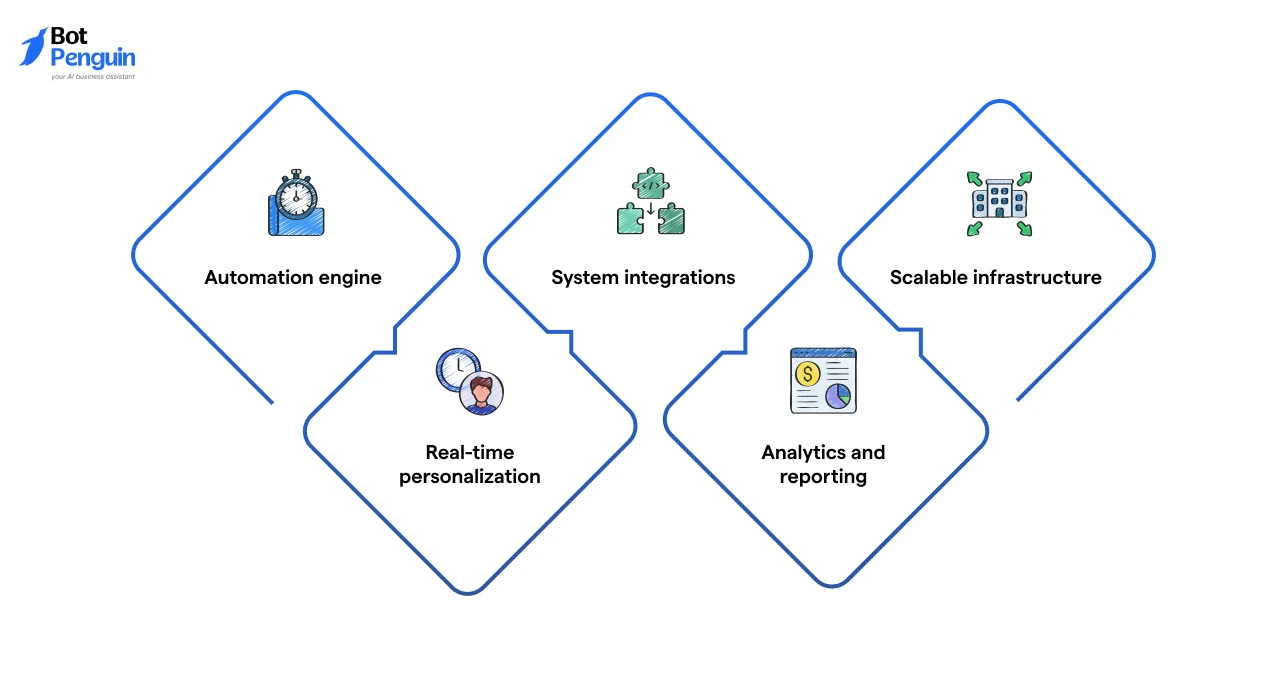
After deciding your approach, evaluate the capabilities that determine how effectively the solution will perform in real-world scenarios.
These capabilities define whether the solution can deliver consistent outcomes across your ecommerce operations.
Selecting the right solution becomes easier when approached step by step, ensuring better alignment between your ecommerce business needs and AI capabilities.
Generative AI is reshaping how ecommerce businesses grow, operate, and compete.
It does not just automate tasks. It improves conversions, enhances personalization, and increases efficiency throughout the customer journey.
To unlock its full value, you need a clear strategy supported by the right generative AI tools and continuous optimization. Platforms like BotPenguin enable you to deploy generative AI chatbots and AI agents that handle conversations, automate workflows, and drive real-time engagement.
As the future of ecommerce AI becomes more proactive, early adoption gives you a clear competitive edge.
Generative AI helps ecommerce businesses create content, personalize recommendations, automate support, and improve conversions by responding to customer intent in real time.
Generative AI improves ecommerce customer experience by offering personalized recommendations, instant responses, and faster product discovery, making the shopping journey smoother and more relevant for each user.
Yes. It helps small stores automate tasks, handle customer queries, and improve engagement without hiring large teams, making scaling more efficient and cost-effective.
Examples include AI-generated product descriptions, personalized product recommendations, conversational chat assistants, smart search, and automated marketing content.
Start by identifying high-impact use cases, then choose a suitable platform, integrate it with your systems, and optimize performance based on real customer interactions.
Key challenges of generative AI in ecommerce include data privacy risks, inaccurate responses, over-automation, and integration issues, which require monitoring, proper setup, and human oversight.
No. Generative AI handles routine queries and reduces workload, but complex or sensitive issues still require human support for better resolution and customer satisfaction.
The best generative AI platform depends on your ecommerce business needs. Tools like BotPenguin offer generative AI chatbots and AI agents that automate conversations and improve engagement, with zero coding.
Boost Ecommerce Growth
Use generative AI in ecommerce to automate sales, support, and engagement. Deploy no-code AI chatbots and AI agents that scale results efficiently with BotPenguin.
Get Started TodayCheckout our related blogs you will love.
Updated at Oct 7, 2026
12 min to read
Updated at Sep 25, 2026
13 min to read
Updated at May 29, 2026
11 min to read
Updated at May 27, 2026
9 min to read

Updated at May 20, 2026
8 min to read
Updated at May 20, 2026
9 min to read
Table of Contents