


How Law Firms Use AI Chatbots: Use Cases & Examples
Updated at Sep 25, 2026
11 min to read
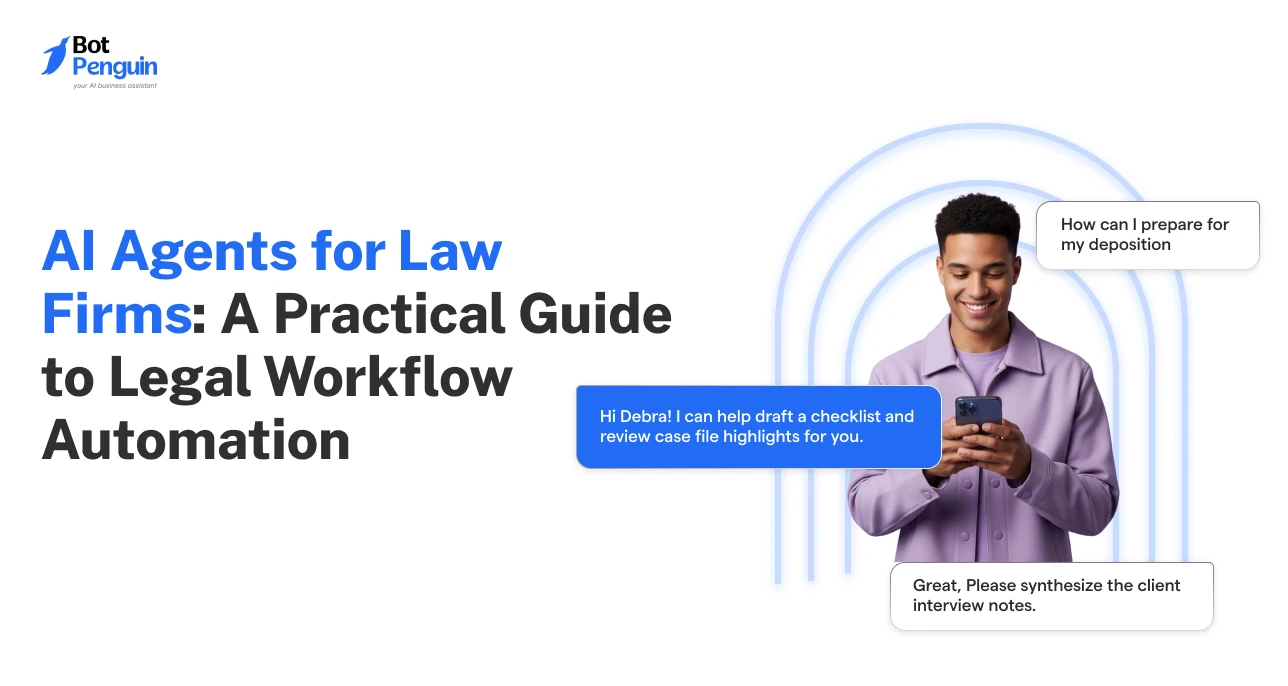
Many law firms already use AI for drafting, summarizing, research, and document review.
But most of these tools still depend on someone to write prompts, check outputs, and manually decide the next step.
This is where AI agents for law firms come in. They can support defined workflows, ask follow-up questions, collect client intake details, trigger next steps, and route tasks to the right person.
This guide will help you understand what AI agents for law firms are, how they work, how they differ from other AI tools, where they fit within law firm automation, and what limitations firms should be aware of.
Law firm AI agents are autonomous systems that help manage legal workflows, including client intake, appointment scheduling, document collection, follow-ups, and client support.
Unlike basic AI chatbots or tools that wait for instructions, these agents can understand the purpose of a request and proceed to the next approved step.
For example, when a potential client contacts a firm, an AI agent can identify the case type, ask intake questions, collect contact details, check urgency, and route the inquiry to the right attorney or intake team.
This makes them useful for law firms where many daily tasks are repetitive, process-driven, and communication-heavy. However, they do not replace legal expertise.
Legal service providers and agencies can also explore White-Label AI Agents to launch branded AI agent solutions for law firms and other professional services.
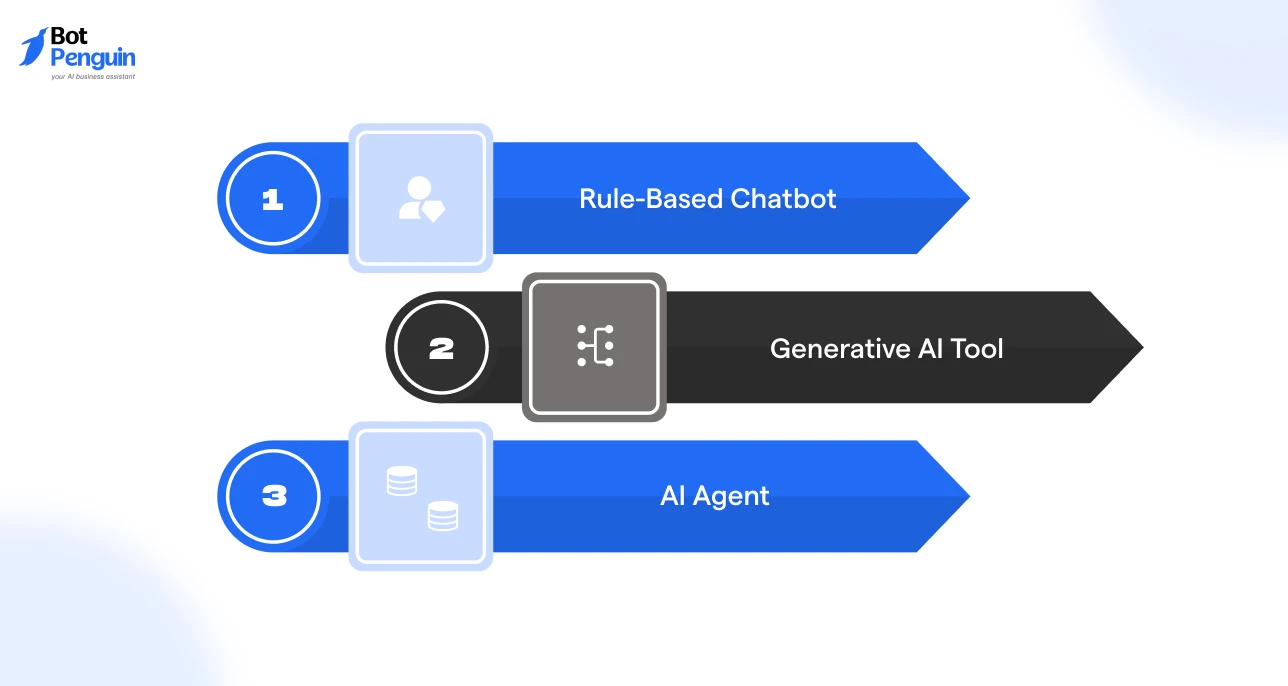
A rule-based law firm chatbot can answer fixed questions, whereas a generative AI tool can draft, summarize, or research based on prompts.
An AI agent for a law firm goes further by understanding context, supporting workflow automation, and moving a legal process toward the next approved step.
The table below shows the key differences in a law firm setting:
The key difference is that AI agents are more action-oriented. They are not limited to answering questions or generating content.
Likewise, they can help move structured legal workflows forward across intake, scheduling, document collection, follow-ups, and client communication.
Now, let’s uncover the main types of AI agents used in law firms.
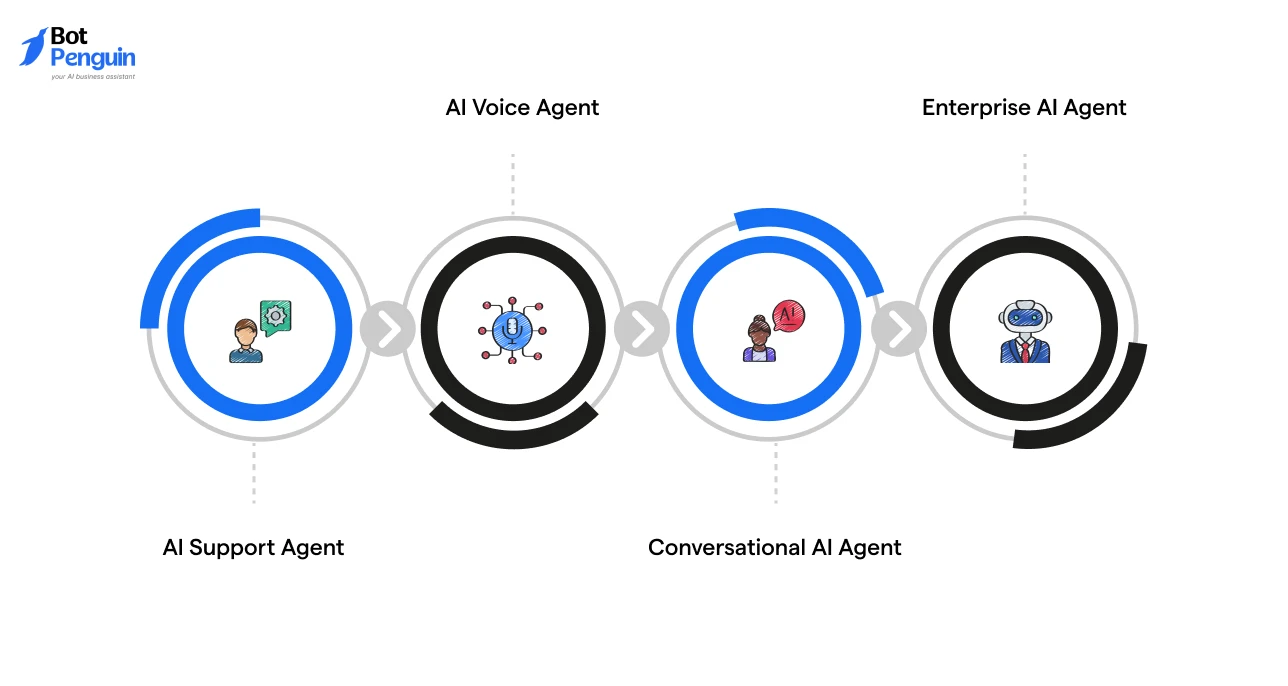
Law firms use different AI agents based on the workflow, communication channel, and operational needs. Some support website conversations, some handle calls, and others connect with deeper legal operations systems.
The table below shows the main types and their key differences:
Each type serves a different part of the law firm workflow. The sections below explain where each AI agent fits and what tasks it should support.
AI support agents for law firms help answer routine client questions and guide users to the next step. They are useful for website support, legal FAQs, basic client communication, and follow-up prompts.
For example, they can explain the consultation process, list required documents, guide a visitor to an intake form, or remind the user to complete an unfinished inquiry.
They also support live chat handoff when a question involves legal advice, urgency, or sensitive case details.
AI voice agents for law firms help manage phone-based inquiries when staff members are busy or unavailable. They can answer calls, capture caller details, ask basic intake questions, reach out to leads who fill forms, and route inbound legal leads.
This is useful for missed call automation and after-hours intake.
However, they should not be used to give legal advice. Its role is to collect information, identify urgency, and move the call to the right person.
Conversational AI agents manage two-way client interactions across website chat, WhatsApp, SMS, and other messaging channels.
It includes both text- and voice-based interactions, in which users communicate naturally with an AI system via chat, messaging, or phone.
For law firms, they can support lead capture, consultation booking, intake follow-ups, basic FAQs, and handoff to staff when the conversation needs human review.
This helps firms manage client communication without relying only on phone calls or manual email responses.
They are most useful for high-volume, repetitive conversations.
Enterprise AI agents for law firms are designed for larger teams with more complex workflows. They may support case management integrations, permission controls, audit logs, secure access to knowledge, and governance.
These agents are more relevant when a firm needs AI connected to internal systems and controlled across departments.
They are less about simple chat and more about structured legal operations.
For law firms exploring AI agents, BotPenguin brings support, voice, and conversational AI agents into a single platform. It can help firms manage phone-based inquiries, lead capture, appointment booking, FAQs, follow-ups, and multi-channel client communication without treating each channel as a separate workflow.
Next, let’s move from AI agent types to practical use cases, showing where these AI agents can support daily legal workflow automation.
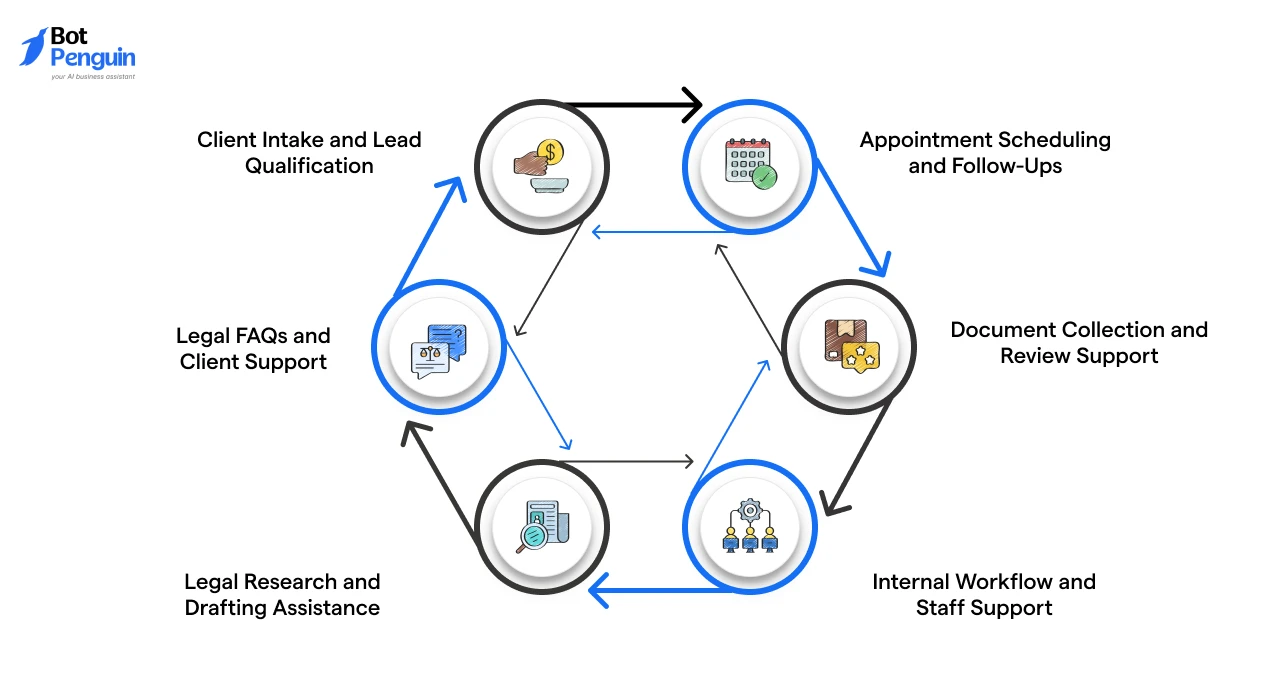
AI agents support legal workflow automation by handling repetitive, structured tasks that slow down intake, communication, and staff coordination.
They are most useful where a law firm needs to collect information, guide a client to the next step, trigger follow-ups, update workflow records, or route a request without replacing attorney judgment.
The table below shows where AI agents commonly fit in daily legal operations.
These use cases show how AI agents fit into practical law firm workflows. The sections below explain each use case in more detail.
AI agents can help law firms collect intake details before staff review the inquiry. They can guide a potential client through the first step and send the right information to the intake team.
This helps teams review higher-quality inquiries and respond with the right next step more quickly.
AI agents for law firms can reduce the manual back-and-forth involved in consultation booking. They help keep the process moving when a lead is ready to speak with the firm.
This helps firms reduce missed appointments and improve response continuity across channels.
AI agents can answer routine client questions that do not require legal advice. They help website visitors and existing clients access basic process information without waiting for staff to be available.
This makes client support more consistent while keeping legal advice and judgment with attorneys.
AI agents can support document collection before an attorney or staff member begins review. They reduce the to-and-fro by reminding clients what to submit and organizing the information received.
However, the AI agent should not make legal conclusions from documents. Its role is to reduce administrative friction before human review.
AI agents can assist with research preparation and first-draft support under attorney supervision. Modern generative AI agents are especially useful for organizing information, retrieving context, summarizing legal materials, and generating structured draft content faster for legal teams.
But this use case should stay supervised because legal accuracy, strategy, and interpretation require human judgment.
AI agents can support internal legal operations by keeping routine tasks visible and moving. They help reduce coordination gaps between intake staff, paralegals, attorneys, and admin teams.
This helps staff spend less time tracking routine tasks and more time on work that needs legal or operational judgment.
Now, let’s look at the practical benefits these AI agent workflows can create for law firms.
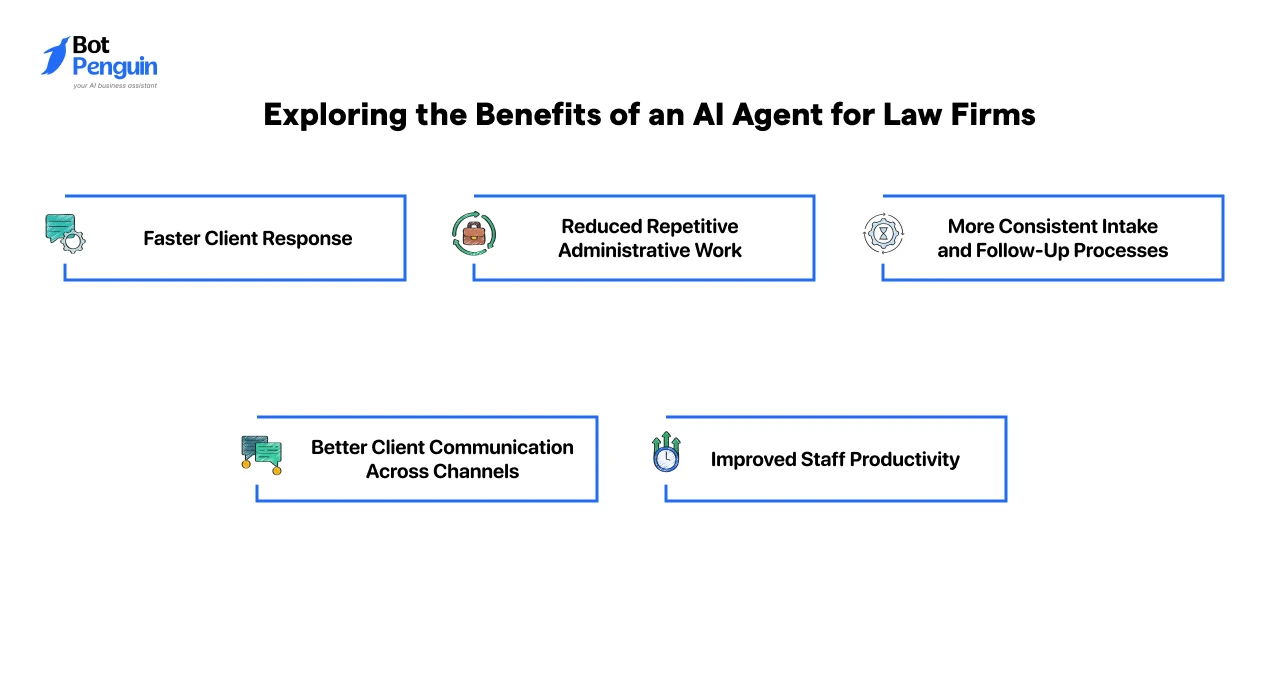
AI agents help law firms improve response speed, reduce repetitive admin work, and keep client-facing workflows more consistent. These benefits are most evident in firms that handle high volumes of inquiries, frequent follow-ups, and manual intake coordination.
The sections below explain how each one supports law firm efficiency.
AI agents help law firms respond quickly to routine client inquiries. They can handle first responses through website chat, voice, SMS, or WhatsApp when staff are busy or unavailable.
AI agents reduce manual work around common legal admin tasks. They can handle basic data collection, appointment coordination, reminders, and routine follow-ups.
AI agents help standardize intake and follow-up steps. They can ask the same required questions, capture details in a structured way, and trigger next-step communication.
AI agents support communication across multiple client-facing channels. This helps firms manage website inquiries, voice requests, SMS updates, and WhatsApp conversations from a more structured workflow.
AI agents help staff spend less time on repetitive coordination. They handle routine information collection and workflow prompts, while staff focus on work that needs judgment.
Next, let’s also cover the limitations of AI agents, because law firms need clear boundaries around legal advice, accuracy, confidentiality, and human review.
Law AI agents can support legal workflows, but they cannot replace legal judgment, attorney review, or responsible data handling. Their role should remain within structured tasks such as intake, scheduling, reminders, routing, and basic support.
The table below summarizes the main limitations law firms should overcome before using AI agents in client-facing or internal workflows, along with their practical fixes:
These limitations do not mean law firms should avoid AI agents. They mean firms should use them with clear boundaries, under attorney supervision, and in accordance with responsible AI practices.
Next, let’s understand what law firms should know before exploring AI agents, so these limitations are addressed before workflows are automated.
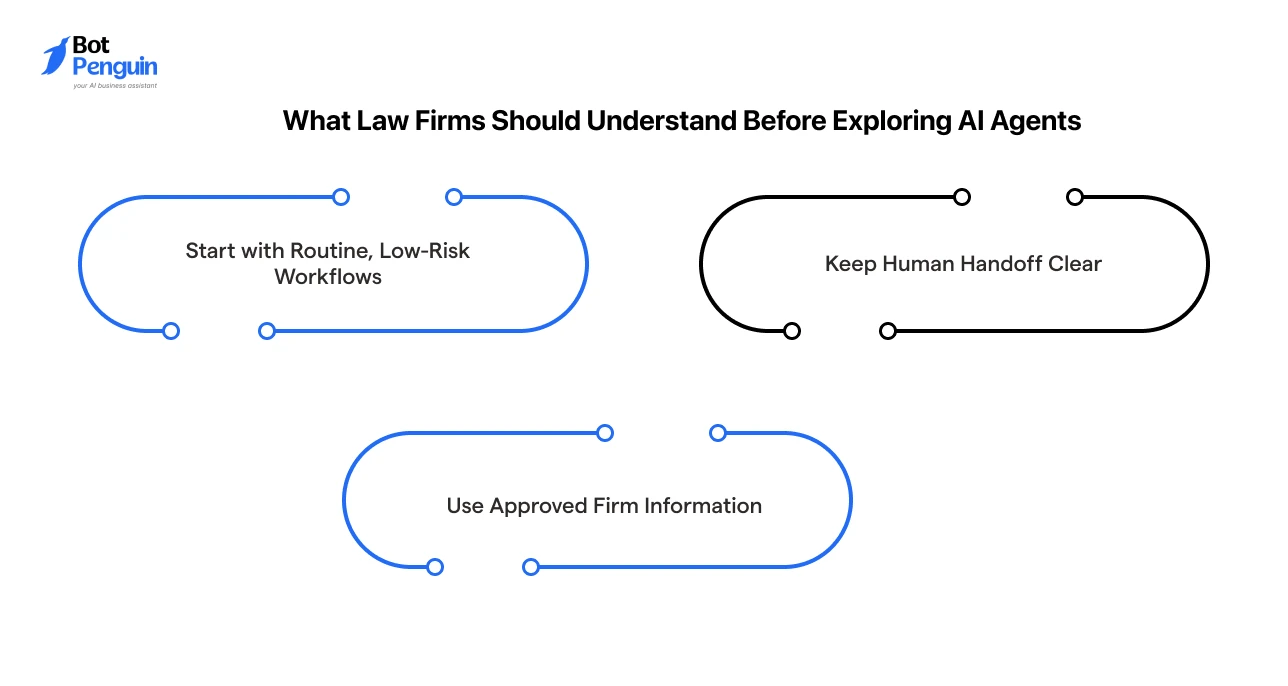
Law firms should understand that AI agents work best when they are introduced with clear workflow limits, approved information, and human oversight.
Agentic AI for law firms can support automation, but it should not be applied to every legal process at once. The safest approach is to begin with structured tasks that the agent can follow.
The sections below outline three basic areas that law firms should clarify before using AI agents in client-facing or internal workflows.
Law firms should start with workflows that are recurring, predictable, and easy to supervise. Good starting points include:
These workflows help firms test AI adoption without handing over complex legal work.
AI agents should know when to transfer a conversation to a person. Clear handoff rules protect the firm when a query involves legal advice, urgency, client frustration, or sensitive case details.
Define who receives each escalation, such as:
This keeps automation useful without weakening client safety.
AI agents should rely on verified firm content and controlled knowledge sources. This includes:
Using approved information helps maintain workflow accuracy and reduces the risk of inconsistent answers.
So, before moving toward broader automation, firms should ensure their workflows, handoff rules, and knowledge base are ready.
And when used with appropriate boundaries, AI agents become a support layer that helps legal teams work faster without shifting legal judgment away from attorneys.
With BotPenguin, law firms can turn these readiness basics into controlled AI agent workflows, so automation stays structured, supervised, and aligned with how the firm already handles client communication.
AI agents for law firms are most valuable when they accelerate routine legal workflows while allowing attorneys to retain control over judgment and advice.
This blog explained the main types of AI agents law firms may use, and the practical use cases across intake, scheduling, FAQs, document collection, research support, and internal operations.
It also covered the benefits, limitations, and basics firms should understand before exploring AI agent adoption. For firms exploring how these workflows could work in practice, BotPenguin is a good AI agent platform to consider.
Ensure you don't automate everything at once, and start with structured workflows where the AI agent can deliver clear operational value.
AI agents are used for client intake, appointment booking, FAQs, document reminders, lead routing, follow-ups, and internal workflow support under human supervision.
Agentic AI can advance legal workflows through defined steps, while regular AI tools usually help attorneys draft, summarize, research, or review information in response to prompts.
AI support agents can answer general process questions, but case-specific legal advice should always be escalated to attorneys or qualified legal staff.
AI voice agents can handle missed calls, after-hours inquiries, basic intake questions, appointment requests, caller routing, and follow-up prompts.
They can be, if firms use secure platforms like BotPenguin with access controls, approved knowledge sources, data-handling rules, and clear human-review processes.
Client intake is often the safest starting point because it is structured, repetitive, easy to supervise, and directly tied to response speed.
No. AI agents support repetitive tasks, but paralegals, intake staff, and attorneys remain responsible for judgment, review, client handling, and legal decisions.
Explore Law Firm AI Agents
Automate client intake, booking, support workflows & more instantly with BotPenguin’s AI agents for law firms.
Try BotPenguinCheckout our related blogs you will love.
Updated at Sep 25, 2026
11 min to read

Updated at Oct 14, 2026
11 min to read
Updated at Oct 14, 2026
10 min to read
Updated at Oct 14, 2026
10 min to read
Updated at Oct 13, 2026
11 min to read
Updated at Oct 9, 2026
10 min to read
Table of Contents