


AI Agents for Law Firms: A Practical Guide to Legal Workflow Automation
Updated at Jun 16, 2026
12 min to read
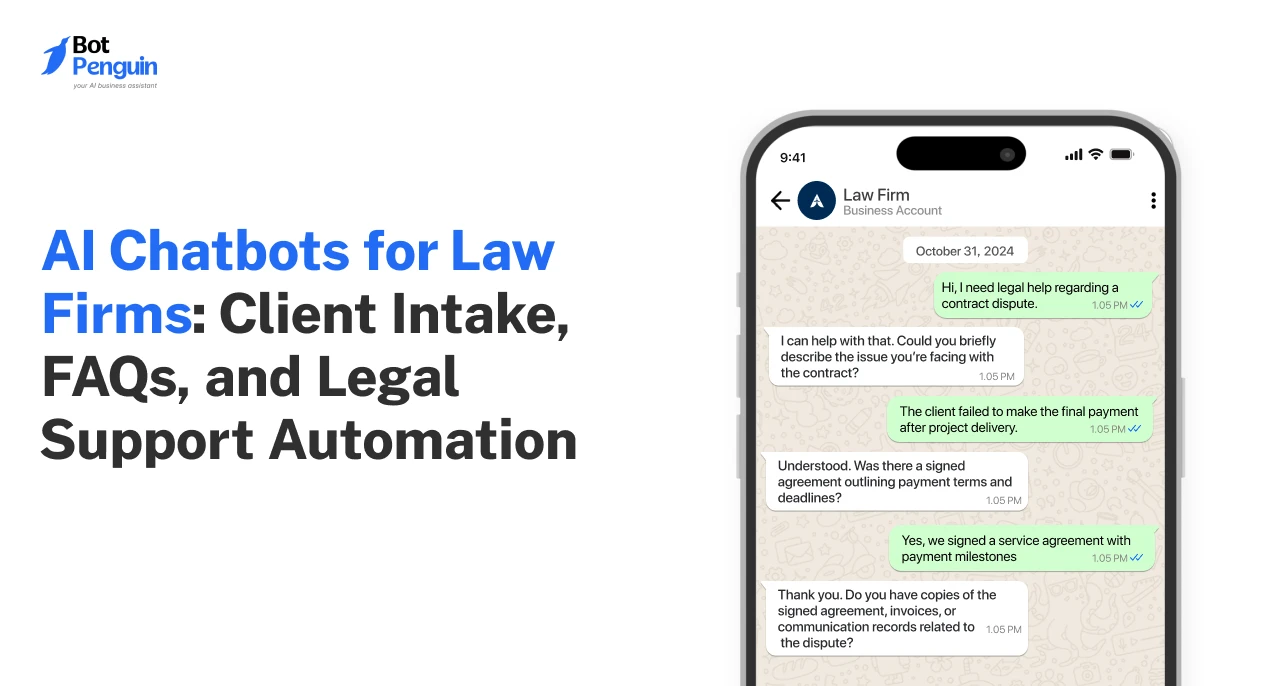
Law firms use AI chatbots to handle routine client-facing tasks such as initial intake, common questions, consultation scheduling, and conversation routing. These tools help reduce repetitive administrative work while giving prospective clients faster access to basic information.
This guide explains how law firms use AI chatbots across everyday firm operations. It covers common chatbot use cases for law firms, practical benefits, examples, implementation considerations, and limitations. Chatbots can support operational workflows, but legal judgment and legal advice should remain with qualified professionals.
Chatbots for law firms are automated tools that interact with website visitors, answer common questions, collect client details, and help legal teams manage inquiries more efficiently.
Many law firms today also use them to handle internal workflows and client-facing tasks at scale.
For example, Troutman Pepper Locke, a popular law firm, built an internal AI chatbot called Athena with GenAI capabilities on OpenAI's GPT models to handle drafting, summaries, and internal Q&A. (Source: Troutman)
Although it looks simple from the outside, the process actually involves several coordinated steps working behind the scenes:
This way, chatbots for law firms handle the entire first touchpoint, without a single staff member stepping in.
While some chatbots follow fixed conversation paths, others use AI to understand intent, respond naturally, and handle more complex client interactions.
Here’s how to visualize that difference in practice:
Corroborating its effectiveness, Gartner reports that AI-powered chatbots achieve a 78% resolution rate compared to just 52% for rule-based systems, a gap that widens as client queries get more complex.
Next, let’s see how chatbots differ from live chat or conversational AI assistants for law firms.
A chatbot handles the repetitive front-desk work, live chat brings in a human when things get personal, and a conversational AI assistant does the heavy lifting in between.
Here's how the three actually differ:
Now that you know what these tools are and how they differ, the real question is: why are so many law firms making the switch right now? The answer lies in a set of very real, very costly pain points that are covered in the next section.
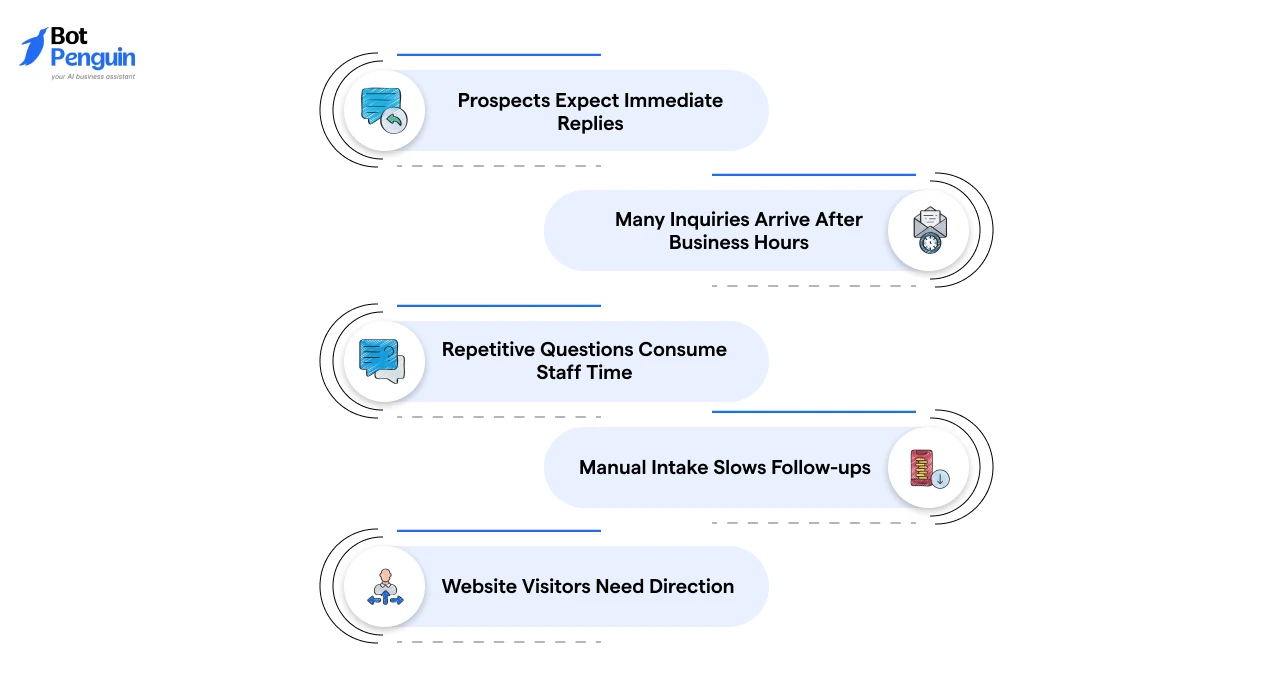
Law firms are under growing pressure to respond faster, manage more inquiries, and improve client communication without increasing administrative workload.
AI chatbots for law firms help bridge that gap.
Together, these challenges explain why law firms increasingly use chatbots to support routine client communication, intake, scheduling, and other administrative workflows.
AI chatbots support law firms across the entire client journey, from first website visit to ongoing case communication and follow-ups.
The table below offers a quick overview of these core law firm chatbot use cases:
Now, let’s study each of these use cases individually:
An AI chatbot on a law firm website can greet visitors, answer routine questions, and guide them toward relevant next steps such as intake, consultation scheduling, or contacting the appropriate team.
Tools like LawDroid allow firms to use custom intake bots on their websites to support initial inquiries and structured intake workflows.
Law firm chatbots automate intake by collecting contact details, legal issue summaries, and case-related information through guided conversations.
Chatbots can also answer repetitive questions about consultations, practice areas, fees, office hours, and legal processes without staff involvement.
Think: A client asking "Do you handle DUI cases?" at 11 PM gets an instant answer without involving any member from the legal department.
AI chatbots can help route inquiries based on predefined intake criteria such as practice area, location, stated urgency, and the type of assistance requested.
Chatbots connect with calendars to schedule consultations automatically without repeated emails or phone calls.
This helps firms fill their calendars faster while freeing staff from the endless scheduling loop.
Automated reminders by AI-powered chatbots further reduce missed consultations and keep potential clients engaged after the first interaction.
Chatbots can request forms, IDs, contracts, or supporting documents before consultations begin.
It becomes particularly important when a client's case requires time-sensitive paperwork or when attorneys need documents ready before the first meeting.
Clients can receive updates, reminders, and notifications without calling the legal office repeatedly.
It ensures clients stay informed at every stage, without tying up staff time on routine check-in calls.
For firms that use WhatsApp for client communication, a WhatsApp chatbot for law firms can support routine inquiries, initial intake, and conversation routing on that specific channel.
Complex, emotional, or urgent situations can be transferred directly to legal staff or attorneys.
From first click to case update, AI chatbots handle the repetitive, time-sensitive, and administrative layers of client communication, so attorneys can stay focused on what actually requires their expertise.
Different legal practice areas use AI chatbots in different ways based on client urgency, intake complexity, and communication needs. The examples below show how chatbot workflows can vary across common law firm practice areas.
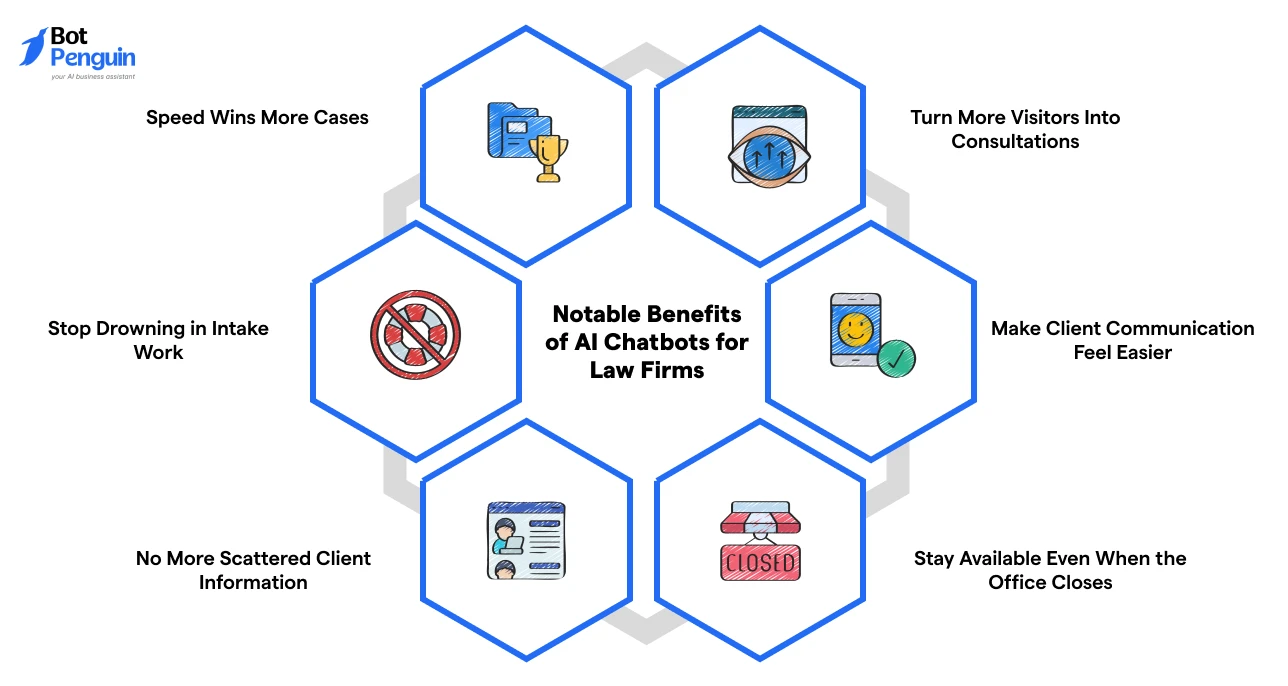
AI chatbots can support law firms by reducing repetitive administrative work, improving response times, and making routine client communication easier to manage.
The result? Fewer missed leads, less staff burnout, and a client experience that feels entirely responsive.
If your firm is evaluating a chatbot platform after reviewing these use cases and benefits, explore BotPenguin’s AI chatbot for law firms for client intake, FAQs, scheduling, and other operational workflows.
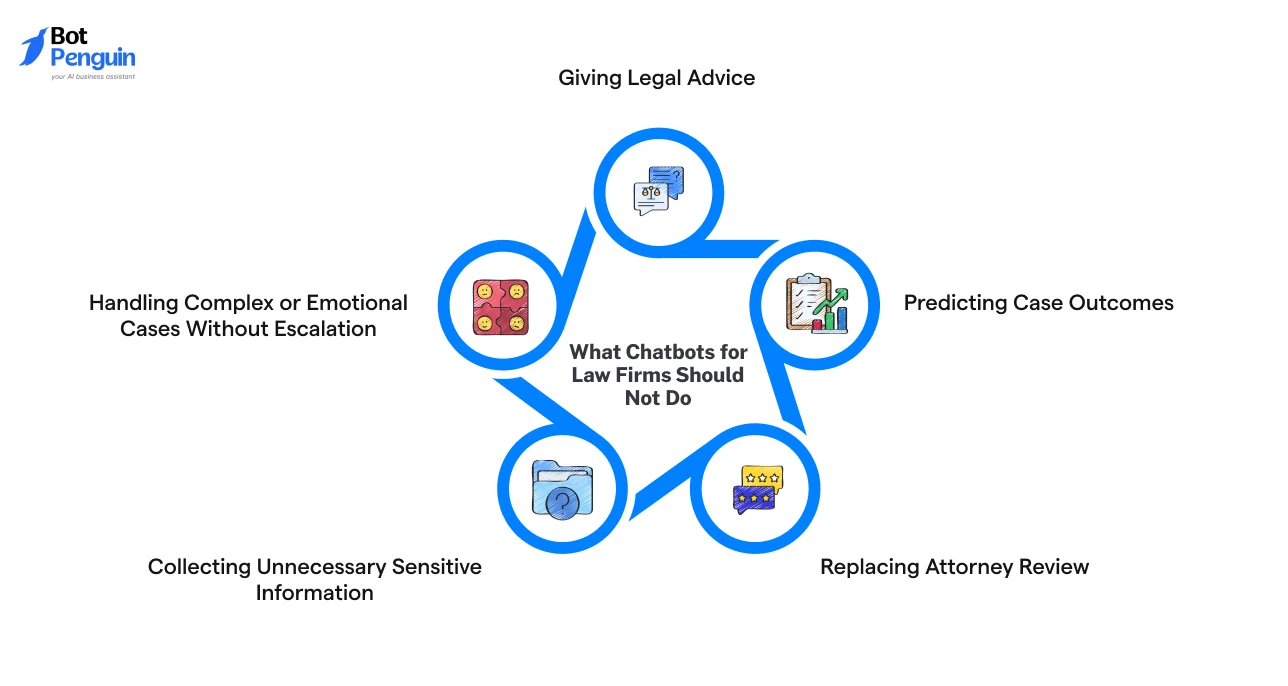
AI chatbots can improve legal operations, but they still need clear boundaries. Law firms should use them to support workflows, not replace legal judgment.
These are the main tasks and decisions that should remain outside the chatbot’s role:
A chatbot should never provide legal advice or tell users what legal action to take. Legal guidance requires attorney review and case-specific analysis.
AI chatbots should not estimate settlement amounts, promise results, or predict whether someone will win a case.
Every legal matter depends on unique facts and legal interpretation.
Chatbots can collect information and automate workflows, but final legal review should always remain with qualified attorneys or legal staff.
Law firms should avoid asking for excessive personal, financial, or confidential details during initial chatbot conversations unless absolutely necessary.
Sensitive situations such as criminal charges, domestic disputes, or urgent legal matters should be transferred to human staff instead of being handled entirely by AI.
Used within these boundaries, AI chatbots can support routine legal operations without replacing the professional judgment and human oversight required for legal work.
Law firms using AI chatbots must balance automation with legal ethics, privacy, and responsible client communication.
Each of these considerations has been explained below:
Getting these considerations right from the start is far easier than correcting a compliance issue after deployment. So treat ethics as a setup requirement, not an afterthought.
BotPenguin is GDPR, HIPAA, and CCPA compliant, ISO certified, SOC 2 attested, and VAPT-assessed by a CERT-In empanelled auditor.
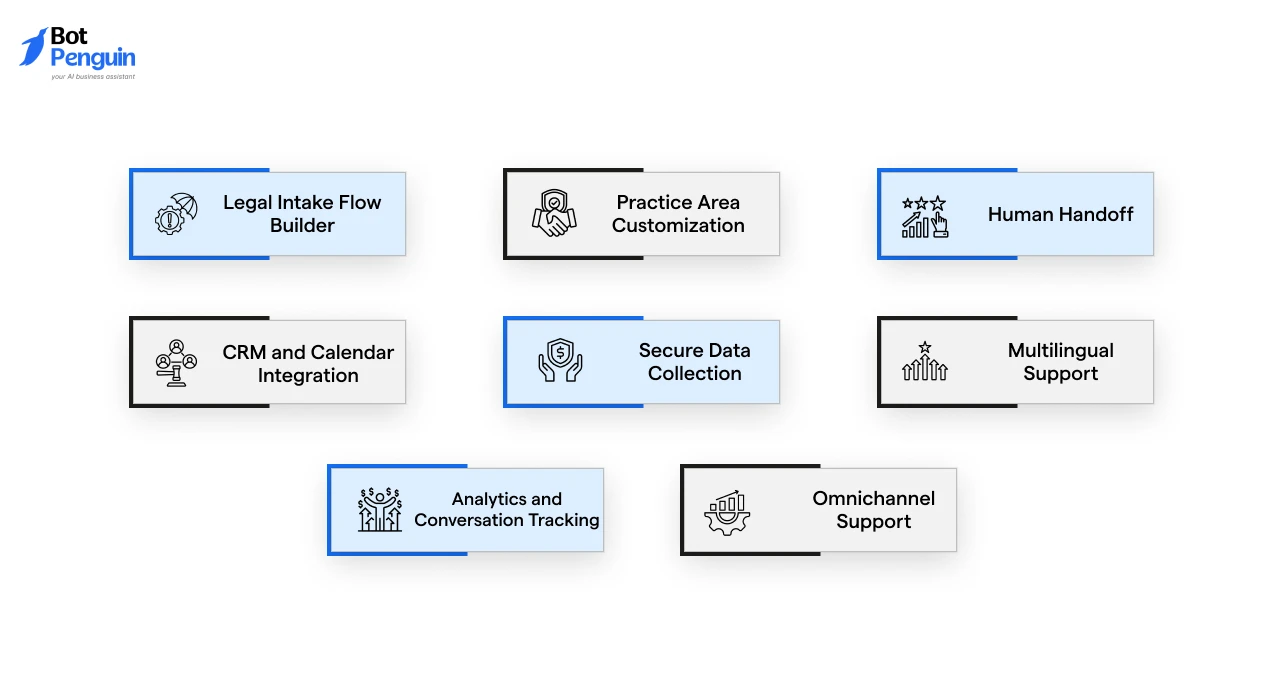
The features a law firm needs depend on its intake process, communication channels, practice areas, and escalation requirements. When evaluating chatbot capabilities, firms should focus on features that support administrative workflows while maintaining appropriate privacy and legal boundaries.
Here are the features you should consider:
These capabilities help law firms align chatbot workflows with intake, communication, and administrative needs without adding unnecessary operational complexity.
A successful law firm chatbot needs clear workflows, legal boundaries, and regular optimization. Follow these steps to implement it effectively:
The steps above are not just a checklist; they are the difference between a tool that converts and one that frustrates.
Remember: A chatbot that is well-planned from day one will outperform one that is patched together over time.
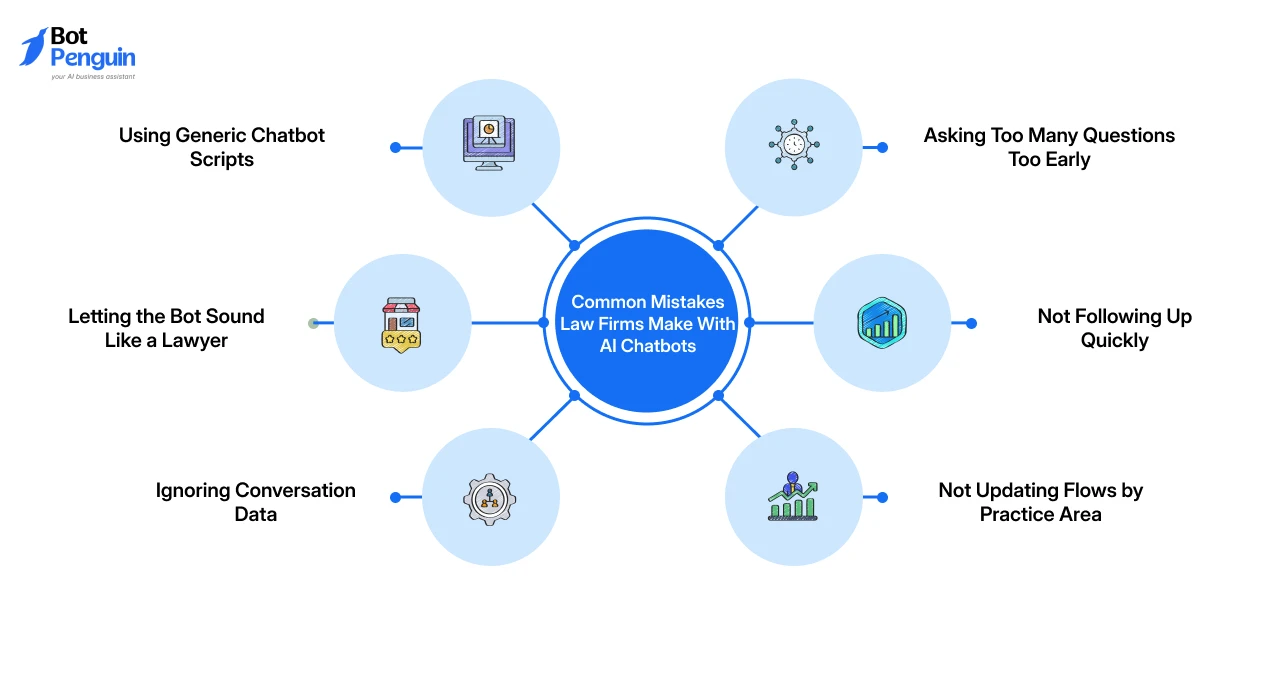
Many law firms adopt chatbots quickly but fail to configure them for legal workflows. This leads to poor user experience and lost leads.
Here are the common mistakes you should avoid while deploying a law firm chatbot:
What matters most is how you look at your chatbot. If you treat it as a living system, and not a one-time setup, you will see consistent lead growth, better client experience, and fewer dropped conversations over time.
AI chatbots can support law firms by handling routine client communication, intake, FAQs, scheduling, follow-ups, and other administrative workflows. Their value depends on choosing appropriate use cases and setting clear boundaries around what should remain with legal professionals.
Effective implementation also requires thoughtful intake flows, reliable human handoff, privacy safeguards, and regular review of chatbot conversations. Used within these boundaries, AI chatbots can reduce repetitive administrative work while helping firms respond more consistently to client inquiries.
The key is to use chatbots as operational support for legal teams, not as a replacement for attorneys, legal judgment, or case-specific advice.
Chatbots for law firms are AI tools that answer routine questions, collect initial client details, support intake, and route inquiries to the appropriate staff member.
It collects contact information, basic case details, and the reason for an inquiry through structured conversations, reducing manual intake work for legal teams.
No. AI chatbots should not give legal advice. They can support intake, routine FAQs, and inquiry routing, but should not replace attorneys or legal judgment.
A chatbot uses automation to respond instantly, while live chat relies on human agents for real-time conversation and support.
Yes. They can collect initial accident details, capture contact information, schedule consultations, and route inquiries to the appropriate legal staff for review.
It can ask for basic details such as contact information, inquiry type, location, and a brief description of the matter while avoiding unnecessary sensitive information during initial intake.
Law firms use chatbots to respond faster, reduce intake workload, improve lead conversion, and provide 24/7 client communication support.
Streamline Client Intake With Law Firm Chatbots
Capture leads, answer FAQs, and schedule consultations instantly on your website. Reduce missed inquiries, improve response speed, and convert more legal leads with automated AI workflows.
Explore Now!Checkout our related blogs you will love.
Updated at Jun 16, 2026
12 min to read
Updated at Oct 7, 2026
12 min to read
Updated at Oct 7, 2026
13 min to read
Updated at Oct 7, 2026
9 min to read
Updated at Oct 6, 2026
10 min to read
Updated at Oct 6, 2026
17 min to read
Table of Contents