


AI Agent for Recruiting: How It Works and 6 Key Workflows
Updated at Oct 6, 2026
10 min to read
A recruitment chatbot helps staffing teams stay in touch with candidates, screen early interest, and capture client inquiries without constant recruiter follow-up. It keeps conversations moving, even when recruiters are busy filling roles or managing multiple client accounts.
Finding the right hires is tedious -- but AI can make it simpler.
Recruiters spend hours sorting applications, answering candidate questions, screening profiles, and coordinating next steps. When dozens or even hundreds of candidates are in the pipeline, small delays can quickly turn into lost talent.
This is where a recruitment chatbot steps in. It connects with candidates around the clock, collects their details, answers common questions, runs initial screening, and moves qualified applicants forward, without waiting on a recruiter’s calendar.
For staffing teams, that means fewer hours lost to routine hiring tasks and more time spent on the people who actually move the needle.
So how exactly do recruitment chatbots speed up hiring? In this guide, you'll learn how recruitment chatbots work, the core features staffing teams should look for, and how to put one to work across your hiring pipeline.
For the broader role of chatbots across HR functions, see our guide to HR chatbots.
A recruitment chatbot is an AI-driven conversational tool. It handles candidate screening, interview scheduling, and FAQs in real time. This helps staffing agencies speed up hiring and improve applicant engagement.
Greenhouse found that applications per recruiter increased 412% from 2022 to 2025, while average time-to-fill rose 37%. (Source: Greenhouse, 2026)
Traditional staffing workflows often slow down under paperwork and high applicant volume. A chatbot for recruitment agencies helps address these common bottlenecks:
High Candidate Drop-Off Rates: Manual application processes can cause qualified candidates to abandon forms or lose interest when responses and follow-ups are delayed.
Recruiter Burnout from Recurring Tasks: Hiring teams often spend significant time on resume screening, basic qualification checks, and calendar coordination. This leaves less room for high-value work.
Prolonged Time-to-Fill: Slow initial contact and back-and-forth scheduling can stretch out hiring cycles. This can cost agencies client placements.
Inconsistent Candidate Experiences: High applicant volume makes it difficult for staffing teams to give every applicant timely, personal communication. This can affect employer brand reputation.
Underutilized Talent Pools: Existing ATS databases often go cold because recruiters don't have the bandwidth to manually re-engage past applicants for new roles.
By taking care of these high-volume touchpoints, recruitment chatbots help staffing teams respond faster, keep talent pools active, and spend more time on placements.
Tools such as BotPenguin can help staffing teams bring these capabilities into their existing hiring workflows, from answering candidate queries and collecting applications to handling initial screening and scheduling.
A chatbot for recruitment is not just a window bolted onto a careers page. A few technologies work together behind the scenes to make it useful for staffing teams.
Natural Language Processing (NLP): This lets the chatbot understand candidate questions written in plain language, not just fixed keywords. A candidate can ask “Is this role remote?" instead of picking from a menu.
Conversational AI Engine: This powers the back-and-forth. It keeps track of context within a chat, so the bot remembers what a candidate already shared and doesn't ask for the same details twice.
Resume Parsing: When supported, this can pull structured data (skills, experience, education) out of uploaded resumes, so the chatbot can pre-fill fields and match candidates against role requirements.
ATS and CRM Integration: This connects the chatbot to a staffing agency's existing systems, so candidate data flows into the pipeline recruiters already use, instead of sitting in a separate tool.
Scheduling Logic: This checks recruiter or interviewer availability and lets candidates pick a slot directly in the chat, cutting out email threads.
Here's how those pieces come together in an actual hiring workflow, from first click to recruiter handoff.
Beyond the first application, a recruitment chatbot can help staffing teams reconnect with candidates when suitable roles open.
Outreach can happen across channels such as SMS, WhatsApp, and web chat. It can also qualify inbound client inquiries by collecting hiring needs, role details, and urgency before a recruiter follows up.
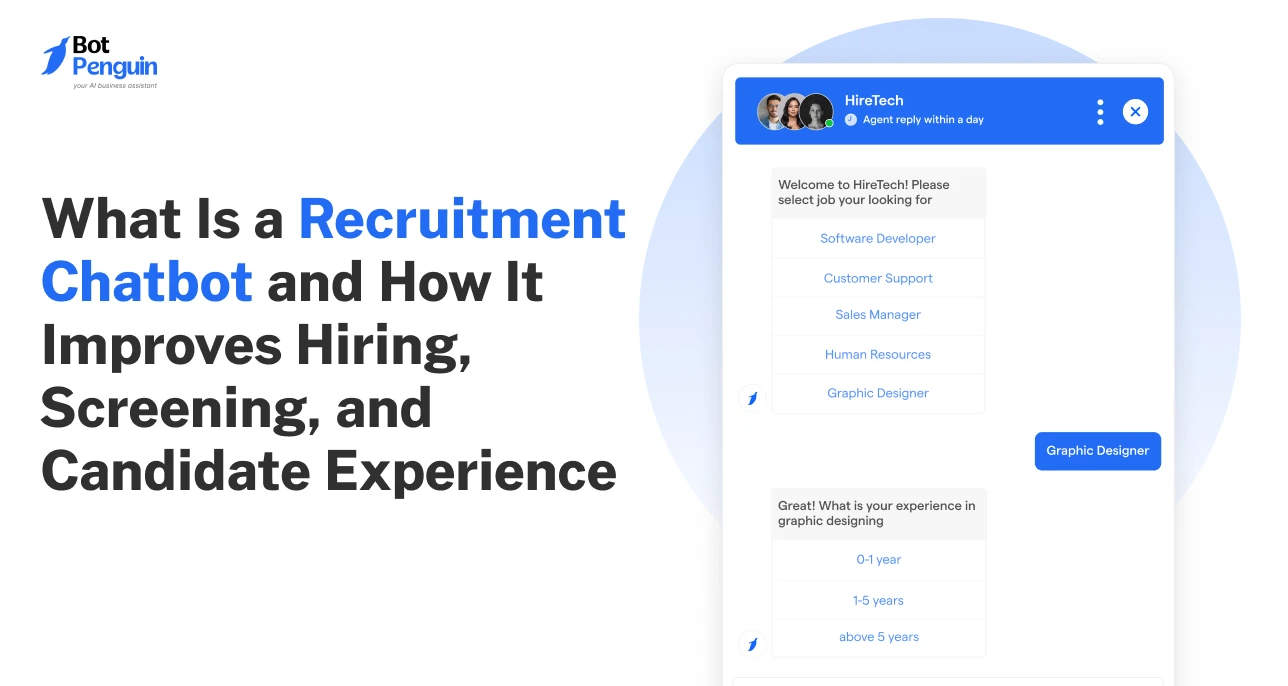
Here’s what this might look like in practice, for a mid-level sales role:
Chatbot: Hi! Thanks for checking out the Sales Executive role. Are you currently open to new opportunities?
Candidate: Yes, actively looking.
Chatbot: Great. How many years of B2B sales experience do you have?
Candidate: 4 years.
Chatbot: That matches the initial requirements. Please upload your resume, and I can help schedule a recruiter call.
Candidate: [Uploads resume]
Chatbot: Thanks. Would Tuesday at 3 PM or Wednesday at 11 AM work better?
Candidate: Wednesday at 11 AM works.
Chatbot: Booked. The recruiter will review your profile before the call.
This keeps the candidate engaged from the first click, without a recruiter needing to be present for every step of the early conversation.
Chatbots vary widely in how well they fit staffing workflows. Here’s what actually matters when evaluating one for your agency:
The chatbot should sync candidate data directly into your existing ATS or CRM.
Without this, recruiters end up exporting data manually, which defeats the purpose of automating the front end.
If your needs extend to autonomous, multi-step recruiting workflows, see how AI agents for recruiting work.
Look for a chatbot that can read uploaded resumes, pull out relevant skills and experience, and match candidates against open role requirements automatically.
Candidates apply from different places: job boards, your careers page, WhatsApp, LinkedIn.
A chatbot that works across these channels captures more candidates than one confined to a single web widget.
The chatbot should send follow-ups and messages when candidates are most likely to respond, instead of firing them off at a fixed time regardless of time zone or activity patterns.
This keeps engagement rates higher and reduces the chance of a good candidate going cold.
Every role and client has different qualifying criteria. The chatbot should let recruiters set custom screening questions per job, not just rely on a generic template.
Built-in scheduling lets candidates book interview slots directly in the chat, based on real-time recruiter availability, without email back-and-forth.
A chatbot that can revisit your existing talent pool and reach out about new roles helps keep past applicants active instead of letting your database go cold.
Visibility into drop-off points, response times, and conversion rates helps agencies see where the hiring funnel is working and where it isn't.
LinkedIn’s 2025 Search & Staffing report found that 62% of recruiting professionals believe AI can improve how quality of hire is measured. (Source: LinkedIn, 2025)
The right recruitment chatbot should fit into your existing hiring workflow, strengthen candidate communication, and give recruiters clearer visibility across the funnel.
Staffing teams are getting creative with how they use them across the hiring funnel. Here's what that looks like in practice:
Here’s how these use cases play out across real staffing workflows:
Long or time-consuming application forms can cause candidates to drop out before completing the process.
A chatbot can step in earlier, ask a few quick questions, and keep the conversation moving without forcing candidates through a lengthy form.
iCIMS found that 60% of U.S. frontline workers had started but not completed a job application, with lengthy or time-consuming forms cited as the leading reason. (Source: iCIMS, 2025)
A chatbot can run initial screening conversations overnight or on weekends, so by the time a recruiter logs in, there's already a shortlist waiting instead of a blank inbox.
Staffing agencies sit on years of resumes in their ATS. Chatbots can reach back out to past applicants when a matching role opens up, waking up a talent pool that would otherwise stay untouched.
For high-volume roles like retail, warehouse, or gig staffing, chatbots handle hundreds of similar conversations at once, so no candidate feels like a number in a spreadsheet even when volume is high.
Instead of recruiters chasing candidates for scheduling confirmations, the chatbot handles reminders, reschedules, and confirmations directly in chat, keeping candidates warm without extra manual follow-up.
Not everyone browsing careers pages is actively job hunting. A chatbot conversation feels lower-stakes than filling out a full application, which makes passive candidates more likely to engage early.
Together, these applications show how recruitment chatbots can help staffing teams move candidates through the hiring funnel faster, without adding more work to recruiters’ plates.
BotPenguin combines recruitment-focused workflows with no-code setup, multi-channel deployment, and integrations that help staffing teams manage candidate and employer conversations more efficiently.
Candidate Intake and Scheduling: Capture candidate profiles, role preferences, experience, and availability, then let candidates book screening calls or interviews directly in chat.
Candidate Role Matching: Match candidates with relevant openings based on details such as skills, experience, location, salary expectations, and employment type.
Passive Candidate Re-Engagement: Reconnect with inactive candidates when relevant roles become available and check their current availability and preferences.
Employer Job Brief Capture: Collect hiring requirements from employers, including role details and recruitment needs, before consultant follow-up.
Multi-Channel, No-Code Deployment: Build without coding and reach candidates across WhatsApp, website chat, Instagram, Facebook, Telegram, and other supported channels.
80+ Integrations: Connect BotPenguin with CRM, scheduling, automation, and other business tools through 80+ integrations.
For teams handling candidate information, review BotPenguin’s security and trust practices. You can also see what businesses say in BotPenguin customer reviews or explore real customer case studies.
The right recruitment chatbot should fit into existing staffing workflows while helping teams keep candidates active and client conversations moving.
Recruitment chatbots can improve hiring workflows, but poor setup can create new friction.
These are the most common mistakes staffing teams should avoid.
A chatbot that never lets go can leave candidates stranded exactly when they need a human on the line.
Solution: Define clear handoff points for complex questions, sensitive concerns, or qualified candidates who are ready to speak directly with a recruiter.
One screening flow rarely works across every role, client, or seniority level.
Solution: Customize questions around each job’s actual requirements, including experience, location, availability, and role-specific criteria, so suitable candidates are not filtered out by generic logic.
A chatbot working in isolation from your ATS turns every good conversation into data that recruiters never actually see.
Solution: Connect the chatbot with your ATS or CRM so captured details can move into the existing recruitment pipeline instead of creating another data silo.
Asking too many questions upfront can turn a convenient chat into another lengthy application process.
Solution: Collect only the information needed for the current stage, then move qualified candidates forward rather than forcing them through unnecessary questions before recruiter contact.
Chatbot screening should not become the only decision point for candidate suitability.
Solution: Use the chatbot to collect and organize initial information, while recruiters review profiles and make decisions that require context, judgment, or a deeper understanding of the role.
By balancing smart automation with recruiter judgment, staffing agencies can maximize hiring speed and conversion without sacrificing the candidate experience.
Good candidates rarely wait around forever. Neither should your recruitment process.
A recruitment chatbot can handle the early back-and-forth, keep talent pools warm, and help staffing teams move faster when the right role opens. But it should not try to replace the recruiter. The human part still matters, especially when judgment, trust, and real conversations come into play.
The goal is simple: less chasing, fewer cold leads, and more time spent on actual placements.
Pick a chatbot that fits your hiring workflow, connects with your tools, and keeps things moving without making recruitment feel robotic.
A recruitment chatbot is an AI-powered conversational tool that helps staffing teams answer candidate questions, collect applicant details, screen for basic requirements, schedule interviews, and keep candidates informed throughout early stages of the hiring process.
Recruitment chatbots interact with candidates through website chat or messaging channels, ask role-specific questions, capture details, connect with hiring systems when supported, and guide suitable applicants toward scheduling or recruiter handoff.
Yes. A recruitment chatbot can ask predefined screening questions about experience, skills, location, availability, and job preferences. Recruiters can then review the captured information before deciding which candidates should move forward.
Recruitment chatbots help staffing agencies respond faster, reduce manual coordination, keep candidate pipelines active, support high-volume hiring, and give recruiters more time for interviews, client relationships, candidate evaluation, and placement decisions.
Yes. When connected to a recruiter’s calendar or scheduling system, a recruitment chatbot can present available interview slots, capture the candidate’s preferred time, confirm the selection, and reduce back-and-forth coordination.
No. Recruitment chatbots support recruiters with early-stage communication, screening, scheduling, and candidate re-engagement. Human recruiters are still needed for nuanced evaluation, relationship building, interviews, negotiations, client communication, and final hiring decisions.
Website chat, WhatsApp, SMS, and other supported messaging channels can be used for recruitment chatbot conversations. The right channel mix depends on where candidates engage and what integrations the staffing agency uses.
Staffing agencies should avoid overly long chat flows, generic screening questions, weak ATS integration, and unclear human handoffs. A recruitment chatbot should support recruiter judgment, not create extra steps or frustrate candidates.
Speed Up Hiring With a Recruitment Chatbot
Screen candidates, answer questions, schedule interviews, and engage applicants across the hiring funnel. Keep candidates moving while giving recruiters more time to focus on top talent.
Start NowCheckout our related blogs you will love.
Updated at Oct 6, 2026
10 min to read
Updated at Sep 25, 2026
11 min to read
Updated at Sep 18, 2026
10 min to read
Updated at Sep 18, 2026
12 min to read
Updated at Sep 17, 2026
12 min to read
Updated at Oct 14, 2026
11 min to read
Table of Contents