


Facebook Chatbot Examples: 5 Real Flows You Can Copy
Updated at Aug 7, 2026
12 min to read


Compare AI and rule-based chatbots, then build your Facebook chatbot around the conversations your business actually handles.
An AI Facebook chatbot is useful when customers ask varied questions, use different wording, or continue a conversation across several messages. A Facebook AI chatbot can interpret context and open-ended requests, while a rule-based chatbot is better for predictable questions and structured actions.
Neither approach is universally better. The right choice depends on conversation complexity, setup capacity, budget, control requirements, and ongoing maintenance.
Before comparing the two approaches, understand what a Facebook chatbot is and where it fits within broader Facebook automation.
AI and rule-based chatbots have different cost structures.
A rule-based chatbot mainly creates costs through the platform subscription, workflow design, integrations, testing, and manual maintenance. An AI chatbot can add model usage, knowledge-base preparation, response testing, monitoring, and governance.
Generative AI services commonly use consumption-based pricing. The Google Cloud generative AI pricing page lists prices according to usage factors such as input and output processing. Amazon Bedrock pricing also varies according to the selected model, provider, modality, and processing option.
This supports a limited conclusion: an AI-enabled chatbot can introduce a variable model-usage cost that a purely rule-based workflow does not have.
It does not mean every AI chatbot costs more overall. The final cost depends on the platform plan, included allowances, conversation volume, integrations, setup requirements, and maintenance workload.
A rule-based chatbot does not use a generative AI model to create every response. Its cost can still depend on:
A small workflow for business hours, store locations, contact details, or booking links may require limited setup and maintenance.
A larger workflow can require more resources because every additional branch, condition, redirect, and fallback must be created and tested.
An AI Facebook chatbot may involve:
These are possible cost drivers rather than universal price increases.
BotPenguin offers free and paid plans with different message allowances, chatbot limits, team-member limits, and AI features. Plan details can change, so see current Facebook chatbot pricing and review the latest information on the BotPenguin pricing page.
Subscription price alone does not show the total cost of either approach.
When comparing Facebook chatbot pricing, consider:
A rule-based setup may be more economical when conversations are limited, predictable, and easy to map.
An AI setup may provide better value when varied questions create substantial support work or make fixed-flow maintenance difficult.
Rule-based chatbots are generally faster to launch when every response and path can be defined in advance.
AI-based systems require broader configuration, testing, and response controls. The right setup depends on how predictable your customer conversations are.
This approach works best when you already know the questions customers ask and the steps they should follow.
The usual setup includes:
A visual Facebook chatbot builder allows teams to connect messages, buttons, conditions, forms, and actions without writing code.
The main challenge appears as the workflow grows. Every new question, condition, or customer path may require another branch.
An AI setup requires broader instructions because customers can ask questions in many different ways.
Key setup tasks include:
The setup should also define what the chatbot must avoid answering and when it should transfer the conversation to a person.
A rule-based setup is easier when the customer journey is clear and limited.
An AI setup becomes practical when the business has too many possible questions to map manually. Initial configuration can require more preparation, but it may reduce the need to create separate branches for every wording variation.
Setup complexity depends on whether your team prefers to configure individual paths or define broader response behaviour.
The central capability difference is straightforward: AI interprets flexible language, while rules execute predefined conditions.
Consider a product-selection conversation. A customer might ask:
An AI Facebook chatbot can interpret these as related buying-intent questions and respond using approved product information.
A rule-based chatbot would usually need buttons, keywords, conditions, or separate branches for each route.
Rules remain useful when the next step must be exact. A lead form may require the customer to provide a work email, choose a company-size range, accept a consent statement, and select a meeting slot in a fixed sequence.
A rule-based flow can enforce that sequence without skipping required fields.
AI is useful when later messages depend on earlier context.
A customer may ask about one plan and then write, “Does that include analytics?” The chatbot must connect “that” with the plan mentioned previously.
A rule-based chatbot can preserve context when the required variables and branches are designed in advance. This works well for structured workflows but is less flexible when customers move outside the expected route.
Rule-based systems need a fallback when no keyword, button, or condition matches.
AI systems can attempt to interpret unexpected wording, but that flexibility introduces a different risk. An answer may be inaccurate, unsupported, or outside the chatbot’s approved scope.
AI expands the range of language a chatbot can interpret. Rules reduce variation in how important actions are completed.
A Facebook Messenger AI chatbot is suited to:
For a broader explanation of intent recognition, knowledge sources, and contextual responses, learn more about AI Facebook chatbots.
Rule-based Facebook automation is suited to:
AI and rules do not need to operate separately.
A business can use AI to identify intent and answer from approved information. Rules can then collect structured data, trigger a booking, update a CRM, transfer the conversation, or complete another controlled action.
AI offers conversational flexibility. Rules offer process control.
A hybrid setup connects flexible interpretation with predictable execution.
Initial setup and ongoing maintenance are different costs.
A chatbot may launch quickly but still require updates as customer questions, products, policies, and support needs change. The easier option depends on what your team must maintain after launch.
Rule-based systems need manual updates whenever the conversation structure or business information changes.
Teams may need to revise:
New customer wording can also require additional triggers or branches.
A question such as “Can I change my delivery date?” may fail when the workflow recognises only “reschedule order.”
As the number of flows grows, testing becomes more complex. Teams must check each route to confirm that buttons, conditions, redirects, and fallback messages still work correctly.
A Facebook AI chatbot does not remove maintenance. It changes the work from editing fixed paths to reviewing response quality.
Regular tasks include:
The knowledge source must remain current. Outdated product details, policies, or service information can produce incorrect answers even when the chatbot is configured correctly.
A small rule-based workflow may need limited monitoring. Manual editing increases as more branches and customer journeys are added.
AI can adapt to wording differences and reduce some flow-building work. It still requires quality checks, source reviews, and response governance.
Rule-based maintenance focuses on editing paths. AI maintenance focuses on answer quality and source accuracy.
For businesses managing a large number of branches, AI can reduce some manual flow-editing work. However, it introduces different maintenance requirements, including source updates, response reviews, and accuracy testing.
The right choice depends on conversation complexity, business size, budget, control, and maintenance capacity.
Use the simplest system that can handle customer needs without creating unnecessary setup or management work.
Choose a rule-based setup when:
Common use cases include business hours, store locations, contact information, basic bookings, lead forms, and simple FAQs.
Choose an AI Facebook chatbot when:
A hybrid setup works when the business needs flexible understanding but must keep important actions controlled and predictable.
Use AI for support questions, product discovery, and intent recognition.
Use rules for structured data collection, bookings, payments, escalation, consent, and compliance steps.
Start with the simplest approach that can handle your actual customer conversations.
Add AI when fixed flows can no longer manage the variety, context, or volume of customer questions.
Not universally. AI handles complex, unpredictable queries better. Rule-based chatbots suit simple, predictable flows that require faster setup and tighter control.
Rule-based is typically cheaper for simple flows because it avoids generative model processing. Check the Facebook chatbot pricing guide for current platform costs.
Yes. Platforms supporting both approaches may let you add AI to existing rule-based workflows without rebuilding every conversation path.
AI can take longer to configure because it needs approved knowledge, response limits, escalation rules, and testing for unexpected questions.
Businesses handling predictable questions, basic FAQs, bookings, contact collection, or fixed workflows may not need the additional flexibility of AI.
Neither option is universally better.
A rule-based chatbot works well for clear questions, fixed steps, and predictable customer journeys. It can launch quickly when the required paths are already known, but manual maintenance may increase as conversations expand.
An AI Facebook chatbot is more useful when customers ask varied, contextual, or multi-step questions. It can handle more language variation, but it also requires approved information, testing, monitoring, and response governance.
Choose based on actual customer conversations, not the popularity of AI.
A hybrid setup can provide a practical balance by combining flexible answers with controlled actions.
When you are ready, build either type for free with BotPenguin’s Facebook chatbot builder.
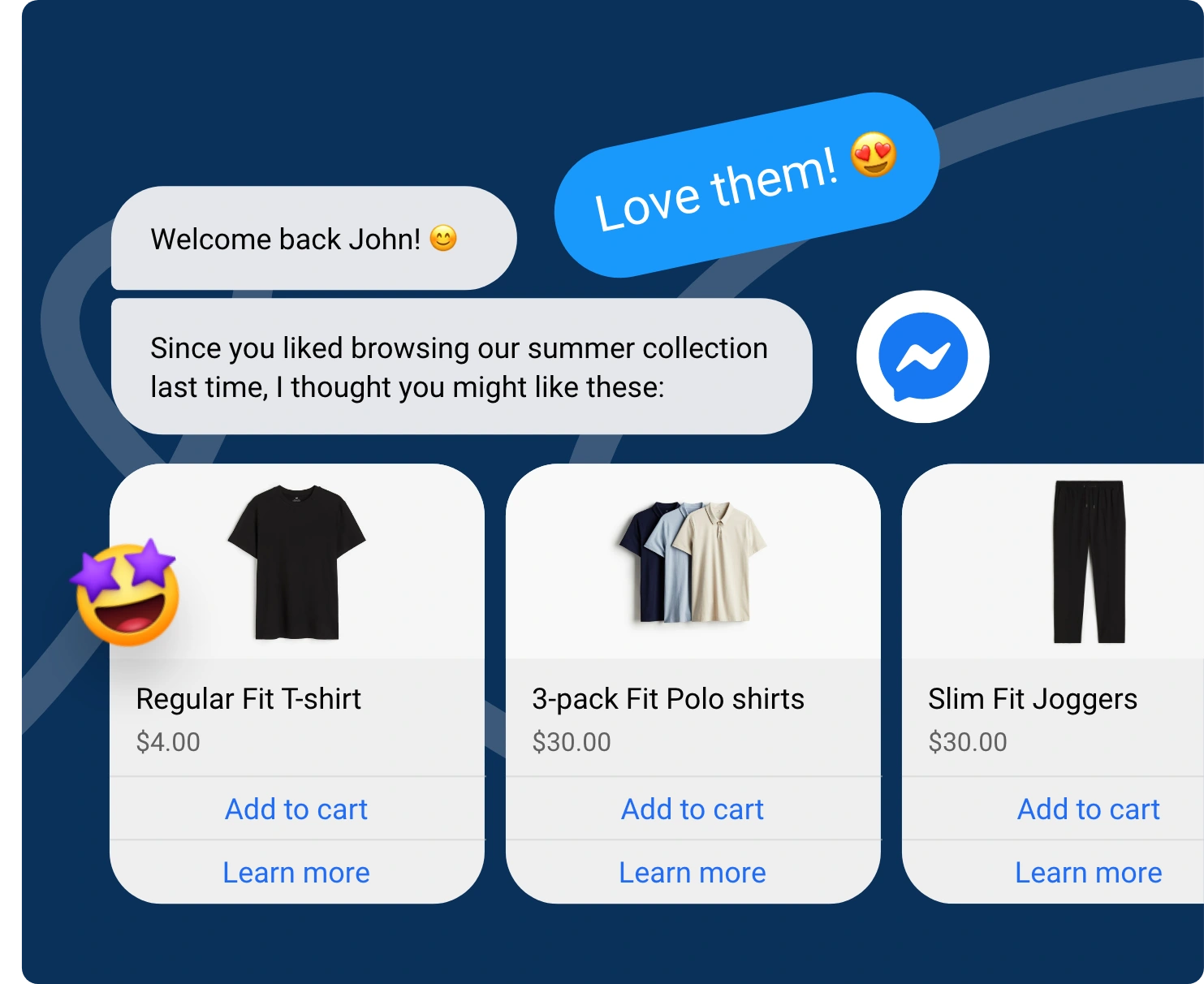
Choose the Right Facebook Chatbot
Compare AI and rule-based options, then build the setup that fits your customer conversations, budget, and business needs.
Build Your ChatbotCheckout our related blogs you will love.
Updated at Aug 7, 2026
12 min to read
Updated at Aug 7, 2026
10 min to read
Updated at Aug 7, 2026
10 min to read
Updated at Jul 29, 2026
11 min to read

Updated at Jun 5, 2026
9 min to read
Table of Contents

