


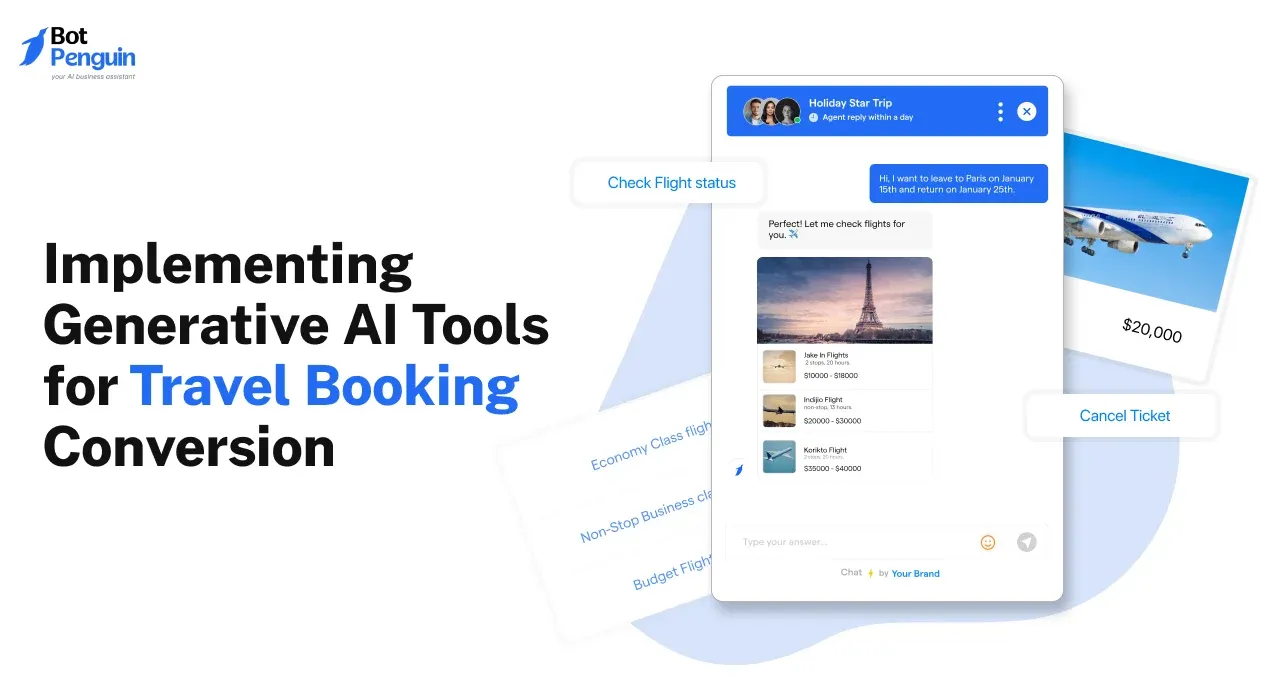
Generative AI in Travel: How It Improves Booking Conversion
Updated at Oct 14, 2026
7 min to read
A generative AI platform is a software ecosystem for building, deploying, and managing AI applications powered by language or multimodal models. Generative AI platforms include foundation models and cloud services, developer frameworks, and no-code application platforms. Each category serves different teams, technical requirements, and business use cases.
The term "generative AI platform" encompasses products built for very different users.
Comparing generative AI platforms without distinguishing their roles can lead to misleading conclusions. That distinction matters as adoption grows.
McKinsey’s 2025 Global Survey on AI found that 79% of respondents said their organizations use generative AI in at least one business function. (Source: McKinsey, 2025)
Technical teams may consider Amazon Bedrock a platform. Developers may think of LangChain or Hugging Face. Business teams may instead picture a no-code AI agent builder.
Understanding what is generative AI helps clarify the technology behind these products. This guide focuses on platform categories, capabilities, users, and implementation needs.
It explains four major platform types, provides concrete examples, and shows how teams can choose among them based on skills, use cases, data requirements, and specific business goals.
A generative AI platform provides the infrastructure to build and manage AI experiences. Its role extends beyond producing text, images, or responses.
Depending on its category, a platform can help organizations:
Access large language or multimodal models
Connect business data and external knowledge
Build applications, agents, and automated workflows
Deploy AI experiences across different environments
Manage governance, security, access, and ongoing operations
Amazon Bedrock provides cloud infrastructure and model access.
Developer frameworks support application development and orchestration. No-code platforms help business teams build applications without managing model infrastructure.
The main difference is whether users build AI experiences or consume them.
ChatGPT is primarily a ready-to-use application from OpenAI. Instead, Amazon Bedrock helps teams build their own AI applications.
These generative AI platform examples show why the category covers distinct product types. Understanding those differences also clarifies which capabilities matter across platform categories.
Generative AI capabilities vary by platform type, but several functions appear consistently. These functions determine how teams build, connect, control, and operate AI applications.
Platforms may provide access to one or several generative AI models. These can include language, image, audio, or multimodal systems.
Model access may come through APIs, built-in interfaces, or integrations. The platform does not always own the underlying foundation model.
Model choice can affect:
Output quality and supported tasks
Response speed and latency
Usage and infrastructure costs
Integration and implementation requirements
Business applications often need information beyond a model’s general knowledge. Retrieval-Augmented Generation, or RAG, helps connect that missing context.
RAG can retrieve relevant information from:
Internal documents
Databases and knowledge bases
Company websites
Business systems
Approved external information sources
The application retrieves relevant data before generating its response. This helps produce answers grounded in business-specific information.
Some platforms move beyond generating content into performing actions. They can support workflows involving several connected steps.
An agent may call APIs, use external systems, or trigger actions. It can also pass information between different workflow stages.
The distinction between agentic AI vs generative AI helps clarify this shift. Generative systems create outputs, while agentic workflows can work toward defined outcomes.
Guardrails help control how AI applications operate within defined boundaries. Their depth varies significantly across platform categories.
Common controls can include:
User and role-based access
Content and response rules
Business logic and data boundaries
Monitoring and governance
Human review or escalation
Together, these capabilities define what a platform can support in practice. Their implementation becomes clearer when platforms are grouped by type.
There is no single category covering every generative AI platform. Their roles depend on where they sit within the AI stack. The best generative AI platforms therefore depend on what buyers need to build.
These generative AI platform examples show the four main categories clearly.
These categories simplify the market without making every product interchangeable. Each category offers a different level of technical control and abstraction.
This category provides the greatest control over AI infrastructure.
Teams can decide how models, data, APIs, and cloud services work together. That flexibility also increases implementation responsibility. Organizations may need technical expertise for architecture, deployment, monitoring, and ongoing optimization.
These platforms make sense when custom development is central. They are especially relevant when applications require deeper control over infrastructure or complex enterprise integrations.
Developer frameworks sit between raw model access and finished applications. They help technical teams connect different components into working AI systems.
Their value often appears in areas such as:
Retrieval and data connections
Model orchestration
Agent logic
Tool and API calls
Custom workflow design
However, frameworks still require development resources. Teams must manage application logic, testing, integrations, and deployment decisions themselves.
That requirement separates them clearly from application layers designed for business users.
A no-code generative AI platform abstracts much of the underlying technical work. Teams focus on configuring the business experience rather than engineering the AI stack.
This layer can support practical workflows such as:
AI chatbot conversations
Lead qualification
Customer support
Appointment scheduling
Business messaging
Customer-facing AI agents
BotPenguin belongs within this application layer. It enables teams to build business chatbots and AI agents without needing to become foundation model providers.
Teams evaluating BotPenguin AI Agents can consider this approach when the goal is customer-facing automation.
These products provide immediate access to generative AI capabilities. Users interact with the application rather than building the underlying system.
A broader comparison of generative AI tools covers ready-to-use products across common tasks.
That distinction matters when comparing them with development platforms.
A finished AI application can solve valuable tasks without providing infrastructure for custom deployment.
ChatGPT illustrates this difference. It is primarily an OpenAI application for end users. OpenAI’s API provides the platform layer for developers building their own integrations.
With these platform layers separated, comparison becomes more useful. Choosing between them now depends on team capabilities, business requirements, and implementation constraints.
The right platform depends less on brand rankings than actual requirements. Start with what you need to build and who will build it.
Knowing how to choose a generative AI platform means matching capabilities with team resources. The platform should fit both the use case and operating model.
Start with the outcome the platform must support. Different use cases require very different capabilities.
Common requirements include:
Custom AI applications
Internal knowledge assistants
Creative generation
Customer service
AI agents
Business messaging
A clear use case prevents comparisons between products serving different layers.
Next, assess who will build and manage the system.
Developers may need cloud platforms or developer frameworks. These options provide deeper control over models, APIs, and architecture.
Business teams may prefer no-code application platforms. They reduce infrastructure work and simplify ongoing management.
Define how much customization the application actually requires.
Check whether your team needs:
API access
Model selection
Custom architecture
Workflow control
Complex integrations
Infrastructure management
More control usually creates more implementation responsibility. Choose only the flexibility your use case needs.
Subscription price shows only part of the total cost.
Include model usage, cloud infrastructure, development work, integrations, maintenance, and staffing. A cheaper platform can become expensive when technical overhead grows.
Identify what data the platform will access and process. This is already a major implementation barrier.
Deloitte reported that 38% of surveyed leaders identified regulatory compliance as the top challenge when developing and deploying generative AI applications. (Source: Deloitte, 2025)
Review storage, permissions, governance, security controls, and regulatory requirements. Eliminate options that cannot meet mandatory business or compliance standards.
Compare individual vendors only after identifying the right category.
For initial discovery, teams can compare AI tools and use community preferences to identify options worth investigating. Validate the shortlist against your integration requirements, data policies, and a small pilot's results.
Evaluate remaining options against your use case, team, control requirements, costs, and data needs. This keeps the shortlist relevant rather than unnecessarily broad.
For customer-facing messaging and engagement, this process often points business teams toward the application layer.
Many businesses do not need to build AI infrastructure. They need AI that can handle customer conversations and business workflows.
Application-layer platforms focus on practical customer interactions rather than on model development.
Typical use cases include:
Website conversations
WhatsApp and social messaging
Lead qualification
Customer support
Appointment scheduling
Sales conversations
For these teams, a no-code generative AI platform can reduce technical overhead. Teams can configure useful AI experiences without directly managing foundation models.
This approach suits businesses focused on deployment, workflows, and customer engagement.
BotPenguin belongs within this application layer. It helps businesses build customer-facing AI agents and conversational automation without having to build the underlying AI infrastructure.
Its relevant capabilities include:
No-code chatbot building
AI agents
Training AI with business data
Human handover
Deployment across messaging channels
However, BotPenguin is an application-layer option, not a foundation model alternative.
Businesses evaluating conversational use cases can also review our guide on generative AI chatbots for additional context.
Generative AI platforms are software ecosystems for building, deploying, and managing AI applications. They include cloud and foundation platforms, developer frameworks, no-code application platforms, and end-user tools. Each category differs in capabilities, technical depth, control, and intended users.
A generative AI platform supports the building, integration, deployment, or management of AI applications. A generative AI tool usually delivers a finished experience for a specific task. Platforms generally provide broader capabilities for development, integration, governance, customization, and deployment for teams in practice.
ChatGPT is primarily a generative AI application from OpenAI, not the same platform category as Amazon Bedrock. Users interact with ChatGPT directly. Developers building custom applications instead use OpenAI’s API as the platform layer for accessing underlying model capabilities securely.
Examples differ by platform category. Amazon Bedrock and Azure AI support cloud-based development. LangChain and LlamaIndex support developer workflows. No-code application platforms support business teams, while products like ChatGPT provide ready-to-use generative AI experiences for customers.
Start with the use case and the team responsible for implementation. Then evaluate technical control, integrations, model flexibility, data access, security, compliance, and total operating cost. Choose the right platform category first, then compare vendors that fit those specific requirements.
A no-code generative AI platform lets teams build AI applications without directly managing model infrastructure or orchestration code. These platforms can support chatbots, AI agents, business messaging, customer support, and practical customer-facing workflows. BotPenguin fits this application layer category.
There is no single best generative AI platform for every business. Generative AI platforms serve different layers, users, and technical requirements.
Cloud and foundation platforms offer greater control over infrastructure. Developer frameworks support custom application development. No-code platforms simplify deployment for business teams, while end-user tools provide ready access to AI capabilities.
The right choice depends on who will build the solution. It also depends on the outcome, data needs, budget, and required control.
For customer-facing automation, BotPenguin fits the application layer.
Teams focused on messaging, support, leads, or appointments can explore BotPenguin AI Agents when that model matches their needs.
Subscribe to Our Newsletter
Get the latest business insights straight into your inbox.
Checkout our related blogs you will love.
Updated at Oct 14, 2026
7 min to read
Updated at Oct 10, 2026
12 min to read
Updated at Oct 9, 2026
11 min to read
Updated at Oct 8, 2026
14 min to read
![Featured image for Top Generative AI Tools [2024]](https://cdn.botpenguin.com/assets/website/Generic_Image_8f8c4a2b48_86763bb729.png)
Updated at Sep 10, 2026
12 min to read
Table of Contents