


Every agency with small-business clients is having the same conversation right now.
The client asks about AI agents. They have seen competitors automate replies, capture leads faster, and manage bookings through chat-based workflows.
Your job is to give them a clear answer — and ideally, to deploy the solution yourself and bill for it monthly.
This guide is written for agencies and freelancers serving small business clients.
It covers how to choose an AI agent for small business clients in 2026, how agencies can deploy it under their own brand, how to price the service, and which use cases deliver the most measurable value.
What Makes an AI Agent for Small Business Clients Worth Deploying?
Not every small-business AI agent tool makes sense to deploy within an agency. Before listing specific platforms, here are the four criteria every tool in this list was evaluated against:
- White-label capability: Can you brand the AI agent with the client's business name — or your agency's name — so vendor branding is not visible? This is the difference between reselling a service and providing a managed service.
- Omnichannel deployment: Small-business clients' prospects are on WhatsApp, on their website, and on social media simultaneously. An AI agent that only works on website chat leaves most opportunities untouched.
- No-code setup: Agencies serving multiple small-business clients cannot afford to pay developer time for each deployment. The platform must let you build and deploy without writing code.
- Agency-friendly pricing: Partner plans or per-client workspace billing that support margins. Per-seat pricing that scales linearly is not suitable for agencies managing multiple SMB clients.
For agencies, the best AI assistant for small business clients is not just a tool that answers questions. It should capture leads, support customers, book appointments, connect to client systems, and remain easy to manage across multiple accounts.
Understanding these criteria makes comparing platforms far more practical. Next, we’ll evaluate the leading options against these standards.
The 8 Best AI Agents for Small Business Agencies in 2026
The best AI agents for small business agencies are the ones that help you deploy client-ready automation without adding operational complexity to every account.
For agencies, the real comparison is not just features. It is whether the platform supports client delivery, repeatable setup, pricing control, and clear use-case fit.
The table below briefly compares the leading AI agent platforms for small business agencies.
The following sections compare the listed leading AI agent platforms for agencies in detail.
BotPenguin — Best for Agencies (White-Label, Omnichannel)
BotPenguin is the top AI agent platform for agencies serving small businesses. It combines omnichannel deployment across WhatsApp, website, Instagram, and Facebook with full white-label capability - your brand, your pricing, 100% of client revenue. No-code setup means deployment takes under 12 hours per client.
This makes BotPenguin a strong fit for agencies that want branded client delivery instead of referral-only automation services.
Here are the platform’s main features and agency-relevant capabilities:
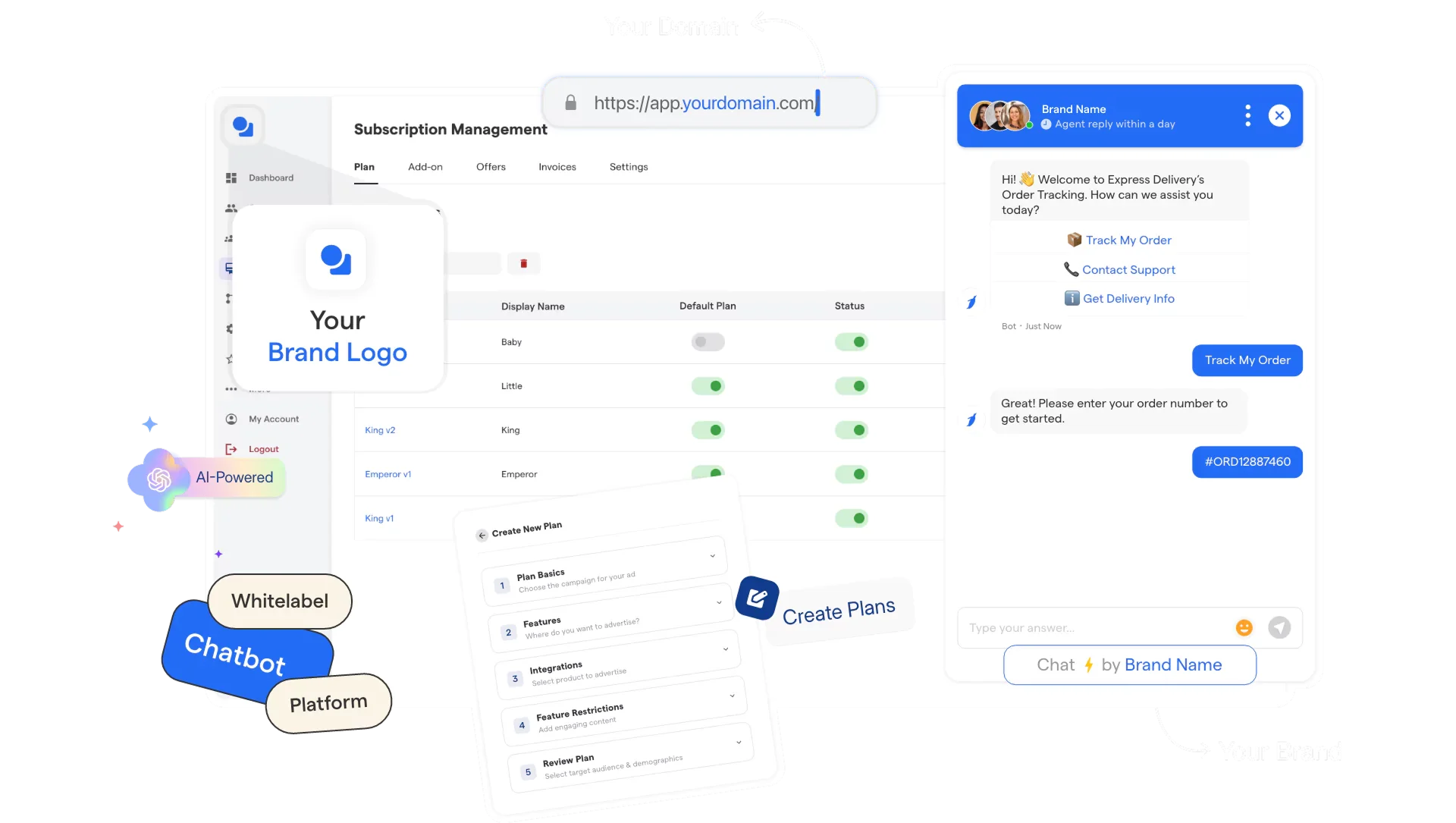
- Each client gets a separate branded workspace — your agency's domain, logo, and pricing, with no BotPenguin branding visible.
- All conversation data syncs automatically to the client's CRM or other tools via 80+ available integration options.
- One partner dashboard manages all client accounts with one login.
- BotPenguin is also an official Meta Business Partner, which adds credibility for client deployments on WhatsApp.
- Agency partner plans start at $1,500/yr with no revenue sharing — you keep 100% of what you charge clients.
Best use cases for small business clients: lead qualification, appointment booking, customer support automation, and eCommerce order tracking.
Tidio — Best for eCommerce Small Business Clients
Tidio combines live chat and AI automation in one tool. Strong Shopify and WooCommerce integrations make it a good fit for eCommerce SMB clients. The Lyro AI agent handles customer support queries automatically.
Core features agencies can position for clients:
- Live chat and AI support automation in one platform
- Shopify and WooCommerce integrations
- Customer support automation through Lyro AI
- Cart recovery and product recommendation support
Limitation for agencies: Tidio offers branding-related options on higher plans, but it is not built as a full white-label agency resale platform. Per-client delivery may still require separate account handling.
Best for: eCommerce clients on Shopify needing cart recovery and product recommendation automation.
Intercom — Best for SaaS Small Business Clients
Intercom's AI agent (Fin) handles complex customer support with high accuracy, trained on the client's help documentation. Strong CRM integrations with HubSpot, Salesforce, and Zendesk.
Core features agencies can position for clients:
- AI support agent trained on help documentation
- Strong customer support automation for SaaS teams
- CRM integrations with HubSpot, Salesforce, and Zendesk
- Useful for clients with high-volume support conversations
Limitation for agencies: Intercom uses seat-based and outcome-based pricing, which can become expensive for small-business clients as teams and support volume grow. No white-label options.
Best for: B2B SaaS small businesses with significant support volume.
ChatBase — Best for Knowledge Base Automation
ChatBase builds AI agents trained on a client's existing documentation or website content. Fast to set up, no technical expertise required.
Core features agencies can position for clients:
- AI agent trained on website content or documentation
- Fast setup for FAQ-heavy businesses
- No technical expertise required for basic deployment
- Strong fit for knowledge base and self-service automation
Limitation for agencies: Website only — no WhatsApp or social media integration.
Best for: Professional service businesses (lawyers, accountants, consultants) with comprehensive FAQ content.
ManyChat — Best for Instagram and Facebook Clients
ManyChat specializes in Meta channel automation — Instagram DMs and Facebook Messenger. Strong in social media lead-generation campaigns.
Core features agencies can position for clients:
- Instagram DM automation
- Facebook Messenger automation
- Social campaign lead capture
- Useful for comment-to-DM and campaign-driven workflows
Limitation for agencies: No WhatsApp Business API. No website chat. Limited to Meta channels.
Best for: Social media-first small businesses running regular Instagram or Facebook campaigns.
Zapier AI — Best for Workflow-Focused Clients
Zapier's AI layer connects AI capabilities to hundreds of apps — email, CRM, spreadsheets. More of an intelligent workflow automation tool than a conversational agent.
Core features agencies can position for clients:
- AI-powered workflow automation
- App-to-app process automation
- Email, CRM, and spreadsheet connectivity
- Useful for internal operations and repetitive back-office tasks
Best for: Operations-focused small businesses needing back-office automation rather than customer engagement.
Jasper AI — Best for Marketing Agencies Serving Content-Heavy SMBs
Jasper AI generates marketing content at scale — blog posts, ads, social media copy. Integrates with HubSpot's marketing hub for content workflow automation.
Core features agencies can position for clients:
- Blog, ad, and social media copy generation
- Marketing content workflow support
- HubSpot marketing hub integration
- Useful for clients with ongoing content production needs
Best for: SMBs with high content marketing needs, such as eCommerce brands or B2B companies with active content programs.
N8N — Best for Technical Agencies
n8n is an open-source workflow automation platform that can be configured as a sophisticated AI agent with custom logic. Highly flexible but requires technical expertise to set up and maintain.
Core features agencies can position for clients:
- Open-source workflow automation
- Custom AI agent logic
- Advanced integrations and workflow control
- Flexible setup for complex automation requirements
Best for: IT consultancies or development agencies with in-house technical staff serving enterprise SMB clients with complex automation requirements.
BotPenguin is the only platform in this list with full white-label capability. Agencies can deploy it across use cases using its white-label AI agent platform for agencies — under their own brand, their own pricing, and with 100% of client revenue retained.
Now, let's move to how agencies can deploy AI agents to small-business clients under their own brand.
How to Deploy AI Agents for Small Business Clients Under Your Brand
The fastest deployment path for agencies using BotPenguin follows a simple phased process. After all, agencies offering white label AI agents for small businesses need a deployment process that is repeatable across clients, channels, and use cases.
For agencies that want a broader view of branded deployment, our white-label AI agents guide can also help clarify how white-label ownership, client branding, and account control work.
The sections below explain the practical steps, considerations, and outcomes involved.
Week 1 — Client onboarding and workspace setup
Create a branded workspace for the client in BotPenguin's partner dashboard. Connect their website, WhatsApp Business account, and CRM.
Upload their product and service information, as well as FAQ content, to train the AI agent.
Week 2 — Agent configuration and testing
Build conversation flows for the client's primary use cases — lead qualification, appointment booking, or support deflection. Test across all channels.
Run simulated conversations to confirm AI responses are accurate.
Week 3 — Go live and first performance review
Deploy the agent live. Monitor conversations for the first 5–7 days.
Fix any gaps in the agent's knowledge base. Share a performance report with the client showing conversation volume, lead capture rate, and response accuracy.
Month 2 onwards — Monthly optimization
Review conversation logs monthly. Update the AI agent's training as the client's business evolves. Adjust channel deployment based on where the most conversations are happening.
Once deployment is structured, the next step is deciding how to price your AI agent services. The next section discusses that in depth.
Pricing AI Agent Services for Small Business Clients
Agencies comparing affordable AI agents for small-business clients should look beyond the monthly tool cost and evaluate margin, account control, setup effort, and potential for recurring billing.
The following three pricing models work well for agencies deploying AI agents for SMB clients:
- Monthly managed service: $200–500/month per client
Covers deployment, maintenance, and monthly optimization. The most common model for ongoing agency relationships.
- Setup plus maintenance: $500–1,500 one-time setup plus $150–350/month ongoing
Recovers the initial deployment investment while building recurring revenue.
- Performance-based: $15–30 per qualified lead captured
Higher upside for high-volume clients, but requires strong AI agent performance and clear lead-qualification criteria from the start.
For reference: BotPenguin's partner plan starts at $1,500/yr. At $300/month per client with 6 clients, the platform cost is recovered in the first month of revenue.
This is why agencies should price the service around client outcomes, not software access. A single small-business client paying $300–500/month for lead capture, support automation, or appointment booking can create predictable recurring revenue without increasing platform cost at the same rate.
For agencies, the stronger offer is not “AI software.” It is a managed AI agent for small business clients that improves response speed, captures more leads, and reduces manual follow-up.
Agencies still building their service model can also explore our guide on how to start an AI agent business before finalizing packages, retainers, and client onboarding workflows.
Once pricing is clear, the next step is deciding which use cases are easiest to sell and deliver. The following section breaks down the AI agent use cases that deliver the most value for small-business clients.
Use Cases That Drive the Most Value for Small Business Clients
The most valuable AI agent use cases for small-business clients are tied to clear outcomes: more qualified leads, faster replies, and fewer missed bookings.
That is why agencies should start with use cases that clients can measure quickly.
With BotPenguin, companies like TTRacing captured an estimated 15,000+ leads per month, while Galaxy Toyota generated 800+ qualified leads and increased test-drive bookings by an estimated 30–45%.
The following use cases are the easiest to package, explain, and report each month.
Lead Generation Agents
AI agents for lead generation help small-business clients convert more website and WhatsApp conversations into qualified opportunities.
The AI agent proactively engages website visitors and WhatsApp contacts, asks qualifying questions about budget, timeline, and specific needs, and captures contact details before passing qualified leads to the sales team or automatically booking a meeting.
For agencies selling lead-generation automation to small-business clients, this use case is often the easiest to connect to measurable client ROI.
Typical improvement: On average, 3–7x as many qualified leads as with static contact forms.
Customer Support Agents
AI agents for customer support help small-business clients reduce repetitive support workload while maintaining consistent response times.
The AI agent handles the top 20–30 most common customer queries automatically, available 24/7, escalating to a human agent only when questions fall outside its trained scope.
Most SMB clients see inbound support volume reduce by 40–60% within the first 30 days (approximately).
Appointment Booking Agents
Appointment-booking AI agents are especially useful for service businesses, where missed calls often mean missed revenue.
For service businesses — dental clinics, hair salons, legal consultancies, repair services — the AI agent handles booking requests across WhatsApp and website chat, checks availability, confirms appointments, sends reminders, and handles rescheduling.
Typically, these AI agents eliminate 80–90% of the phone-based booking workload (on average).
These use cases also represent some of the fastest paths to measurable results for small business clients.
By focusing on solutions that improve lead capture, customer communication, and operational efficiency, agencies can deliver clear value while creating scalable service offerings.
Frequently Asked Questions
What is the best AI agent for small business clients?
BotPenguin is the top AI agent for agencies serving small businesses because it combines omnichannel deployment (WhatsApp, website, Instagram, Facebook), a no-code builder, and full white-label capability. Agencies can resell it under their own brand with custom pricing and keep 100% of client revenue.
Can agencies white-label AI agents for small business clients?
Yes. BotPenguin's white-label platform lets agencies deploy AI agents for small-business clients under their own brand — with a custom domain, logo, and pricing. Clients see only the agency's branding. Agencies manage all client accounts from one dashboard and keep 100% of what they charge.
How much do AI agents cost for small businesses?
End-user plans range from free (limited) to $100–500/month. Agencies using BotPenguin's white-label program pay from $1,500/yr and can charge clients any price — typically $200–800/month per client, generating strong margins on the platform investment.
What use cases work best for AI agents in small businesses?
The three highest-ROI use cases: (1) lead generation — qualifying website visitors automatically, (2) customer support — handling FAQs 24/7, (3) appointment booking — automating scheduling for clinics, salons, and service businesses. All three are deployable via BotPenguin's white-label platform.
How do I choose the best AI agent for my small business clients?
Evaluate on four criteria: (1) channel support — WhatsApp, website, and social; (2) white-label availability — client-facing branding control; (3) no-code setup — no developer time per deployment; (4) pricing model — supports per-client billing. BotPenguin scores highest on all four.
What does an AI agent for small business clients do?
An AI agent for small-business clients can qualify leads, answer repeat-customer questions, book appointments, send follow-ups, update CRM records, and escalate complex conversations to a human. For agencies, this makes AI agents easier to package as a managed service instead of a one-time chatbot setup.
Can small businesses afford AI agents in 2026?
Yes. End-user AI agent plans start from free. For agencies, the white-label model is the most cost-effective. A single platform fee covers unlimited clients, with each client billed separately at the agency's margin. BotPenguin's partner plan starts at $1,500/yr.
Conclusion
Small-business clients do not need to know which AI agent platform you are using.
They need to know their business is getting more leads, better customer service, and saved staff time. Your job as an agency is to deliver those outcomes.
BotPenguin’s white-label platform helps you do it without building infrastructure from scratch.
The agencies adding AI agent services to their SMB client roster in 2026 are creating a new recurring revenue line that compounds as more clients are onboarded.
For agencies comparing the best AI agents for small-business clients, the strongest choice is the platform that supports branded delivery, client control, omnichannel deployment, and recurring revenue from a single platform.