Build Your Own White Label & Reseller AI Business - Chatbots, Agents & Voice, All Under One Program
Resell or white-label AI chatbots, AI agents, automations, and voicebots through our partner program.Your brand, your pricing, our infrastructure.


One White Label Platform. Four AI Solutions to Sell as Your Own.
From AI chatbots and AI agents to voicebots and automations, explore white-label AI solutions that go to market entirely under your brand.

White-Label AI Chatbots

Become a white label AI chatbot partner and put your brand on AI chatbots built for WhatsApp, Instagram, Facebook, Telegram, websites, and more. Your clients see your product. You keep every dollar.
Explore White-Label Chatbots ↗

White-Label AI Agents
Deploy white label AI agents that think, decide, and act, handling leads, appointments, and support across your clients' favorite platforms. Your brand, your margins.
White-Label AI Agents ↗

White-Label AI Voice Agents
White-label AI voice agents and bots that talk to customers, resolve queries, and book appointments, around the clock, no human needed.
White-Label Voice AI ↗

White-Label Marketing Automation
Bundle full-funnel automations. Lead capture, follow-ups, CRM sync, support routing into your offering across 80+ integrations.
Explore White-Label Automations ↗

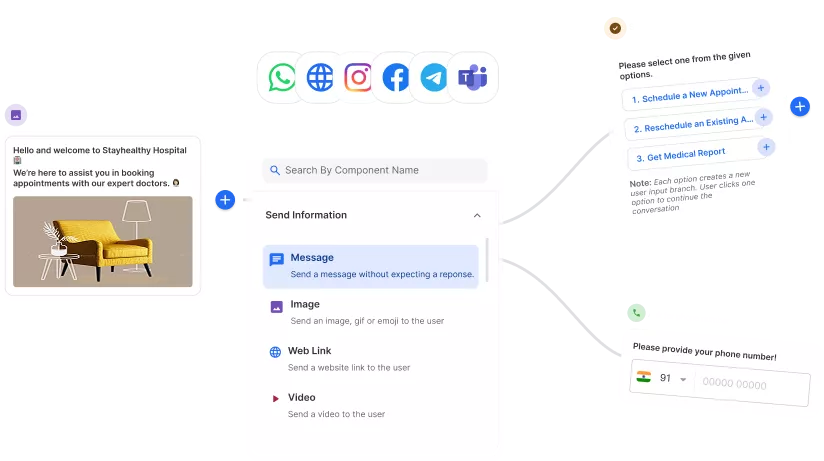

White Label AI Across Every Channel Your Clients Use
White label WhatsApp, Instagram, live chat, and SMS. Offer fully branded AI chatbots, agents, and automations across every channel your clients use, all under your name.

White-Label WhatsApp AI Chatbots
Launch a fully branded WhatsApp AI chatbot for your clients - customer support, broadcast campaigns, order updates, and lead qualification, all automated.
Explore White-Label WhatsApp
White-Label Instagram AI Chatbot
Sell branded Instagram chatbots that handle DMs, story replies, and lead capture and expand your clients' reach across every interaction.
Explore White-Label Instagram
Live Chat
White-Label Live Chat for Websites
Offer your own live chat experience on your clients' websites - AI-powered, agent-assisted, and customized to their brand.
Explore White-Label Live Chat
SMS
White-Label SMS Marketing Automation
Enable clients to run branded SMS broadcast campaigns, drip sequences, and keyword-triggered automations, white-labeled under your platform.
Explore White-Label SMSWhite Label AI Agents & Chatbots for Agencies, Built for Every Client Use Case
From lead generation and customer support to marketing and sales automation, give your clients AI chatbots that do the heavy lifting, under your brand.
Lead Generation
White-label AI chatbots that qualify leads, collect contacts, and sync to your clients' CRM, 24/7.
Customer Support
Branded AI chatbots that resolve FAQs, handle tickets, and escalate to live agents instantly.
Marketing Automation
Run broadcast campaigns, drip sequences, and WhatsApp automation, fully branded under your white-label AI agency.
Sales Automation
White-label chatbots that follow up, recommend products, and move prospects through the funnel automatically
Appointment Booking
AI chatbots that check availability, confirm bookings, and send reminders - branded as your own product

Reseller or White Label Partner Program? Pick the One That Suits You
Own a fully branded AI platform and keep 100% of your earnings, or resell BotPenguin's AI solutions and earn 30% recurring commission. Two programs, one goal: building a scalable AI business on your terms.
White-Label Program
From $1,500/year
Full white-label platform - your brand, domain, logo
Set your own pricing and subscription plans.
Keep 100% of every dollar you earn.
Sell to unlimited customers globally.
80+ native app integrations
Integrate your own payment gateway.
Dedicated partnership manager (add-on)
White-label help documentation for your clients (add-on)
On-premise hosting available (add-on)
Reseller Program
From $500/year
Earn 30% recurring commission
Dedicated partner panel
Enroll unlimited customers.
Create unlimited chatbots and AI agents.
Earn on every upsell, add-ons, and renewal.
Partner onboarding and training
Sales Support (Objection Handling) and Ongoing Customer Support
Done-for-you marketing collateral
Commission-Based AI Reselling - Earn 30% Commission with Our Reseller Chatbot Partner Program
With BotPenguin's chatbot reseller program, you own the client relationship, we become your product knowledge backup. Refer, resell, and earn 30% recurring commission on every AI chatbot, agent, and voicebot plan your clients subscribe to.
Resell AI Chatbots, Earn on Every Channel
Join BotPenguin's chatbot reseller program and sell AI chatbots that respond to queries, qualify leads, and book appointments for your clients, across every channel.
Resell AI Agents for Recurring Commissions
Offer your clients an AI workforce that updates CRMs, sends follow-ups, and completes tasks autonomously, and earn 30% commission on every seat.
Resell AI Voice for Call-based Revenue
Add AI voice agents to your reseller portfolio. Sell solutions that answer inbound calls, qualify leads, and schedule bookings without any human involvement.
Resell Automations, Earn on Each Workflow
Resell automated broadcast campaigns, drip sequences, and multi-step workflows. Recurring revenue for you, hands-free automation for your clients.
What Makes BotPenguin the Best AI Partner Program
Robust platform, real margins, and dedicated support - BotPenguin provides you everything you need to sell AI chatbots, agents, and voicebots successfully.
Vast Revenue Opportunities
Earn 30% recurring commission as a reseller or keep 100% of every dollar as a white-label partner.
White-Label Platform Empowerment
Launch a fully branded AI platform with your domain, logo, and pricing. Sell chatbots, agents, voicebots, and automations as your own.
Integrate Your Own Payment Gateway - A Key White Label Partner Benefit
White-label partners can connect Stripe, Razorpay, Paddle, Paymob, Moyasar, Lemon Squeezy, or PayPal and collect payments directly from clients - no middleman, no cuts.
Country-Specific Integrations for Every Market
From Shopify globally to Zid and Salla in the Middle East - white-label partners get region-specific integrations tailored to their clients' markets.
Generative AI-Powered Products
Offer clients multi-model conversational AI, custom LLMs, and agentic workflows - all built into one no-code platform.
Unlimited Sub-Accounts, Scalable Client Base
Create unlimited sub-accounts, AI voice agents, and automations. Onboard as many clients as your plan allows. No extra charges for seats.
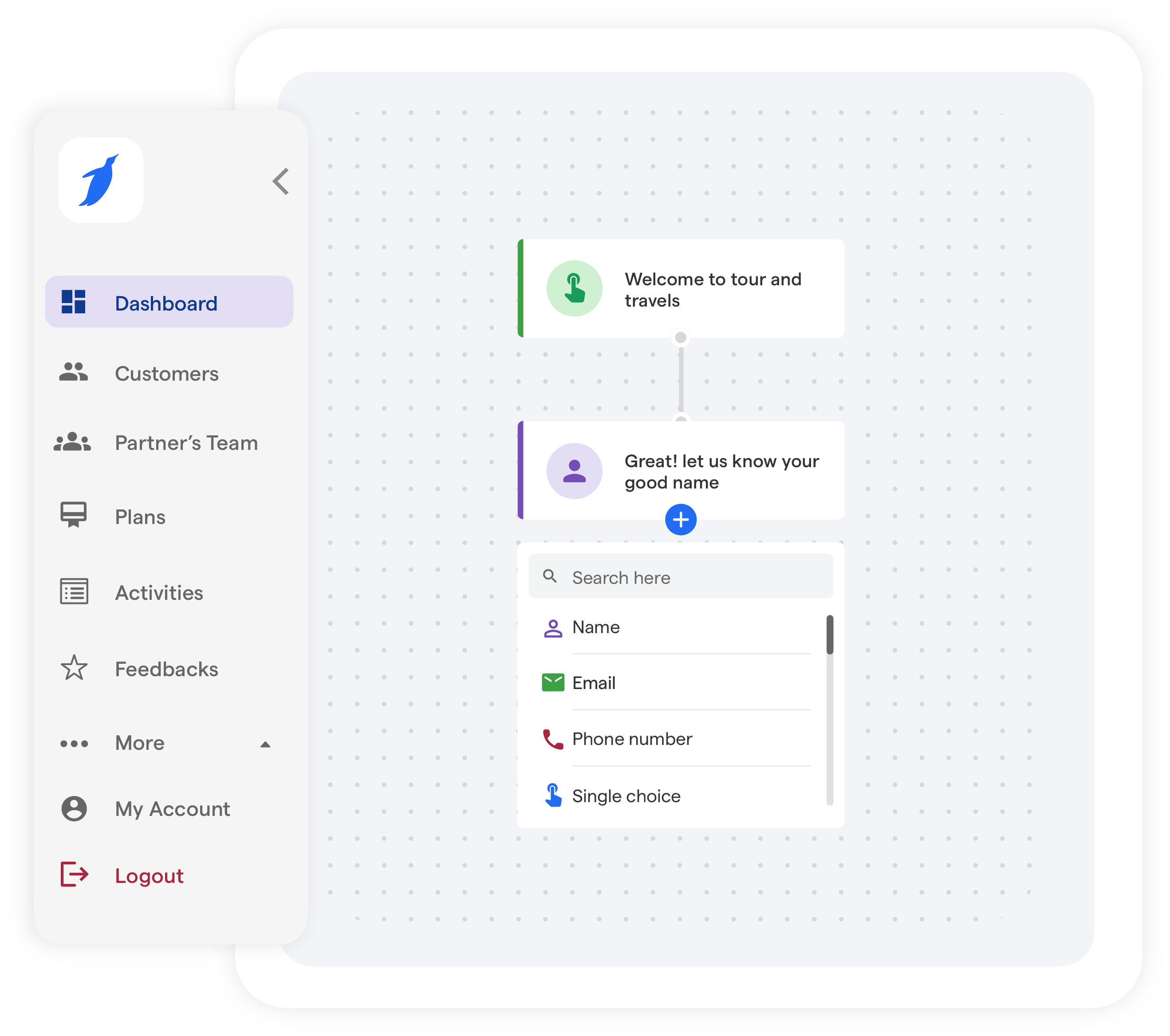
Onboard Your Team
Bring your entire team onto the partner platform - aligned, trained, and ready to manage clients and close deals together.
Design Your Own Plans
Build custom subscription tiers, bundle features, and set your own pricing, tailored to your revenue targets and clients' needs.
Acquire Bulk Message Packs
Buy message packs in bulk to meet growing client usage across WhatsApp and other channels without interruptions or overages.
Flexible Partnership Paths
Switch between reseller and white-label programs as your business grows. No lock-ins, no penalties, full flexibility.
Open for Joint Ventures
Co-build custom AI solutions with BotPenguin's team. Combine expertise and create offerings that neither could deliver alone.

We Back You With Every ResourceYou Need For Growth
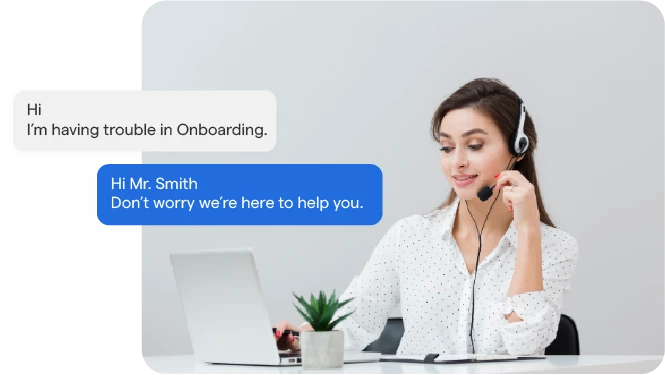
Every BotPenguin partner gets dedicated onboarding, technical support, and in-depth training to sell confidently and scale fast. Branded marketing kits available as an add-on.
White-Label

Ongoing Help Documentation Access
Updated help docs, video tutorials, and platform resources - white-labeled for your clients too.
White-Label Marketing Kit (Add-on)
Sales decks, promotional assets, and client acquisition material - all under your brand name.
Multi-Channel Technical Support
Technical support across time zones via email, support bot, or WhatsApp.
Hands-On Onboarding Sessions
Five guided sessions covering setup, onboarding, and platform management.
Reseller
Expert Tech and CS Support
Direct access to BotPenguin's technical and customer success teams, always.
Dedicated Reseller Dashboard
Track commissions, manage clients, and monitor subscriptions in one place.
Client-Ready Solutions
Pitch-ready AI packages, battle cards, and objection handlers for every prospect conversation.
Sales and Training Material
Ready-to-use sales collateral, scripts, and training guides to help you pitch and close faster.
Extensive Product Documentation
Step-by-step docs and video tutorials to keep your team up to speed.

Simple, Honest Pricing -
Pick the Program That Pays
No hidden costs, no surprises, just simple pricing structured around your business model and earning potential as a BotPenguin AI partner.
White-Label
$1,500/yr
- Starts at $1500/yr
- Keep 100% of your earnings and set your own client pricing.
- Customizable plans depending on add-ons.
Reseller
$500/yr
- Low entry investment - plans from $500/yr
- Earn 30% recurring commission on every plan and renewal.
- Quick payouts with no earnings cap and no lock-in.
Who Can Partner with BotPenguin?
Agencies, consultants, developers, or creators - BotPenguin's partner programs are designed to fit your business model.

Digital Marketing Agencies
White-label AI chatbots and agents for clients, fully branded, your pricing.

IT Consultancies
Embed a white-label enterprise chatbot platform into your consulting offering.

White-Label SaaS Entrepreneurs
Launch your own AI chatbot SaaS business, no coding, no infrastructure.
Strategic Tech Partners
Integrate white-label AI chatbots into your existing software as a native feature.
E-commerce Agencies
Offer white-label Shopify and WooCommerce chatbots for cart recovery and support.
CRM and ERP Vendors
Embed white-label conversational AI directly into your CRM or ERP product.
Hosting and Web Service Providers
Add white-label AI chatbots as a no-code upsell to your hosting offering.
Partner Success Stories, Across the Board
From chatbots to voice AI to automation, see how BotPenguin partners are turning every program into recurring revenue.
 South Africa IT Services
$94Krevenue from 58 clients
$94K White-Label AI Business in South Africa | BotPenguin Partner
A South African IT firm built a $94K white-label AI business on BotPenguin — 58 clients, 9x ROI, live in 10 days. Started Baby, scaled to Emperor. Verified partner WL-178.
Whitelabel WhatsAppWhitelabel Chatbots🇿🇦 Read story IT Agency · SaaS3×faster go-to-market
White Label Chatbot Platform: IT Agency Launches SaaS Business
See how a US IT agency ditched one-off project fees and launched a full SaaS chatbot business — 3x faster GTM, 90% less infra work, 100% their brand.
Whitelabel Chatbots🇺🇸 Read story Dubai IT Solutions3-Daymedian client deployment
White-Label AI Chatbot Business | Dubai, UAE | BotPenguin
A Dubai IT company achieved 9x ROI and $90K in partner revenue, with a 3-day median client deployment, the fastest in BotPenguin's entire partner cohort. Read the full story.
Whitelabel WhatsAppWhitelabel Chatbots🇦🇪 Read story