


Businesses are rapidly adopting chatbot tools for customer support, lead generation, and automation. That growth has also increased interest in chatbot affiliate marketing.
But joining a chatbot affiliate program is only the starting point.
Promoting chatbot tools requires a different approach from typical SaaS products. Users often need more context, clearer use cases, and stronger explanations before they decide to try the product.
That’s why successful chatbot affiliates focus less on dropping links and more on positioning the tool correctly for the right audience.
This blog explains what chatbot affiliate marketing is and how to promote chatbot tools effectively after joining an affiliate program. You’ll learn how to structure your content, positioning, and promotion to drive better conversions.
What Is Chatbot Affiliate Marketing? A Simple Walkthrough
Chatbot affiliate marketing is the process of promoting chatbot tools through an affiliate program to drive signups via your affiliate link.
Once you become a chatbot affiliate, you receive a tracking link and basic promotional assets. Your role is to bring users to the product and influence their decision to try it.
Unlike simpler tools, chatbot software often needs more explanation. Users may not immediately understand what it does or how it fits into their needs.
This changes how the affiliate model is applied.
In affiliate marketing for chatbots, success depends on how clearly you present the product and its value. You are not just sharing a link. You are helping users understand why the tool is worth trying.
To understand why this approach is necessary, it’s important to see how promoting chatbot tools differs from traditional affiliate marketing.
How Is Affiliate Marketing for Chatbots Different from Traditional Affiliate Marketing?
Chatbot affiliate marketing requires a deeper explanation, clearer positioning, and stronger user education than traditional affiliate marketing.
In traditional tools promotion, users already understand the product category. They know what the tool does, so decisions happen faster.
With chatbot tools, users often need more clarity before taking action. This changes how you approach promotion.
Key Differences at a Glance
What This Means for You
To succeed in chatbot affiliate marketing, your role changes. You are not just promoting a tool. You are:
- Explaining what the product does
- Showing where it fits
- Helping users connect it to their needs
This is why traditional affiliate tactics don’t work as effectively here.
You need a different marketing approach. The next section explains how this process works in practice.
How Chatbot Affiliate Marketing Works: A Step-by-Step Approach
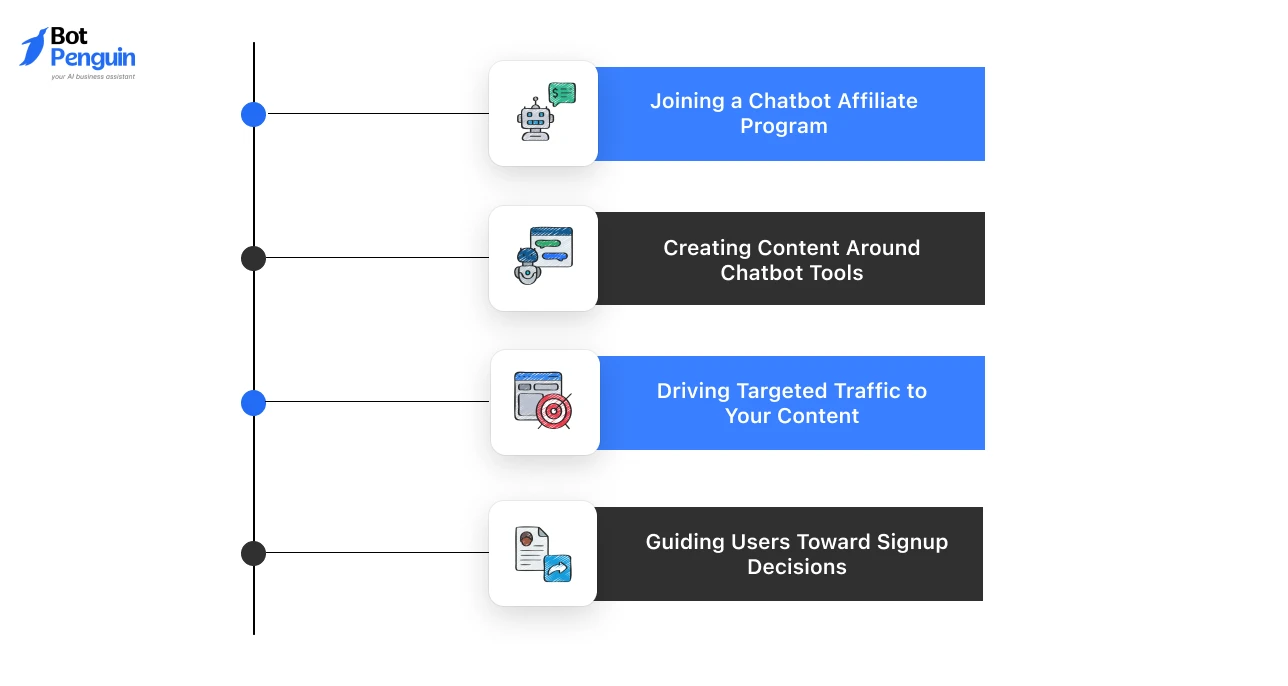
Unlike simple affiliate setups, marketing for chatbot affiliate programs is not just about sharing links. It follows a clear affiliate workflow that moves users from awareness to action.
1. Joining a Chatbot Affiliate Program
You start by joining a chatbot affiliate program and getting access to your promotion assets.
Once enrolled, you receive:
- A unique affiliate link
- Access to an affiliate dashboard
- Basic product resources and tracking tools
This setup allows you to track clicks, signups, and commissions. It forms the foundation of your affiliate model.
For example, BotPenguin’s chatbot affiliate program offers a well-organized dashboard, ready access to product information, and clearly defined chatbot use cases. This helps you quickly understand the product and market it more effectively in the next steps.
Curious about the top chatbot affiliate programs? Read our comprehensive guide comparing commissions, payout models, partner benefits, and earning potential.
2. Creating Content Around Chatbot Tools
You create content that explains chatbot tools, their benefits, and how they are used in real scenarios. This includes:
- Blog posts explaining chatbot features
- Tutorials showing how chatbot software works
- Use-case content like lead generation or customer support
The goal is not just visibility. It is to make the product easy to understand.
3. Driving Targeted Traffic to Your Content
You bring relevant users to your content using focused traffic channels.
Common traffic sources include:
- SEO-driven blog traffic
- Social media posts and communities
- Paid ads targeting specific audiences (in this case, ecommerce businesses, marketing agencies, or service providers looking to automate customer conversations)
The key is targeting users who are likely to benefit from chatbot tools.
4. Guiding Users Toward Signup Decisions
You move users from interest to action by clearly presenting value and relevance. To do this, you:
- Connect chatbot features to real outcomes.
- Address common doubts or confusion.
- Show where the tool fits into their workflow.
This completes the conversion path, which guides users from understanding to signing up via your affiliate link.
Now, let’s check the many channels you can choose to promote the chatbot affiliate program and reach the right audience, in detail, in the next section.
Where to Promote Chatbot Tools as an Affiliate
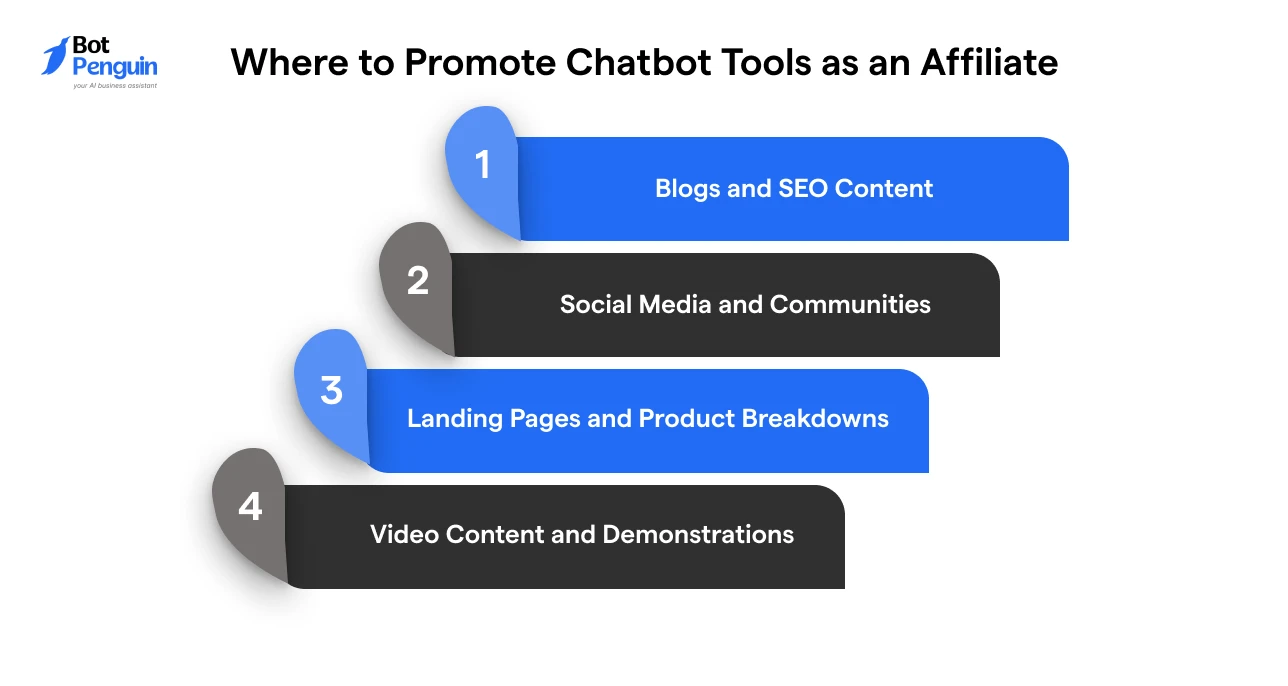
You should promote chatbot tools on blogs, social media, landing pages, and video platforms where you can clearly explain the product and its use cases.
These channels work best because they let you educate users before they decide to try the tool.
Below is how each channel helps a chatbot affiliate promote tools more effectively.
Blogs and SEO Content
Blogs help you educate users and attract high-intent traffic searching for chatbot solutions.
With SEO content, users already have a problem in mind. You can:
- Target keywords around chatbot use cases.
- Explain how chatbot tools solve specific problems.
- Position the product naturally within content.
This makes blogs one of the strongest channels for chatbot affiliate marketing because users arrive with intent and stay for clarity.
Social Media and Communities
Social platforms help you create awareness and direct users to your content. However, users on social media are not always ready to convert. They need exposure first.
You can:
- Share short insights or use cases.
- Post examples of chatbot applications.
- Drive users to deeper content, such as blogs or videos.
Communities (like LinkedIn groups or forums) work well for audience engagement and discussion-driven promotion.
Landing Pages and Product Breakdowns
Landing pages help simplify chatbot tools and guide users toward decisions. These pages act as focused explanations of the product.
You can:
- Break down features into simple benefits.
- Highlight specific use cases.
- Show clear outcomes users can expect.
A well-structured page reduces confusion and improves the conversion path.
Video Content and Demonstrations
Many users struggle to understand chatbot platforms solely through text. Videos help users understand chatbot tools more quickly through visual explanations.
With video, you can:
- Show how the tool works step-by-step.
- Demonstrate real use cases.
- Walk through features in action.
This makes video one of the most effective formats for understanding products and building trust.
Choosing the right channel is only the first step. The next step is identifying who you should target within those channels to make your promotion effective.
Who Should You Target in Chatbot Affiliate Marketing?
As a chatbot affiliate, you should target users who actively deal with customer conversations, lead generation, or repetitive communication tasks. Promotion works best when the audience already has a clear need for automation.
Targeting the right users improves content relevance, engagement, and conversion rates.
The following segments represent the most relevant audiences where chatbot tools naturally fit and are easier to promote.
How to Choose Your Audience
Choose one audience segment and align your entire content around it.
Pick a segment where chatbot use cases are obvious. Then build content that reflects their specific needs and workflows.
Focus on:
- One niche (ecommerce, agencies, service businesses)
- Use cases directly tied to that niche
Avoid targeting general audiences and users without a clear need for automation.
What This Means for Your Promotion
Focused targeting improves relevance and makes your content more effective.
Users respond faster when they see a clear connection between their problem and the solution. Consistent messaging across content also builds clarity and reduces confusion.
Result: Better engagement and higher conversion quality
Once the audience is defined, the next step is applying the right strategies to convert them effectively. Let’s go through them next.
Top Strategies to Succeed as a Chatbot Affiliate Marketer
Success in chatbot affiliate marketing depends on clear positioning, strong product explanation, trust-building, and reaching the right audience with the right content.
Chatbot tools do not sell through visibility alone. Conversions happen when users clearly understand how the product fits into their real needs.
The strategies table below summarizes what drives results.
Each strategy addresses a specific gap in how users understand and evaluate chatbot tools. The following sections break down how you can apply them in practice.
Focus on Use Cases, Not Features
Promoting chatbot tools works best when content highlights real use cases rather than listing features.
Features like automation, integrations, or workflows remain abstract for most users. Users relate better to:
- “Automate customer support on WhatsApp”
- “Capture leads on your website instantly”
Use cases make the product easier to understand, more relevant, and more actionable.
As a chatbot affiliate, you should answer, “Where can I use this?” rather than “What does this do?”
Simplify Complex Chatbot Products
Chatbot platforms often appear complex at first glance. Thus, clear and simple explanations improve understanding and increase conversions.
Avoid technical jargon and long feature lists.
Focus on:
- One function at a time
- Simple language
- Outcome-based explanations
Example: “Multi-channel automation” becomes “Respond to customers automatically on WhatsApp and your website”.
Build Trust Through Education
Educational content builds confidence and reduces hesitation before users sign up.
Many users hesitate because:
- Product understanding is incomplete.
- Practical value is unclear.
Strong content includes: Tutorials, real scenarios, and common question breakdowns
Educational marketing reduces uncertainty and builds trust, both of which play a major role in conversions.
Target the Right Audience Segments
Better results come from targeting users who actually need chatbot automation. Broad targeting reduces relevance.
Focus on: Businesses handling customer queries, marketers generating leads, and teams managing repetitive conversations
Strong targeting requires:
- Niche selection
- Tailored messaging
- Relevant examples
Combine Content Types for Better Reach
Users consume content differently. Thus, multiple content formats improve visibility and engagement across different user preferences.
Effective combinations include:
- Blogs for detailed explanation
- Videos for demonstrations
- Social posts for discovery
Each format supports the others. Social drives traffic, blogs educate, and videos build clarity.
A structured mix of these content types helps increase reach and engagement, benefiting you greatly as a chatbot affiliate.
Clear strategies set the direction, but avoiding common mistakes is just as important for consistent results. Let’s find out what they are in the next section.
Common Mistakes to Avoid in Chatbot Affiliate Marketing
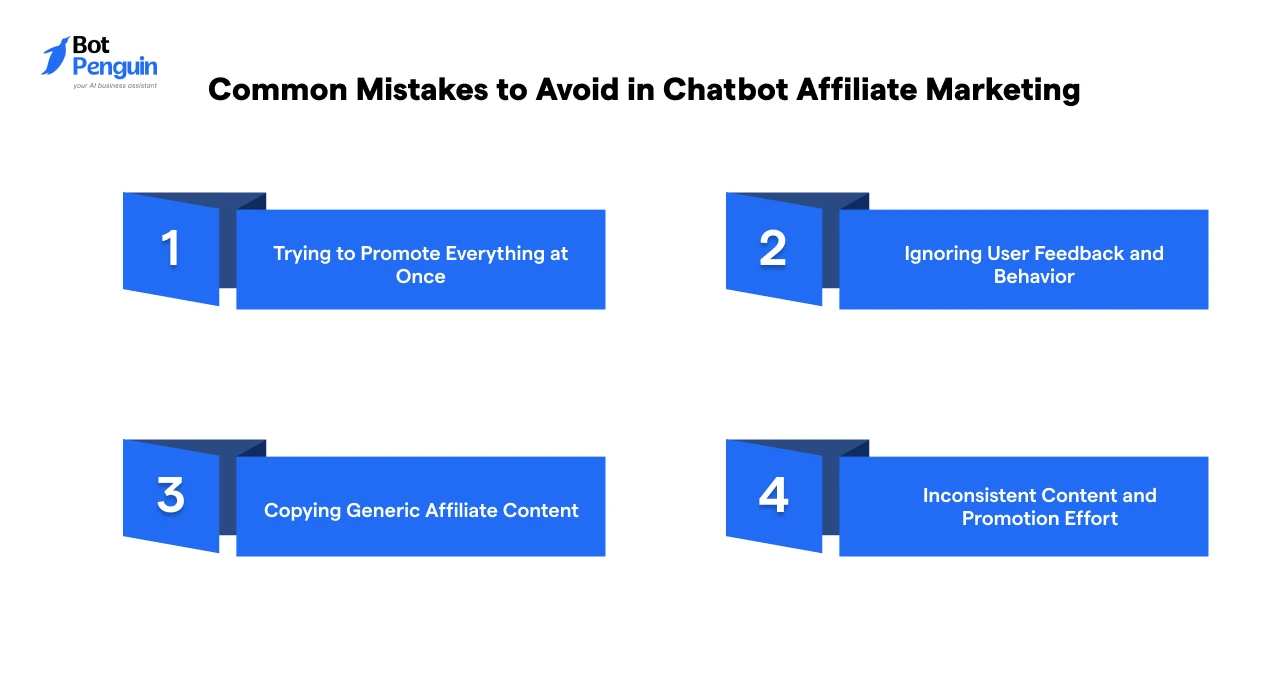
Key pitfalls in chatbot affiliate marketing include promoting without focus, ignoring user feedback, copying generic content, and being inconsistent in execution. These issues reduce clarity, weaken messaging, and limit conversions even when traffic is strong.
Below are common pitfalls and solutions to fix them for better results.
Mistake 1: Trying to Promote Everything at Once
Covering too many features or use cases in a single place makes it harder for users to understand which action to take.
Solution:
- Focus on one use case per content piece.
- Create separate content for different scenarios.
- Keep messaging specific and outcome-driven.
Mistake 2: Ignoring User Feedback and Behavior
Lack of visibility into what users engage with prevents you from improving your promotion approach.
Solution:
- Track which content drives clicks and engagement.
- Identify drop-off points in your content.
- Refine messaging based on actual user behavior.
Mistake 3: Copying Generic Affiliate Content
Using the same messaging as other affiliates removes differentiation and makes your content easy to ignore.
Solution:
- Add original explanations and examples.
- Break down chatbot tools in your own way.
- Focus on clarity instead of copying structure.
Mistake 4: Inconsistent Content and Promotion Effort
Irregular publishing slows momentum and reduces your chances of building visibility over time.
Solution:
- Maintain a consistent publishing schedule.
- Build content around a clear theme or niche.
- Continue promoting even when early results are slow.
Avoiding these mistakes strengthens your execution and improves long-term results. Now, let’s move on to the exact way you can start promoting a chatbot tool after joining an affiliate program.
How to Start Promoting a Chatbot Tool as an Affiliate
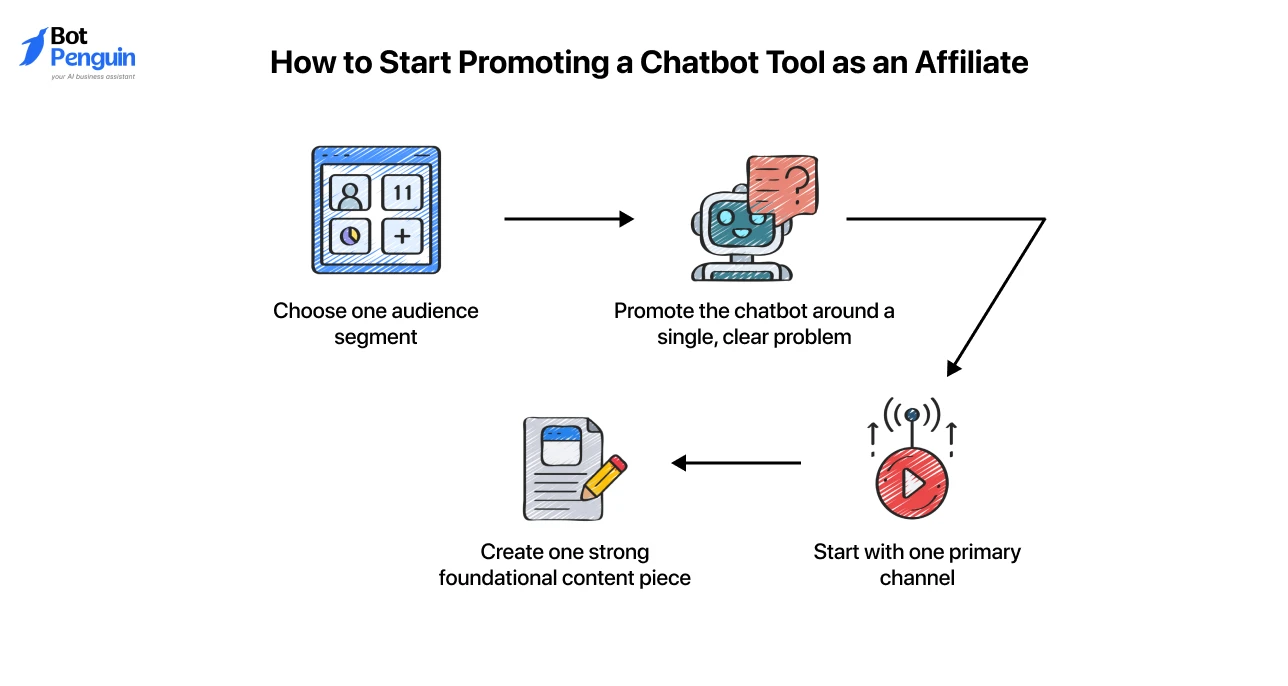
You should start promoting a chatbot tool as an affiliate by choosing a clear niche, creating focused content, and staying consistent with one promotion channel. However, starting without structure often leads to scattered messaging and weak positioning.
The focused setup provided below helps you move faster and stay consistent.
- Choose one audience segment, like ecommerce businesses, agencies, or service providers. Focused targeting improves relevance and makes content easier to position.
- Promote the chatbot around a single, clear problem rather than explaining every feature. Lead generation, support automation, or appointment booking are easier angles for users to understand.
- Start with one primary channel, such as blogging, YouTube, or LinkedIn. Consistency on one platform builds stronger visibility than spreading efforts too early.
- Create one strong foundational content piece before publishing multiple smaller ones. A detailed guide, tutorial, or use-case breakdown builds trust faster.
This framework gives you a practical starting point for chatbot affiliate marketing. Partner programs like BotPenguin make this easier with clearly defined use cases and structured partner resources.
Want a more detailed breakdown? Read our complete guide on how to start a chatbot affiliate business to learn setup, positioning, and scaling strategies in depth.
Final Thoughts
Chatbot affiliate marketing is not about pushing links. It is about making the product easy to understand and relevant to the user.
This blog covered how the approach differs from traditional affiliate marketing, what the process looks like, where to promote, and which strategies actually drive results.
Each section builds toward one goal. Help users see how chatbot tools fit into their needs before expecting them to sign up.
Consistent execution, clear positioning, and focused messaging create long-term results.
Chatbot affiliates who treat chatbot tools like explainable solutions, not just products, are the ones who see steady growth over time.
Frequently Asked Questions (FAQs)
What is chatbot affiliate marketing?
Chatbot affiliate marketing is the process of promoting chatbot tools through affiliate links and earning commissions when users sign up or purchase.
How to choose the right target audience for chatbot affiliate marketing?
Target users who handle customer interactions or lead generation. Businesses with repetitive communication needs convert better than general audiences.
Do I need technical knowledge to promote chatbot tools?
No. A clear understanding of use cases and outcomes matters more than technical depth. Simple explanations perform better than complex breakdowns.
How long does it take to see results in chatbot affiliate marketing?
Results of marketing efforts for a chatbot affiliate program depend on consistency and content quality. Most affiliates start seeing traction after building focused content for a few weeks to months.
What type of content works best for chatbot affiliate marketing?
Blogs, tutorials, product breakdowns, videos, and real-world use-case content work best because they help users understand chatbot tools clearly.
Which audiences convert best for chatbot affiliate marketing?
Ecommerce businesses, agencies, SaaS companies, and service providers convert well because they actively use customer communication and automation tools.
What are the biggest mistakes in chatbot affiliate marketing?
Common mistakes include broad targeting, unclear messaging, inconsistent content, and explaining too many features at once.
Are there beginner-friendly chatbot affiliate programs?
Yes. Programs like BotPenguin’s chatbot affiliate program offer defined use cases and resources, making it easier for beginners to start promoting effectively.