



How to Add a Chatbot to Your Website: A Complete Step-by-Step Guide
Updated at Oct 6, 2026
17 min to read
AI only becomes a problem if nobody is responsible for what it does.
Companies today already have access to powerful AI tools, models, and platforms, yet many AI initiatives still stall or fail to deliver meaningful results. The issue is often not the technology itself. It is the lack of clear ownership, decision-making structures, accountability, and oversight.
In fact, McKinsey states that only 39% of Fortune 100 companies have any formal board-level oversight of AI, despite 88% already using it across business functions.
This is why we believe AI transformation is a problem of governance, not technology.
In this guide, we’ve covered what governance in the AI transformation context actually means, why it matters, and how it shapes successful AI-driven digital transformation.
AI transformation depends on how organizations define ownership, decision-making, accountability, and oversight around AI systems.
That means, while technology enables deployment, it is the governance structure around it that determines whether AI creates real business value.
For instance, when Google launched Gemini's image generation feature, the biased and historically inaccurate outputs forced CEO Sundar Pichai to personally call the outcome “completely unacceptable”. Here, the tech wasn't the problem; the missing governance guardrails were.
The real challenges vis-à-vis AI success come from decision rights, cross-team alignment, data control, and a lack of execution structure.
Here’s why the real constraints are almost never technical:
However, when it comes to governance, without clear ownership and coordination, even the role of AI in digital transformation cannot translate into real business impact.
Another common confusion in this space is mixing up AI adoption with AI transformation. Although often used interchangeably, they mean very different things.
AI adoption is the act of integrating AI tools into existing workflows to improve efficiency. AI transformation refers to the fundamental rewiring of how a business operates, makes decisions, and creates value, with AI embedded at its core.
Below, we've broken down the difference across six key dimensions:
The distinction matters because most organizations mistake adoption for transformation. Real AI transformation only happens when governance ensures AI is accountable, scalable, and aligned with business outcomes.
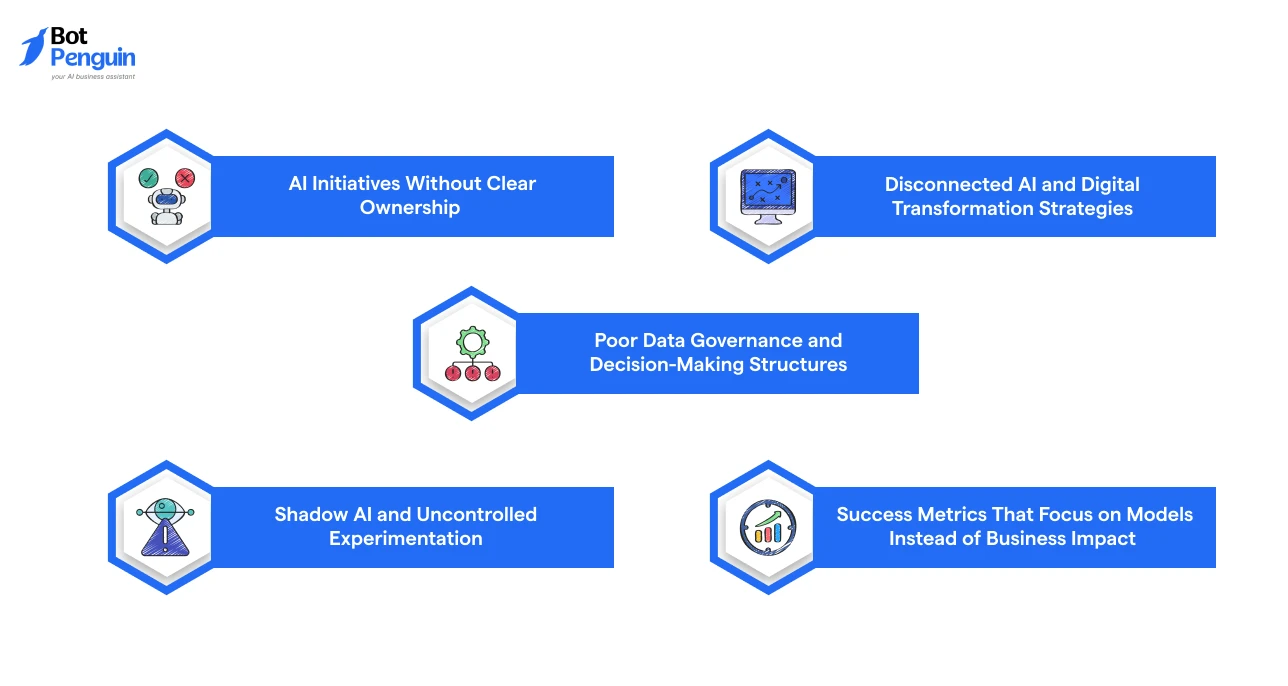
AI transformation fails when budgets go into tools, but governance does not define how AI should be owned, measured, and scaled. Common failure patterns include:
IT owns the platform, operations owns the workflow, and leadership expects results, but nobody owns the outcome. This split creates slow approvals, unclear accountability, and stalled adoption.
When AI use cases don't connect to process redesign, customer experience, or revenue goals, they remain isolated experiments rather than drivers of real transformation.
If teams work from fragmented databases or unclear approval rules, even the strongest models produce weak, untrustworthy decisions.
Employees using unapproved AI tools to save time can expose customer data, create compliance gaps, and produce inconsistent outputs across the business.
A Software AG study found that 50% of employees were already using unauthorized AI tools at work, and most wouldn’t stop even if banned!
Accuracy alone doesn't prove transformation. Adoption rates, time saved, cost reduction, and business outcomes matter just as much.
These failure patterns are often seen in organizations that treat AI as a technology rollout rather than a governance challenge.
However, platforms like BotPenguin are already leading the charge with well-governed AI practices for chatbot or agent development. Backed by built-in compliance with GDPR, SOC 2, CCPA, and HIPAA, AI deployment stays accountable, audit-ready, and aligned with business outcomes.
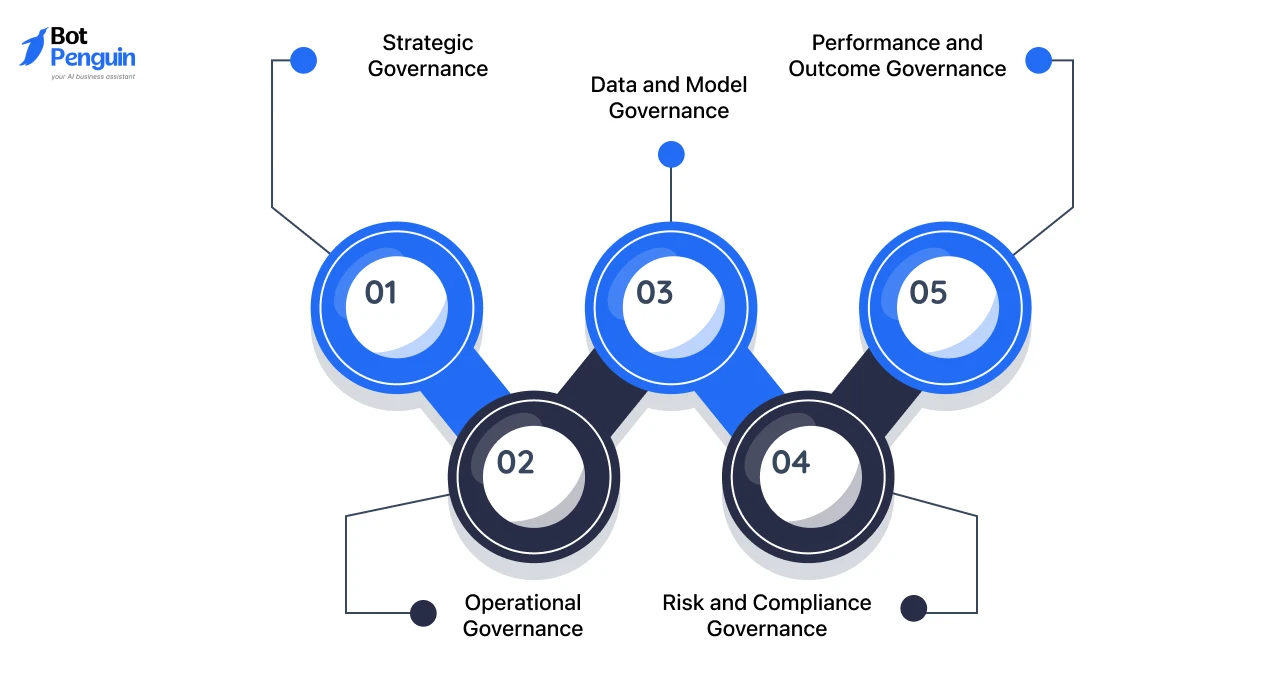
Governance defines how AI is directed, controlled, and measured across the organization.
In this section, we break down the five governance pillars that separate organizations scaling AI successfully from those stuck in pilot mode.
(Add an image here.)
This defines how AI aligns with business goals and where it should be applied. Without it, teams chase interesting use cases instead of impactful ones.
High-performing organizations gate every AI use case against a business impact threshold before committing resources to scale.
This refers to managing ownership and execution of AI initiatives across teams. The moment ownership is unclear, execution stalls.
JPMorgan Chase uses a “quad structure” bringing together Product, Technology, Design, and Data & Analytics teams around every AI initiative, ensuring shared visibility, clear ownership, and a unified roadmap.
This pillar controls data quality, access, and model lifecycle management. Garbage in, garbage out; no model performs better than the data behind it.
Governance-conscious organizations implement tiered data access. Only authorized teams interact with sensitive data used to train production models.
This ensures AI systems follow legal, ethical, and security standards. Skipping this step doesn't eliminate risk; it just delays it.
Financial institutions running AI-driven credit or risk models typically require mandatory bias audits and compliance sign-off before every deployment or update cycle.
This is all about measuring whether AI creates real business value. Tracking model accuracy without tracking business outcomes is like optimizing a process nobody asked for.
Likewise, mature AI programs tie every initiative to a measurable outcome: cost saved, revenue influenced, or time reduced, reviewed quarterly against pre-defined targets.
In fact, organizations that operate across all five pillars consistently see faster scaling, fewer failures, and stronger business outcomes than those treating governance as an afterthought.
Once this governance framework is clear, it becomes easier to identify where the real risks and gaps live. Let's explore the core areas of concern in the next section.
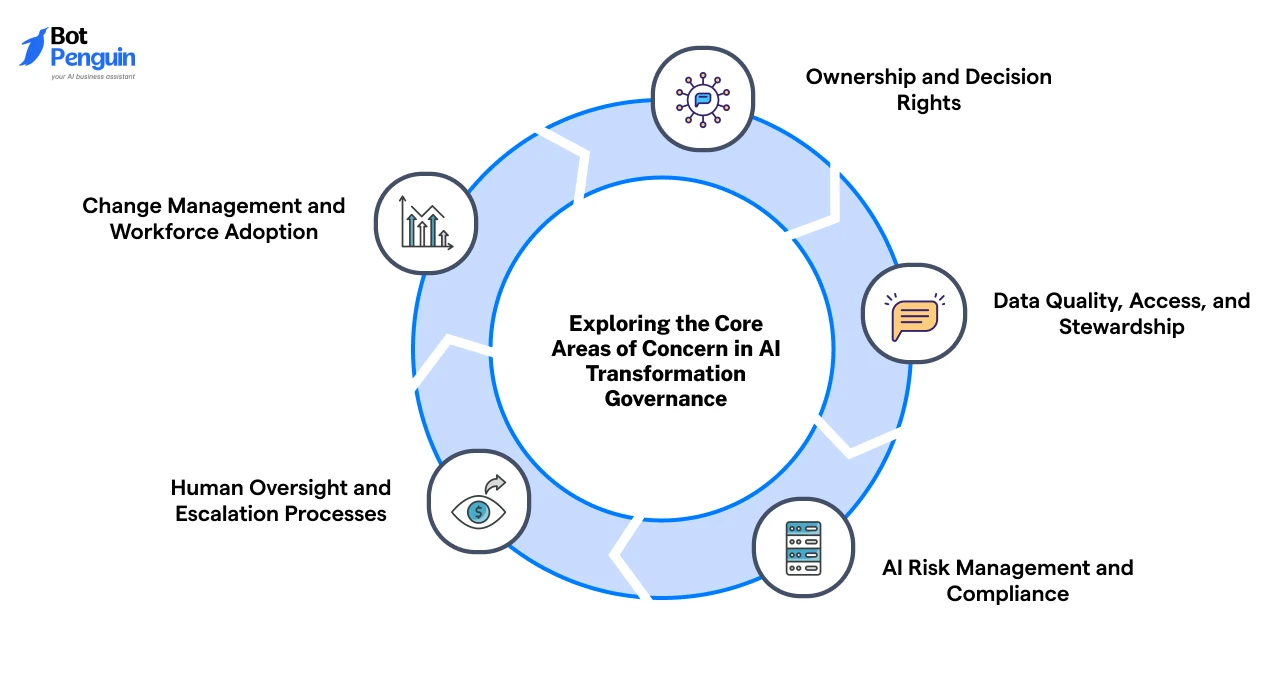
A governance framework tells you how to govern. These core areas tell you what to govern.
Miss any one of them, and your AI systems either stall, produce unreliable outputs, or create risks you didn't see coming.
Addressing these five areas consistently is what separates organizations that govern AI with confidence from those that manage it reactively.
Good governance isn't abstract, but shows up in everyday decisions about who owns what, who can access what, and what gets reviewed before it goes live.
Here’s what it looks like in practice:
In short, strong governance turns AI from isolated experiments into a controlled, scalable transformation.
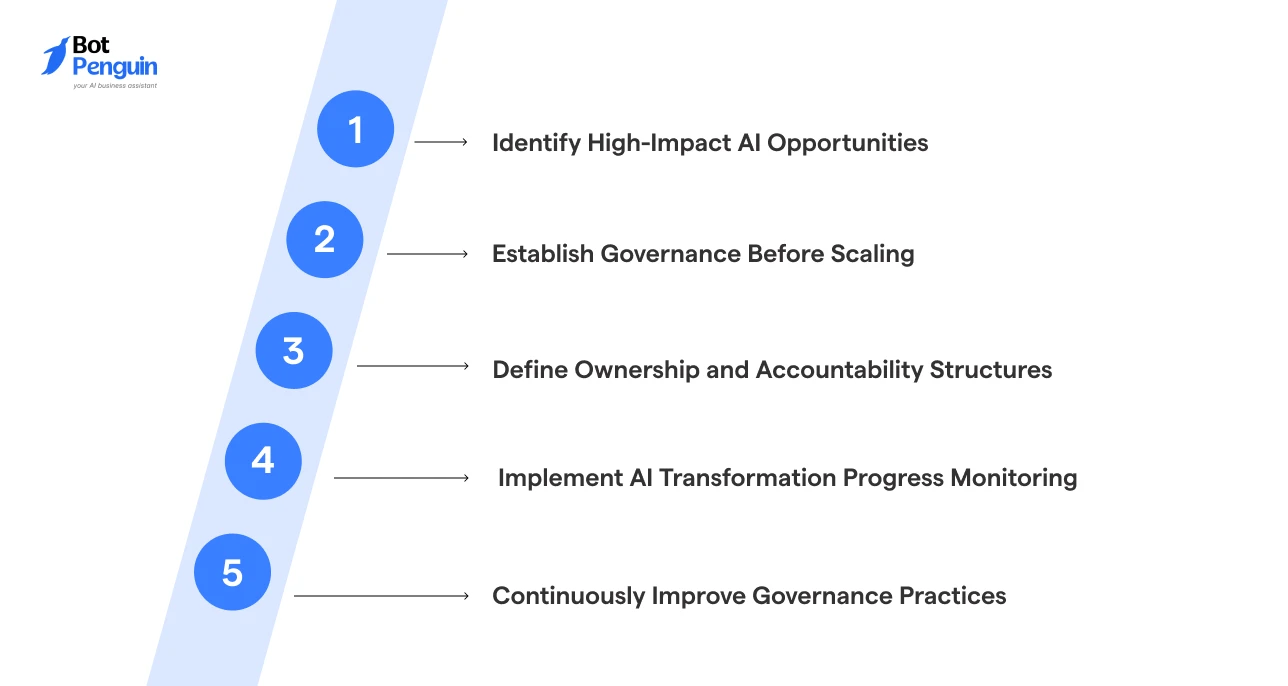
A governance-first roadmap ensures AI is structured before it is scaled. Without this sequence, organizations often expand AI use faster than they can control it.
Here's a step-by-step guide to building an AI transformation roadmap that puts governance at the center:
Start by focusing on use cases that directly affect revenue, efficiency, or customer experience.
This step is really about aligning AI investments with business priorities from the start. Avoid experimenting without clear business value.
Example: A support automation that cuts resolution time by 40% is a stronger starting point than an internal tool with unclear ROI.
Set decision rules, approval flows, and data controls before expanding AI initiatives. Governance cannot be retrofitted at scale.
Assign clear owners for each AI initiative. Every model, workflow, and outcome must have a responsible stakeholder tied to it.
For instance, a designated model owner reviews outputs, flags anomalies, and approves updates before they influence any business decision.
Track adoption, performance, and business impact continuously. Monitoring should connect AI outputs to measurable business outcomes, not just technical accuracy.
A low adoption rate usually signals poor workflow integration or insufficient training, not a model problem.
Governance is not static. As AI evolves, update policies, controls, and workflows to address new risks and opportunities.
For example, repurposing customer support data for personalization models requires a formal policy review, not a workaround.
A structured roadmap thus ensures AI transformation does not become fragmented experimentation but a controlled, scalable system aligned with business priorities.
For AI transformation to be really impactful, leaders must track adoption, efficiency, outcomes, risk, and governance maturity, not just system deployment.
The table below showcases each metric area along with acceptable scores:
*Note: Scores above are indicative benchmarks. Actual thresholds will vary by industry, organization size, and AI maturity.
In summary:
These metrics work well for governing traditional AI systems. But as we move forward to generative AI, the monitoring goalposts shift significantly.
In the next section, let's see how generative AI reshapes governance responsibilities and what organizations need to do differently to stay in control.
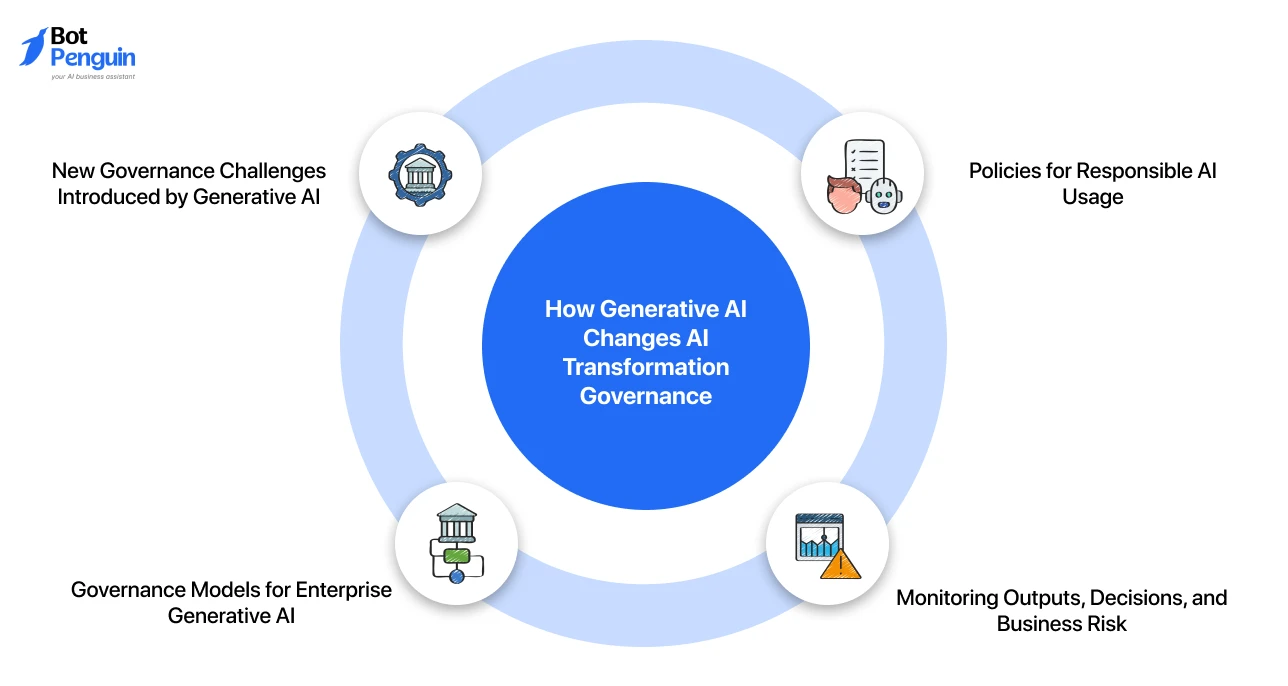
Generative AI for business transformation changes the nature of governance because it doesn’t just process information; it creates it. That shift makes control more complex because outputs are no longer fixed or predictable.
With generative AI in the picture, hallucinations, biased responses, data leakage, and unsafe outputs can surface at scale and often without warning.
What used to be contained in structured AI systems is now more fluid and harder to predict.
For instance, two New York lawyers were sanctioned by a federal court after submitting briefs with entirely fabricated case citations generated by ChatGPT, a direct result of using generative AI without oversight controls.
You need clear, simple rules on where generative AI can be used, what data is off-limits, and when human review is required.
If people don’t understand the boundaries, they will test them.
Monitoring can’t stop at accuracy scores anymore.
You need to look at real outputs; what the AI is actually producing and whether those outputs create risk, confusion, or business impact.
A customer-facing AI that consistently recommends the wrong product tier may score well on response accuracy but still quietly erode revenue and customer trust.
Most enterprises are moving toward a hybrid approach: centralized guardrails with decentralized usage. It keeps control at the core, while still allowing teams to move fast where it makes sense.
Thus, generative AI doesn’t reduce the need for governance; it makes it more immediate, more visible, and far harder to ignore. Next, we’ll look at what governing AI automation transformation means for different business functions.
AI governance touches every team that uses AI to make decisions, create content, or interact with customers. Here's how it applies across core business functions:
Here, every function introduces its own governance risks, which is why governance cannot live only with the IT or data team.
At this stage, it's also crucial to recognize the governance mistakes that organizations most commonly make, even after frameworks are in place.
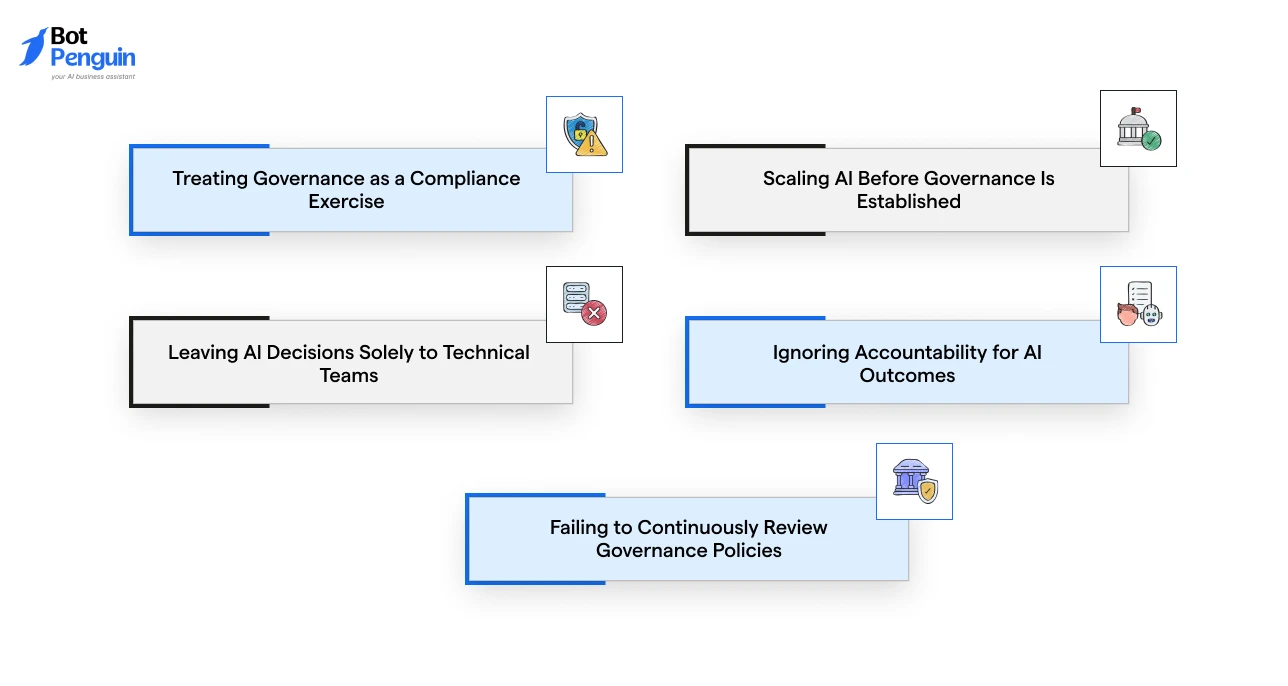
Even when organizations put governance structures in place, AI transformation doesn’t automatically stabilize.
The problem is that governance is often treated as a one-time setup instead of an ongoing discipline. Here’s what you should consider:
Governance should guide decisions, not sit as documentation. When it becomes a checklist activity, teams follow rules without improving outcomes.
AI is not just a technical function. When business teams step back, decisions become misaligned with real-world goals and priorities.
Many organizations expand AI use too quickly. Without foundational governance, scaling only amplifies existing confusion and risk.
If no one owns the result, no one improves it. Lack of accountability leads to weak performance tracking and unresolved failures.
AI systems change fast. Governance that is not regularly updated quickly becomes outdated and ineffective.
Remember: Governance is not a setup task. It is an ongoing system that must evolve with every stage of AI maturity.
If you're looking for a starting point, BotPenguin's chatbot and AI agent platform gives you a governed foundation from day one, with built-in compliance across GDPR, SOC 2, CCPA, and HIPAA, so your AI deployment stays accountable as it scales.
Access to AI models, tools, and platforms is being increasingly commoditized. What will separate leaders from laggards in the future is the ability to deploy AI responsibly, consistently, and at scale. That requires governance.
Regulatory pressure is already accelerating this shift. The EU AI Act, emerging US federal guidelines, and cross-border data regulations are making governance a legal obligation, not just a best practice.
Organizations that build governance infrastructure now will:
The future of AI transformation isn't just intelligent; it's governed.
AI transformation doesn’t usually fail because the technology is weak.
It fails because no one is really steering it. When ownership is unclear, things slow down. When data is messy, outputs lose trust. When accountability is missing, problems just sit there.
These gaps quietly stop AI from moving beyond pilots.
What works is simple. Teams treat governance as something that keeps evolving, not something they set up once and forget. They define who owns what, keep checking outcomes, and fix issues as they show up.
AI can do a lot, but without direction, it drifts. Governance is what keeps it focused, useful, and tied to real business results.
AI transformation governance is the system of policies, owners, controls, metrics, and review processes that guide responsible AI use across business functions.
AI transformation is a governance problem because success depends on ownership, accountability, data controls, risk management, and business alignment, not tools alone.
Technology can be bought, upgraded, or replaced, but unclear decision rights, weak oversight, and poor adoption structures stop AI from creating value.
AI governance differs from IT governance because AI systems are probabilistic, data-dependent, continuously changing, and require ongoing monitoring, human oversight, and risk controls.
Governance supports AI-driven digital transformation by connecting AI initiatives to business goals, workflow redesign, compliance needs, and measurable performance outcomes.
Poor AI governance creates risks such as biased outputs, data exposure, regulatory gaps, shadow AI usage, inconsistent decisions, and unclear accountability.
Leaders should track adoption, usage, workflow efficiency, cost savings, escalation rates, compliance incidents, business outcomes, and AI governance maturity.
Businesses can start by selecting high-impact AI use cases, assigning owners, defining controls, monitoring outcomes, and improving governance before scaling.
Make AI Transformation Work With Strong Governance for AI Chatbots & Agents
Define clear governance to align AI with business goals, control risk, and ensure every initiative delivers real, measurable impact.
Explore Now!Checkout our related blogs you will love.
Updated at Oct 6, 2026
17 min to read
Updated at Sep 28, 2026
15 min to read
Updated at Sep 28, 2026
19 min to read
Updated at Sep 25, 2026
9 min to read
Updated at Sep 1, 2026
10 min to read
Updated at Jun 24, 2026
10 min to read
Table of Contents