


AI customer service agents are reducing support volume by 40 to 60% at the companies deploying them in 2026. The market for AI agents for customer support is growing at 25.8% CAGR. And the overwhelming majority of content written about this topic is aimed at enterprise support teams with 500-seat contact centers.
This guide is not for them.
It is for agencies and managed service providers who want to offer AI customer support as a service to clients.
Who needs to know which platforms support white labeling, which deploy across WhatsApp, website, and social simultaneously, and which give full control over client billing and revenue.
If you run a support team yourself and want to automate it, the platforms covered here will serve you, too. But the evaluation criteria are set up for agencies first.
What Are AI Customer Service Agents?
AI customer service agents are autonomous systems that handle customer queries, resolve issues, and manage conversations without human input at each step.
Unlike rule-based chatbots with fixed scripts, they understand context, access real-time business data across CRM and order management systems, execute multi-step workflows — processing refunds, booking appointments, updating account details — and escalate to human agents when conversations require it.
The key distinction from chatbots is autonomy.
A chatbot answers questions. An AI customer service agent completes tasks — and it can do so across WhatsApp, website chat, Instagram, Facebook Messenger, and voice simultaneously, with all interaction data syncing to the client's CRM in real time.
Gartner projects that AI agents will handle 80% of routine customer service interactions without human involvement by 2029.
In 2026, leading deployments are already landing between 55% and 70% automation rates for structured support workflows.
Why Agencies Are Offering AI Customer Support as a Service in 2026
Agencies that moved early on AI customer support are now closing clients with case studies. Here is what is driving the shift.
Three market conditions make 2026 the clearest window to add AI customer support to your service stack.
1. The results are now measurable and client-presentable
A 40 to 60% support volume reduction in 30 days is a number that holds up in a quarterly business review.
Agencies that deployed AI customer service agents for clients 12 months ago have real performance data to show. That changes the sales conversation entirely. You are no longer selling a concept. You are selling a proven outcome.
2. Clients are already asking for it
Customer service AI has crossed into mainstream business media. Your clients have read about it in Forbes, seen it in competitor announcements, and are wondering why their agency has not brought it up. If you do not offer it, the agency down the road will. This is no longer a differentiator. It is a baseline expectation.
3. It builds the stickiest retainer in agency history
A client with AI agents for customer support embedded across their website and WhatsApp, trained on their product catalog, and connected to their CRM does not churn.
The switching cost is too high. The muscle memory is too deep. This is the kind of service that renews without a conversation.
4. The economics hold up, too
Customer support automation for agencies runs at $200 to $600 per month per client. Once the initial setup is done, ongoing maintenance takes 1 to 2 hours a month.
White label deployment means your agency brand owns every client touchpoint. The platform vendor stays invisible.
That is recurring revenue at a high margin with low ongoing effort.
Knowing why the market is moving is one part of the picture. Knowing what to look for in a platform before you commit to deploying it for clients is the next step.
Ready to add AI customer support to your service offering? See how BotPenguin's white-label AI agent platform works for agencies.
What to Look For in AI Customer Service Agents (Agency Perspective)
Picking the wrong platform costs you a client. Here is what actually matters when evaluating an AI support agent platform for agencies.
Enterprise buyers evaluate platforms on resolution rates, Salesforce integration depth, and compliance certifications. As an agency deploying for clients, you need all of that covered, plus three more criteria specific to your model.
Omnichannel Coverage (WhatsApp, Website, Social)
A platform that only covers website chat is a partial solution. Your clients' customers reach out across multiple channels simultaneously, and gaps show up fast.
The highest value deployments in 2026 handle the same customer across WhatsApp, website chat, and Instagram DMs with full conversation history intact across every channel. No repetition. No context lost.
WhatsApp requires specific attention before you commit to any platform:
- In MENA, India, LATAM, and Southeast Asia, WhatsApp is the primary inbound support channel
- It regularly handles more volume than email and website chat combined in these regions
- Official Meta Business Partner status is non-negotiable for stable, compliant API access
- Without it, your client deployments are exposed to disruptions entirely outside your control
Confirm this status before shortlisting any platform.
White Label and Reseller Capability
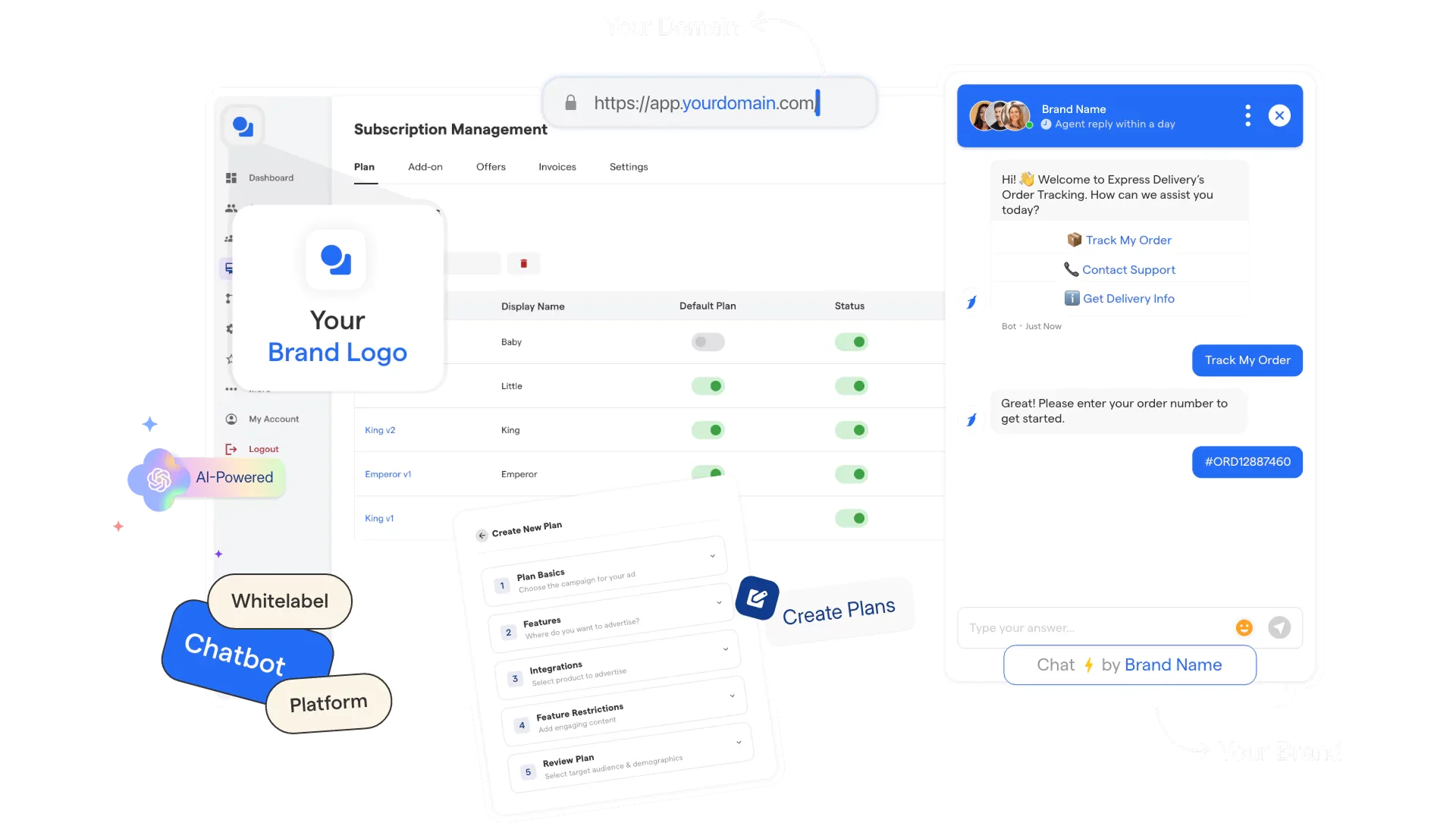
The brand your client interacts with every day should be yours, not the platform vendor's. Full white label ai agents for customer support means your domain, your logo, and your agency name on every touchpoint the client sees.
This goes beyond aesthetics. Clients build loyalty to the brand on the screen. If that brand is the vendor's, the vendor owns the relationship.
Beyond branding, check these specifics before signing anything:
- Can you create your own pricing tiers for each client
- Can you gate features by plan and offer free trials independently
- Does the platform support local currency billing through local payment gateways
- Is client subscription management handled inside the platform or left to manual invoicing
Most platforms skip the billing layer entirely. It is one of the primary reasons agencies building a customer support automation agency practice choose BotPenguin over the alternatives.
Human Escalation and Handoff
AI handles volume. Humans handle exceptions. A platform without configurable escalation is a direct liability for any client operating in a sensitive or high-stakes industry.
According to McKinsey, AI agents can reduce cost per interaction significantly, but only when human handoff is designed correctly. A broken escalation flow undoes the efficiency gains entirely.
What to verify before deployment:
- Escalation triggers must be configurable by your team, not locked to platform defaults
- Supported trigger types should include topic, sentiment score, keyword detection, and customer tier
- The handoff must carry the complete conversation context to the human agent
- The receiving human agent should never need to ask the customer to repeat information already provided
That last point matters more than most agencies account for. It is one of the most cited pain points in customer support interactions and is completely avoidable with the right setup.
These three criteria narrow the shortlist considerably. The next section covers the seven platforms that clear the bar and how each one performs specifically for agency deployments.
Comparing platforms for your agency? Read the white-label AI agents guide before you commit to a platform.
The 7 Best AI Customer Service Agent Platforms for Agencies
Most platforms in this space are built for internal support teams. These seven are evaluated specifically on what agencies need: white label capability, multi-client deployment, and billing control. Each platform is assessed on the criteria that matter to an agency, not an enterprise IT department.
1. BotPenguin — Best for Agencies (White Label, Omnichannel)
BotPenguin is the only AI support agent platform for agencies that combines full white label rebranding, omnichannel deployment, and partner subscription management in one offering. No other platform on this list does all three simultaneously.
For agencies, that matters because branding, channel coverage, and client billing are usually solved with three different tools and three different vendors. BotPenguin handles all of them in one place, which directly reduces the overhead of managing and deploying for multiple clients.
What agencies get:
- Full white label rebranding across the domain, logo, and mobile apps so clients interact only with your agency brand at every touchpoint
- Omnichannel deployment across WhatsApp, website chat, Instagram, Facebook, and Telegram managed from a single partner dashboard.
- Built-in partner subscription management with your own pricing tiers, feature gating, free testing, and local currency billing through local payment gateways
- Official Meta Business Partner status, ensuring compliant and stable WhatsApp Business API access for every client account.
- Native integrations with HubSpot, Zoho, Salesforce, Freshdesk, and 80+ additional tools
- GDPR, HIPAA, CCPA, and ISO certifications are included across all plans
Where it performs best:
BotPenguin is purpose-built for agencies managing SMB and mid-market clients. That is precisely the segment where deployment speed, white-label control, and billing flexibility matter most. Agencies in this space get a platform that is ready to go in 12 hours per client rather than weeks of enterprise onboarding.
2. Intercom (Fin AI)
Intercom is a strong product, but it is built for a very specific buyer. Here is what agencies need to know before recommending it to a client.
Intercom's Fin AI agent handles complex support queries with high accuracy. It trains automatically on the client's existing help documentation, which means setup time is low for clients with well-maintained knowledge bases.
Deep native integrations with HubSpot, Salesforce, Stripe, and Zendesk make it a strong fit for SaaS clients who already operate inside the Intercom ecosystem.
What works:
- Automatic training on client documentation with high query resolution accuracy
- Deep integrations with HubSpot, Salesforce, Stripe, and Zendesk
- Strong fit for SaaS clients with existing Intercom infrastructure already in place
- Clean interface that supports teams to adapt quickly
What agencies need to account for:
- Per-seat pricing starts at $39 per seat and scales poorly when you are managing multiple SMB clients across separate accounts
- No white label capability at any plan level — clients see Intercom branding on every interaction
- Not suited for agencies looking to deploy AI customer service agents for clients under their own brand
- Revenue from client relationships stays tied to the Intercom brand, not yours
For agencies building a white-label customer support automation practice, Intercom is not the right infrastructure. It works well as a point solution for a single well-funded SaaS client. It does not scale as an agency offering.
3. Zendesk AI
Zendesk is one of the most recognized names in customer support. Its AI layer, strengthened after acquiring Forethought in 2026, adds intelligent triage, suggested replies, and automated resolution directly into the Zendesk ticketing suite.
For clients already running Zendesk at scale, the AI layer integrates without friction. There is no new interface to learn and no migration required.
What works:
- Intelligent triage and suggested replies are built directly into existing Zendesk workflows
- Automated resolution for structured, repeatable support queries
- Strong fit for clients already using Zendesk with large ticket volumes
- Forethought acquisition adds more sophisticated AI routing and deflection capabilities
What agencies need to account for:
- Zendesk is priced and structured for enterprise buyers, not SMB client deployments
- Minimum contract sizes make it impractical for agencies managing smaller clients
- No reseller program and no white label option at any tier
- Agencies cannot brand the experience, set their own pricing, or retain client revenue independently
If your agency manages mid-to-large enterprise clients already locked into Zendesk, it is worth knowing the AI capabilities. For agencies building a scalable AI customer support automation offering across multiple SMB clients, Zendesk does not fit the model.
Platforms 2 and 3 highlight a pattern that runs through most of this list. The strongest products in the market are built for enterprise buyers or single-brand deployments. Neither model works for agencies managing multiple clients under their own brand.
4. Freshdesk Freddy AI
Freshdesk is a widely adopted SMB support tool. Its Freddy AI layer adds automation on top of an already familiar interface, which lowers the adoption barrier for clients already using Freshdesk.
Freddy AI handles ticket automation, intelligent routing, and customer self-service entirely within the Freshdesk ecosystem. For agencies whose clients already run Freshdesk as their primary support platform, it reduces the implementation effort considerably since there is no new system to migrate to.
What works:
- Ticket automation and intelligent routing are built into the existing Freshdesk interface
- Customer self-service capability that reduces inbound ticket volume for SMB clients
- Low adoption friction for clients already familiar with the Freshdesk environment
- Reasonable pricing for SMB clients who are committed to the Freshdesk ecosystem
What agencies need to account for:
- Freddy AI only functions inside Freshdesk — clients must already use or adopt Freshdesk for it to work at all
- No standalone deployment across WhatsApp, Instagram, or any social channel
- No white label option at any plan level
- Agencies cannot brand the experience or position it as part of their own service offering
- Not a viable option for agencies looking to deploy AI agents for customer support independently across multiple client environments
Freshdesk Freddy AI is a useful add-on for a specific type of client. It is not infrastructure for an agency building a scalable customer support automation practice across diverse client accounts.
5. Tidio
Tidio is one of the more accessible entry points into AI-powered customer support, particularly for eCommerce clients. Its Lyro AI agent resolves support queries automatically and requires no technical expertise to configure, which reduces deployment time significantly.
Strong Shopify and WooCommerce integrations make it a practical fit for agencies managing eCommerce clients who need basic support, automation up and running quickly.
What works:
- Lyro AI resolves customer queries automatically with reasonable accuracy for standard support scenarios
- Native Shopify and WooCommerce integrations covering order status, returns, and product queries
- No technical expertise required for configuration, reducing setup time per client
- Clean interface that non-technical client teams can manage independently after handover
What agencies need to account for:
- No white label option available on standard plans — the Tidio brand remains visible to end users
- WhatsApp support is limited and not suitable for agencies serving clients in regions where WhatsApp is the primary channel.
- Each client requires a separate account with separate billing, which adds administrative overhead as your client base grows.
- Per client account management does not scale efficiently for agencies running more than five to ten active deployments simultaneously.
Tidio works well as a point solution for a single eCommerce client. The account structure and white-label limitations make it difficult to build a repeatable AI customer support automation for agencies model on top of it.
The pattern across platforms 2 through 5 is consistent. Strong products, built for the wrong buyer. Each one is designed for a business deploying support for itself, not for an agency deploying support across a portfolio of clients under its own brand.
6. ChatBase
ChatBase is one of the fastest ways to get an AI support agent live on a client's website. No technical expertise required, and training on client documentation takes under 30 minutes. For agencies managing professional service clients with large volumes of structured FAQ content, it is a genuinely fast deployment option.
It connects via API with most CRMs, which keeps client data flowing without manual work after setup.
What works:
- AI agent trained on client documentation in under 30 minutes with no technical setup required
- API based integration with most CRM platforms for automatic data sync
- Fast deployment timeline makes it useful for agencies needing a quick turnaround for a specific client
- Best suited for professional service clients with text-heavy FAQ libraries such as law firms, consultancies, and financial advisors
What agencies need to account for:
- Website-only deployment with no WhatsApp, Instagram, Facebook, or any social channel support
- Not viable for clients in MENA, India, LATAM, or Southeast Asia, where WhatsApp drives the majority of inbound support volume
- No white label option, meaning client-facing interactions carry ChatBase branding throughout
- Channel limitation alone disqualifies it for most agencies building a multi-channel support offering for clients.
ChatBase solves a narrow problem well. If a client only needs website FAQ automation and has no social channel requirements, it delivers. Outside that scope, it is not the right tool for agencies building a broader customer support automation agency offering.
7. Botpress
Botpress is the most flexible option on this list from a technical standpoint. It is open source, actively maintained, and gives developer-capable agencies the ability to build highly customized support flows from the ground up.
For agencies with in-house developers who need to build something non-standard, Botpress offers the deepest level of control of any platform in this comparison.
What works:
- Open source architecture gives agencies full control over how support flows are built and extended
- Strong developer community with extensive documentation and active contribution
- API first design, allowing integration with virtually any system a client uses
- High degree of customization for agencies with specific client workflow requirements that off-the-shelf platforms cannot meet
What agencies need to account for:
- Technical complexity is high and increases significantly as the deployment scale grows
- No white label capability available out of the box — building it requires custom development investment
- Not suitable for non-technical agencies or those without dedicated in-house developers
- Each new client deployment requires meaningful development time rather than a repeatable configuration process
- The total cost of ownership increases with every client added when custom development is part of each deployment
Botpress is a strong choice for a specific type of agency. If you have developers, need full control, and are building something genuinely custom, it delivers. For agencies focused on scaling repeatable white-label AI agents for customer support offerings across multiple clients, the development overhead makes it impractical.
Across all seven platforms, the evaluation points to the same conclusion. Most options in this market are built for a single internal team, a single brand, and a single deployment. Agencies need a platform that works across multiple clients, carries their own brand, and handles billing independently. That narrows the shortlist to one.
BotPenguin is the only platform in this comparison with full white-label capability, omnichannel deployment, and partner subscription management built in.
Deploy AI customer support under your own brand — live in 12 hours.
How Do the Top AI Customer Service Agent Platforms Compare for Agencies?
Agencies looking to build a full-service stack can also refer to this guide on AI agent tools for agencies.
How to Deploy White Label AI Customer Support for Clients
Setting up white-label AI customer support for a client is simpler than most agencies expect. The process runs in seven steps, and the first deployment takes 4 to 8 hours end-to-end.
First deployment: 4 to 8 hours. Repeat deployments using a saved template: under 2 hours.
BotPenguin's partner support team is available 24/7 to assist with every step of the setup, so you are never working through this alone.
Deployment gets you live. The next section covers which specific use cases agencies bill for once the agent is running.
Ready to run your first white label deployment?
Get started with BotPenguin's partner dashboard.
Customer Support Use Cases That Agencies Bill For
Getting a client live is step one. Knowing exactly which use cases generate recurring billable value is what builds a sustainable customer support automation agency practice. Here are the three that agencies bill for most consistently.
FAQ Deflection and Ticket Reduction
This is the entry point for most agency deployments and the easiest one to show ROI on in the first 30 days.
Train the AI agent on the client's top 30 to 50 FAQ queries covering orders, returns, opening hours, pricing, and account issues. The agent handles all of these automatically, 24 hours a day, 7 days a week, without any human involvement.
The numbers are well documented. According to McKinsey, first contact resolution rates improve by 15 to 20% when AI handles structured FAQ volume. The client's support staff shift their time to the complex 30 to 40% of queries that genuinely require human judgment.
What agencies bill for:
- Monthly retainer covering AI agent management and ongoing retraining
- Performance-based pricing tied to ticket deflection volume
- Quarterly optimization reviews as the client's FAQ library grows
Live Chat Augmentation
This use case solves a problem every client with a lean support team has but rarely names directly: the gap between when customers need help and when support staff is available.
The AI agent covers off-hours and peak volume periods, with handoff to live agents during business hours. For smaller clients, this eliminates the missed conversation problem that quietly costs them inbound leads. For larger clients with bigger teams, it reduces queue times and lifts CSAT scores during volume spikes.
What agencies bill for:
- Set up and configuration of handoff rules between AI and human agents
- Monthly management of off-hours coverage and peak period performance
- Reporting on queue reduction and CSAT improvement across billing cycles
Proactive Customer Engagement
This is the highest value use case in the list, and the one most agencies underutilize in their client proposals.
Beyond responding to inbound queries, AI agents for customer support can proactively reach out to customers on behalf of the client. Agencies pairing support automation with AI agents for lead generation see the strongest combined revenue impact per client.
Order delivery updates via WhatsApp, abandoned cart follow-ups, renewal reminders, and post-resolution satisfaction surveys sent 24 hours after a ticket closes are all billable workflows an agency can own and manage.
The performance data on proactive engagement is significant. WhatsApp proactive messaging drives 3 to 5 times the conversion rate of email for eCommerce clients. That is a metric clients respond to immediately because it connects directly to revenue, not just support efficiency.
What agencies bill for:
- Campaign setup and message template creation for each proactive workflow
- Monthly management of outbound messaging sequences across client accounts
- Performance reporting on open rates, response rates, and conversion outcomes
These three use cases cover the full range of what a customer support automation agency can offer, from cost reduction at the entry level to revenue generation at the top end.
Clients who start with FAQ deflection typically expand into live chat augmentation and proactive engagement within the first two to three months once they see the initial results.
Conclusion
AI customer service agents in 2026 are delivering the results that the technology promised. 40 to 60% support volume reduction, 24x7 coverage, and CSAT improvements that show up in the data within the first 30 days.
The enterprise market has Zendesk, Salesforce, and Intercom. The SMB client market, served by agencies, has BotPenguin.
For agencies, the question is not whether to offer AI customer support as a service. Which platform lets you deploy it under your own brand, for multiple clients, with full control over pricing and billing?
That narrows the shortlist to one.
Ready to offer AI customer support as a managed service? White label BotPenguin for your clients. Plans from $1,500 per year, 100% of revenue yours.
Start Your Agency Plan
Frequently Asked Questions (FAQs)
What are AI customer service agents?
AI customer service agents are autonomous systems that handle customer queries, resolve support tickets, and manage conversations without human intervention at every step. Unlike chatbots with fixed scripts, they understand context, access real-time business data, execute multi-step workflows (refunds, bookings, escalations), and hand off to humans when needed.
Can agencies white-label AI customer service agents for clients?
Yes. BotPenguin's white-label platform lets agencies deploy AI customer service agents for clients under their own brand — custom domain, logo, pricing, and no vendor branding visible. Agencies set their own prices, keep 100% of client revenue, and manage all client deployments from one partner dashboard.
How much do AI customer service agents reduce support volume?
Properly configured AI customer service agents typically reduce inbound support volume by 40 to 60% within 30 days. The 40% figure is a conservative baseline; companies with high FAQ type queries (order status, returns, opening hours) often see 60 to 70% deflection. Gartner projects AI agents will handle 80% of routine customer service issues by 2029.
What channels can AI customer service agents be deployed on?
The best platforms deploy AI customer service agents across website chat, WhatsApp, Instagram DMs, Facebook Messenger, and Telegram from one system. BotPenguin is an official Meta Business Partner providing compliant WhatsApp API access — critical for agencies serving clients in MENA, India, and LATAM, where WhatsApp is the primary support channel.
How do agencies price AI customer support services for clients?
Three models: monthly managed retainer ($200 to $600 per month per client, covering deployment and maintenance), performance-based ($1 to $3 per resolved ticket versus $15 to $25 with human agents), or setup plus retainer ($500 to $1,500 setup plus $150 to $400 per month). The retainer model is most predictable; the performance model has the highest upside for high-volume clients.
What is the best AI customer service agent platform for agencies?
BotPenguin is the top platform for agencies because it is the only option combining full white label (domain, logo, mobile apps), omnichannel deployment (WhatsApp, website, social), 90+ CRM integrations, and partner subscription management with local payment gateways — covering both the service delivery and the client billing in one platform.